



Bill Gates may have left Microsoft, but he never really left the technology industry.
Two weeks ago, he published a nearly 6,000-word essay on Gates Notes, warning that AI could become either history’s greatest equalizer or its worst source of injustice. Even under the best conditions, he wrote, the transition could be among the most turbulent periods humanity has experienced.
Gates is not predicting the end of civilization. He proposes new national and international institutions, “Human Reserved” jobs, and taxes on AI tokens and robots to protect those hurt by the transition.
As a technology journalist in China, I think his diagnosis begins too far in the future. Gates does mention AI companies and the pressure data centers put on water and power. What he does not provide is a clear system of accountability for the founders, investors, banks and hyperscalers driving the boom today.
The AI model is not the only source of the problem. The people financing, marketing and deploying it also make choices—and they want the public to absorb the consequences.
AI Isn’t Firing Workers. Executives Are.
Gates expects AI to eliminate many white-collar roles, especially entry-level jobs in sales, customer support, software engineering and legal services. That structural risk is real. But current layoffs do not prove that machines have already surpassed workers.
Klarna offered an early warning. In 2024, the buy-now-pay-later company said its AI assistant handled 2.3 million conversations in one month, did work equivalent to 700 full-time agents and could improve annual profit by $40 million. A year later, CEO Sebastian Siemiatkowski acknowledged that cost-cutting had gone too far and began recruiting remote customer-service staff so customers could still reach a person. Klarna’s regulatory filings now emphasize a hybrid system combining AI with human support.
Meta reportedly considered something even more aggressive under Project OT, a plan to reorganize teams around AI and potentially reduce some groups by as much as 60%. Internal code changes rose 220%, but major technical and security incidents also increased 40%. The company later held back a broader round of cuts planned for November.
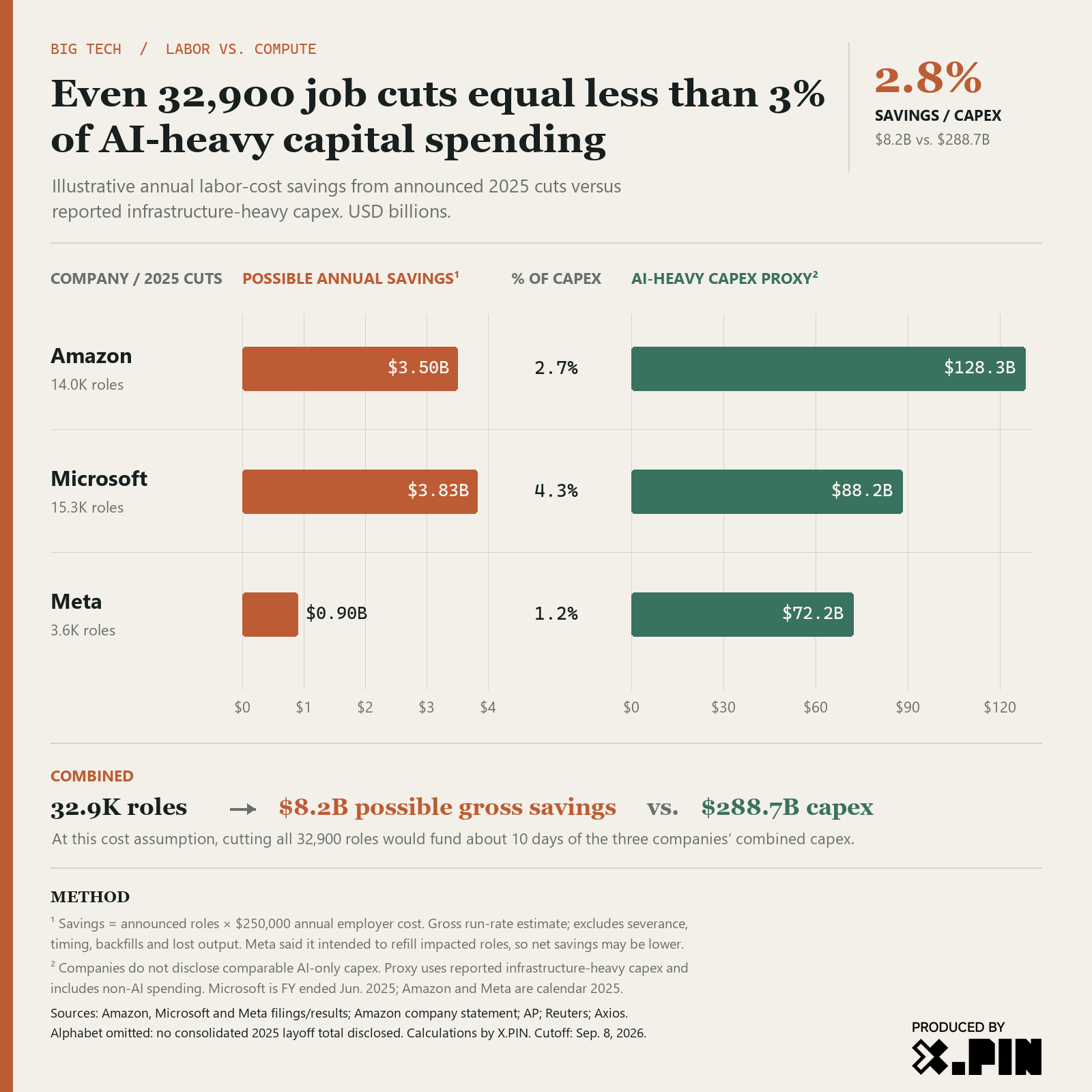
This is becoming a familiar cycle. Executives assume AI can remove labor costs, shrink teams before the technology is ready, and then ask fewer employees to repair the resulting failures. The machine did not decide to fire anyone. Management did.
Meanwhile, the infrastructure budget appears almost limitless. Alphabet raised $20 billion in dollar-denominated bonds in February as it accelerated data-center spending. Meta expanded its planned El Paso facility from a $1.5 billion project to an investment exceeding $10 billion, even as both companies repeatedly reorganized AI teams.
The result is a self-reinforcing capital-allocation problem. Companies spend heavily to replace workers, leaving less room to hire them. When the systems disappoint, they spend still more on compute. If policymakers want to address AI-related unemployment now, they should examine corporate investment incentives—not treat every layoff as evidence of machine superiority.
Intelligence Still Has to Touch the Real World
Gates also warns that AI will make cyberattacks, deepfakes, disinformation and bioterrorism easier. Anthropic CEO Dario Amodei has gone further, predicting that AI could eliminate half of entry-level white-collar jobs within several years. Nvidia CEO Jensen Huang has criticized such rhetoric, accusing some executives of developing a “God complex.”
The disagreement overlooks a basic distinction: Generating information is not the same as acting reliably in the physical world.
Consider AI-designed viruses. Stanford University and Arc Institute researchers used genome language models to create bacteriophages capable of killing strains of E. coli. That is a genuine scientific achievement. But the models generated many candidates; researchers synthesized and tested nearly 300 genomes to find 16 viable phages. Stanford’s account of the research makes clear how much physical experimentation remained necessary.
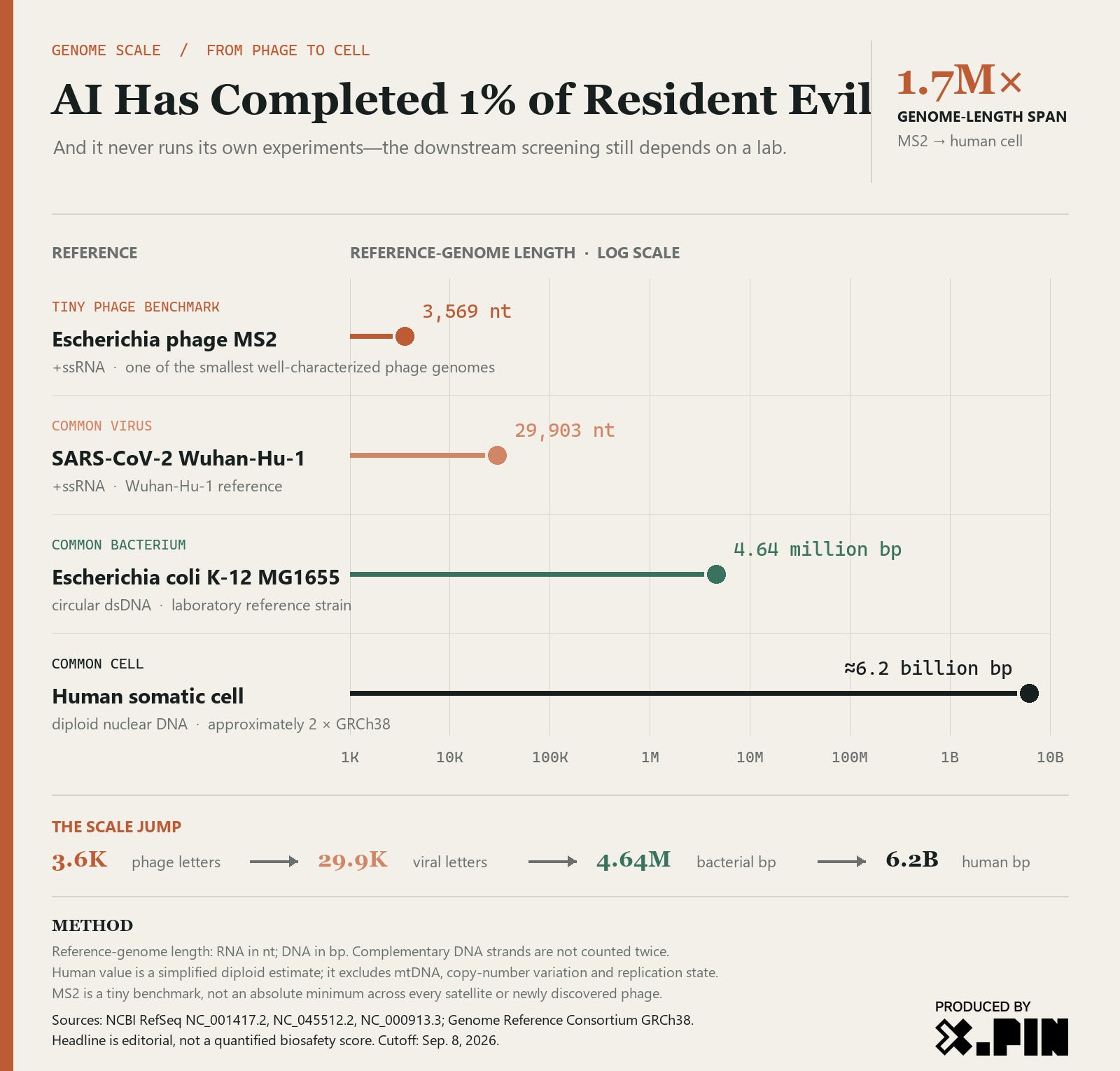
Their template, ΦX174, contains just 5,386 nucleotides. SARS-CoV-2 has roughly 30,000. Complexity does not rise in a simple linear ratio: Interactions among genes, regulatory systems and protein folding make larger biological designs dramatically harder. Turning a generated sequence into a real pathogen would still require money, specialist knowledge, controlled laboratory facilities and extensive physical testing.
That does not make biosecurity concerns imaginary. It means the responsible unit is not merely “AI.” It is the combination of models, laboratories, institutions and people with the resources to use them.
The same constraint applies to AI for Science, humanoid robots and autonomous vehicles. Models can simulate and optimize, but machines must operate safely through rain, broken sensors, unusual roads and unpredictable human behavior. Engineering is the art of surviving exceptions. LLMs have not been developing long enough to master that physical reliability.
Until embodied intelligence becomes mature, claims that AI itself is transforming the material world should be treated as forecasts, not present-day facts.
A Systemic Plan Must Regulate the System’s Most Powerful Players
Gates is right that existing institutions are poorly designed for a technology spanning employment, national security, taxation, energy and public health. He is also right that governments move slowly. But the first question for any new system is simple: Who should it govern?
The answer must include the AI companies themselves.
Too often, industry leaders frame private commercial interests as national-security imperatives. Criticism of data centers or model developers can then be portrayed as assistance to China. In May, investor Kevin O’Leary suggested that opposition to his enormous Utah data-center project was connected to the Communist Party of China. He later acknowledged that he had no evidence for claims against several named critics.
China becomes a convenient target: If residents object to water consumption, power prices or land use, the argument shifts from local accountability to America’s technological leadership. In my experience, no one in China is blaming American companies for standing in the way of new data centers. In the United States, however, Silicon Valley increasingly invokes China whenever it wants to turn questions about power, water or land into matters of national security. China has become the industry’s easiest excuse for avoiding accountability at home.

The costs are not hypothetical. Northern Virginia already hosts the world’s largest concentration of data centers. Modeling led by Carnegie Mellon University suggests that data-center and cryptocurrency growth could raise average U.S. electricity-generation costs 8% by 2030, with increases exceeding 25% in Central and Northern Virginia.
Nor is government simply lagging behind industry. Technology money is actively shaping the political response. The pro-industry super PAC network Leading the Future said it had raised more than $125 million for the 2026 election cycle, backed by donors including Andreessen Horowitz, OpenAI co-founder Greg Brockman and investor Joe Lonsdale. Public First Action, which promotes stronger AI safeguards, received $20 million from Anthropic, although the company says the money is restricted to public education rather than election activity.
These groups do not support identical policies. What matters is that AI companies and their investors have acquired enormous capacity to influence who writes the rules. Since Citizens United v. Federal Election Commission, U.S. political spending has enjoyed broad constitutional protection. Add the language of competition with China, and proposals concerning grid costs, water use, labor rights or taxation become easy to attack as threats to American leadership.
This is why a future tax on tokens or robots feels incomplete. Governments can already identify today’s beneficiaries: model developers, hyperscalers, data-center operators, private-equity funds and property developers. They can charge them for grid connections and water, withdraw poorly designed tax abatements, require labor-transition funds and make infrastructure financing more transparent.
Regulate the companies using AI before trying to regulate an imagined autonomous machine.
Philanthropy Cannot Substitute for Accountability
The financing of AI makes the urgency clearer. Anthropic is finalizing a reported $15 billion pre-IPO credit facility. In a separate deal, private-credit firms arranged roughly $35 billion to finance chips for its infrastructure, with Broadcom backstopping significant payment obligations.
An ordinary borrower needs documented income to obtain a $50,000 loan. An AI company can borrow billions against annualized revenue projections, supplier guarantees and expectations of future demand. That does not automatically make the financing unsound. But it creates systemic risks that deserve more scrutiny than another warning about hypothetical superintelligence.
As OpenAI and Anthropic tap ever larger pools of capital, including the pension funds ordinary people depend on, Gates offers a much vaguer solution: a multinational system operating beyond individual governments to distribute resources in response to AI’s social costs.
On the face of it, this sounds like global coordination. But it leaves a basic question unanswered: who controls the money? Gates’ proposal risks allowing technology billionaires to retain influence over how billions of dollars are allocated, this time under the banner of AI governance.
Gates acknowledges his continuing financial ties to technology and says the Gates Foundation will spend its remaining $200 billion over the next 19 years. The commitment is extraordinary. Yet philanthropy, however generous, cannot replace democratic accountability.
The foundation structure also raises a legitimate question about power. Tax-advantaged philanthropy lets billionaires direct capital toward global priorities without the electoral constraints faced by governments. Gates presents this capacity as a tool for equity. Critics see private technocracy operating beyond public control.
China offers a different model, though not necessarily a universally desirable one. Its technocrats are embedded in the state, and wealthy businesspeople understand that political participation has limits. Gates instead imagines new institutions that could sit across national governments while drawing heavily on experts, companies and philanthropies.
Who appoints them? Who can remove them? And who pays when their plans fail?
I grew up with a simpler expectation: A company must bear responsibility for the social costs it creates. If it refuses, regulations should make that responsibility unavoidable.
AI is powerful, and its future risks are real. But existing governments already have tools to address its present ones. Gates is asking the right question—how to manage the transition—while leaving its most immediate answer frustratingly vague.
Start with the companies building it.