



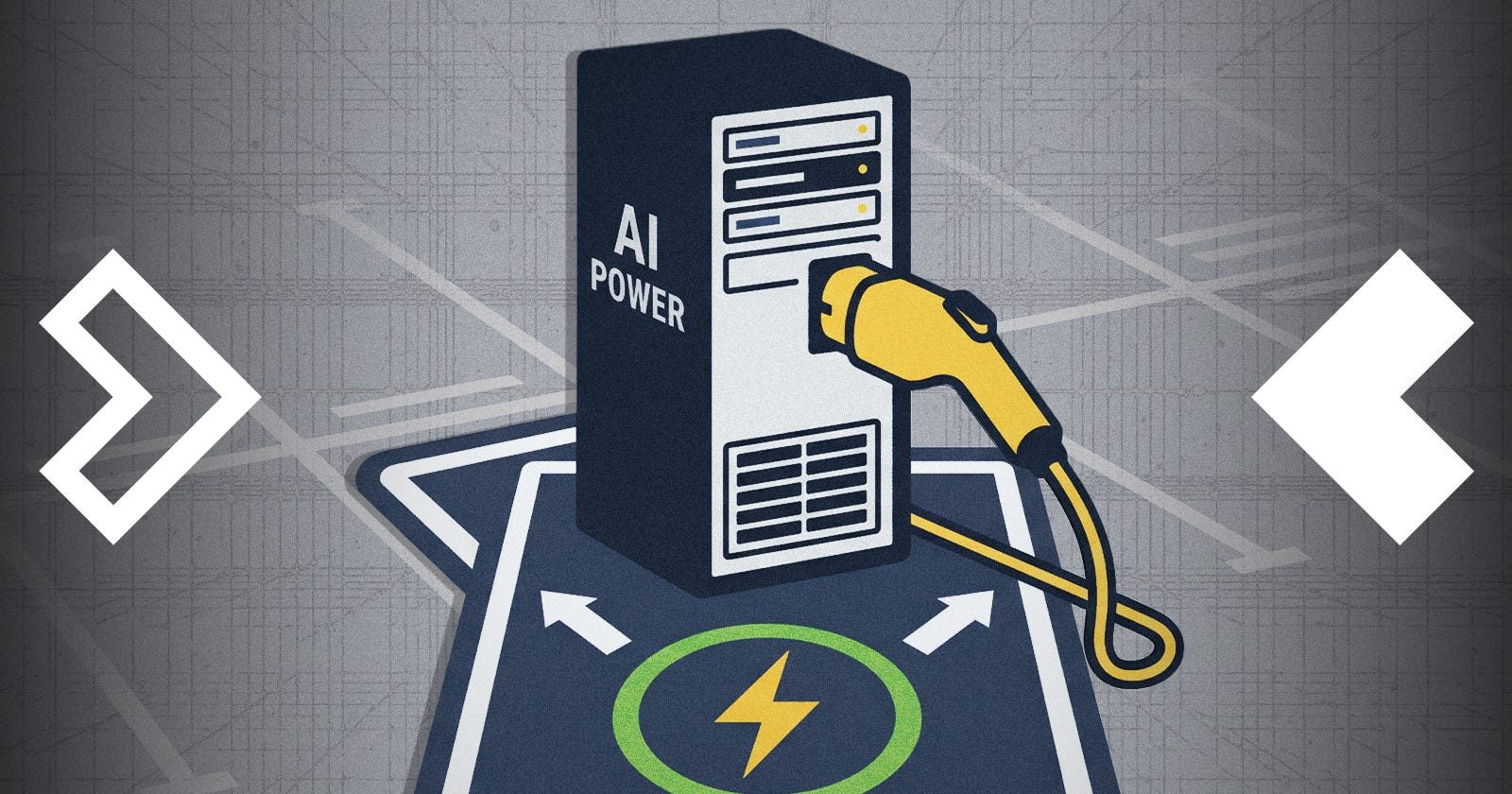
On August 6, 2026, a huge new facility switched on in a stretch of grassland in Inner Mongolia, a region better known for potatoes than for silicon. It’s called Star River (Xinghe), and the building is the size of twenty football fields. It’s designed to hold up to a million AI accelerators working together, with a theoretical output of 100 million PFLOPS. Based on what its builders have disclosed, it’s one of the largest single AI data center facilities in the world.
The city around Star River is Ulanqab. A few years ago, it was best known for out-migration and potato farming. Today, it is one of the fastest-growing AI computing clusters in the Asia-Pacific region. In June, DeepSeek, fresh off a RMB 50 billion funding round, announced plans to build a 1-gigawatt data center there. That’s just one of 89 data center projects that had signed on to Ulanqab by the end of June 2026, together representing more than RMB 500 billion in committed investment.
The obvious question is: why here? The easy explaination is cheap land and generous local subsidies. The real answer has more to do with a deliberate choice: China has decided that electricity, not chips, is the binding constraint on the AI race, and started treating power generation as part of the data center itself, rather than something you queue up for. None of this makes chips irrelevant; they still matter enormously. But once compute scales into the hundreds of thousands, even millions, of accelerators, keeping them fed with electricity becomes just as hard a problem as building them in the first place.
The Numbers, Briefly
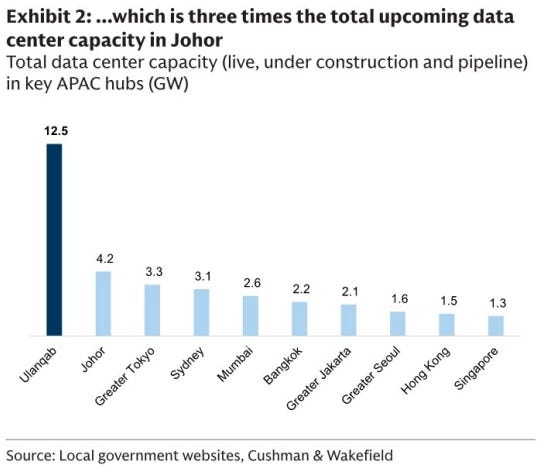
Ulanqab’s planned and operating data center capacity jumped from 3.3 gigawatts in July 2025 to 12.5 gigawatts by June 2026. That’s not incremental growth. It’s nearly a fourfold increase in eleven months, and more than ten times the region’s live capacity in 2025. For comparison, Goldman Sachs research puts Ulanqab’s total pipeline at three times the entire upcoming data center capacity of Johor, Malaysia, currently the largest data center hub in Asia-Pacific outside China.
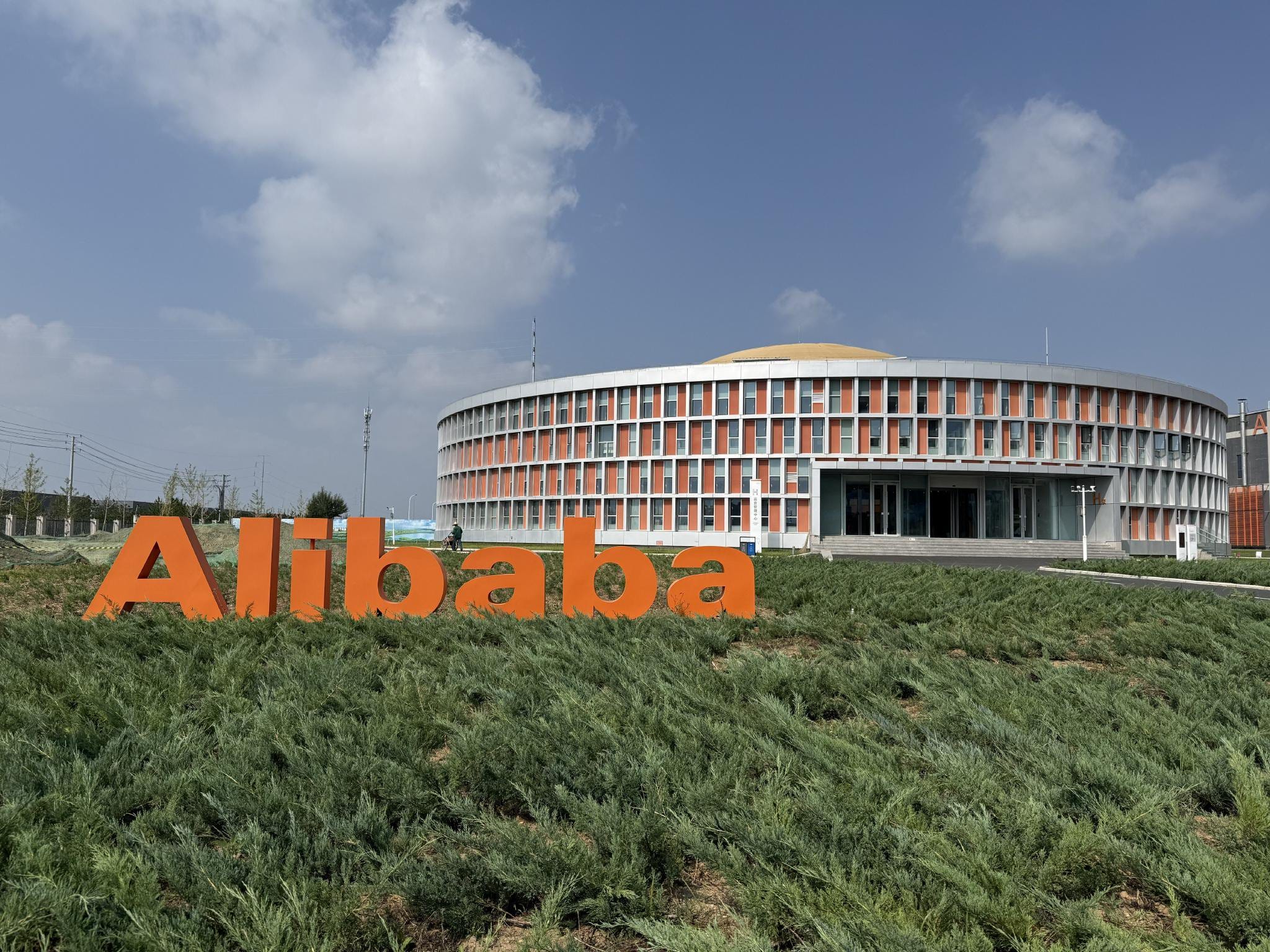
The companies building there include almost every heavyweight in Chinese tech.Three of China’s top four data center operators by live capacity, GDS, VNET, and Chindata, have gigawatt-scale projects underway, alongside renewable energy developer Envision. ByteDance, Kuaishou, UCloud, Alibaba, and DeepSeek are separately building their own campuses.
And crucially, the demand looks real, not speculative. Utilized capacity in Ulanqab grew more than 70% year-on-year, while live computing power reached 165 EFLOPS by June 2026, equivalent to about 5-7% of China’s entire utilized data center capacity, from a single prefecture-level city. VNET’s campuses there have gone from delivery to majority utilization within a few quarters, a ramp-up speed that suggests customers were waiting for the capacity, not the other way around.
Why Here: It’s Not Just that Power Is Cheap
The conventional explanation for Ulanqab’s rise goes like this: electricity makes up 60-70% of a data center’s operating costs, and Inner Mongolia has some of the cheapest, cleanest power in the country. End-user electricity prices for data centers in the region run about RMB 0.33-0.36 per kilowatt-hour, according to CAICT, roughly half of what a data center pays in Beijing, and cheaper even than the Zhangjiakou cluster just outside the capital. Add in a dry, high-altitude climate (average annual temperature of just 4.3°C), and data centers get nearly ten months a year of free cooling from outside air, cutting one of their biggest secondary costs. Two direct fiber routes to Beijing keep latency to about 4 milliseconds, well within tolerance for most AI training and inference workloads. Renewables are locally abundant too: Inner Mongolia has roughly 57% of China’s technically exploitable wind resources and 21% of its solar potential.
All of that is true, and all of it matters. But it’s not really what makes Ulanqab distinctive, and it’s not what the Star River facility is actually built around.
The more interesting fact is what Star River’s power architecture doesn’t do: it doesn’t wait for the grid. Conventional data centers pull power from the public grid, and getting a large new load connected can easily take three to seven years, against an 18-to-24-month deployment window for AI infrastructure, through interconnection studies, transmission approvals, and new line construction. That mismatch is becoming the central bottleneck of the AI buildout everywhere in the world, including in China.
Star River’s answer is to skip the queue entirely. The facility draws power from self-built or directly connected wind and solar plants, feeding into gigawatt-hour-scale battery storage on site, all coupled on the DC side to avoid the losses of repeated AC-DC-AC conversion. On top of this sits an “AI power system,” which forecasts wind and solar generation hours in advance, monitors battery levels, and predicts how much computing power the data center will need. Based on that, it decides when to charge or discharge the batteries, and can even shift the timing of certain compute jobs, all to keep voltage and frequency stable enough for GPUs even when renewable generation fluctuates. If needed, the facility can disconnect entirely from the regional grid and run in island mode on its own generation and storage.
In other words, Ulanqab isn’t winning because it found cheaper electrons on the public grid. It’s winning because, in the most extreme case, it doesn’t need the public grid’s permission at all.
The Mirror Image: America’s Power Problem
Compare this to what’s happening in the United States, where the constraint isn’t chip supply either, it’s power. Morgan Stanley estimates U.S. data center electricity demand will reach roughly 68 gigawatts by 2026-2028, against a grid that can currently supply about 30 gigawatts, a shortfall of more than half. That gap is already showing up in people’s electricity bills: wholesale prices on PJM, the largest U.S. grid, jumped 76% year-on-year in the first quarter of 2026 alone, and polling consistently shows a strong majority of Americans oppose new data centers being built near where they live.
The problem runs deeper than politics. The U.S. grid is really three semi-independent systems (East, West, and Texas), and transmission between regions has been chronically underbuilt. Power-planning authority sits with individual states rather than any national body. And because demand on the grid barely grew for two decades before the AI boom, there was little pressure to expand it. Now that demand is surging, new high-voltage transmission lines routinely take more than ten years to build. Put simply, the U.S. can’t wait for its grid to catch up, and in the meantime, the most advanced chip in the world is just an expensive paperweight without the power to run it.
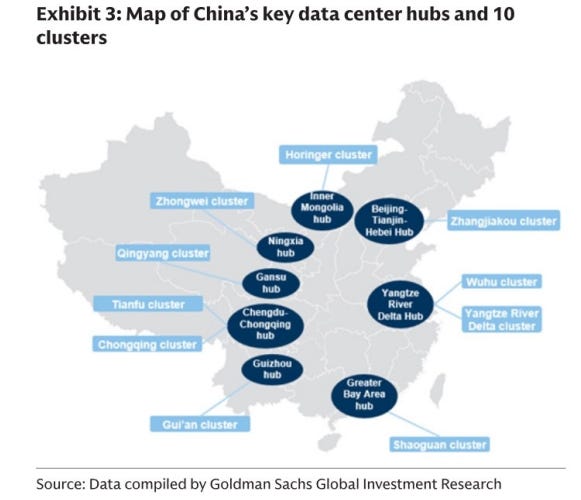
China’s answer, visible in places like Ulanqab, Gansu’s Qingyang cluster (215,000 P of computing power, nearly 10% of the national total), and Ningxia’s Zhongwei, home to the country’s first large-scale “compute-power-and-electricity-coordinated” green power direct-supply project, has been to stop treating the grid as a fixed constraint and start building energy infrastructure alongside compute infrastructure, sometimes in place of it. Western China’s share of the country’s intelligent computing power has climbed to roughly 32.6% as a result.
The Part that Doesn’t Fit a Clean Narrative
None of this is a simple “China wins” story, and it’s worth resisting the temptation to write it as one.
Demand is real. But so is overbuilding. Goldman Sachs, whose analysts have been closely tracking Ulanqab’s build-out, flags a real concern: the region’s 12.5 GW of pipeline capacity (live and planned combined, as of June 2026) is already equivalent to about 45% of China’s entire live data center supply as it stood in 2025. That much capacity landing at once will likely cap any meaningful increase in data center rental prices going forward, good news for AI companies renting compute, less good for the economics of the operators building it. And here’s the tension worth sitting with: utilized capacity in Ulanqab grew more than 70% in 2025, yet the overall utilization rate is still only around 66%, simply because supply was being added even faster than it could be filled. Both things are true at once. China can clearly build compute infrastructure faster than almost anywhere else in the world. That’s not the same as saying every gigawatt of it will earn a good return.
One more thing worth knowing about the green-power story: renewable electricity isn’t necessarily cheaper than ordinary grid power once you account for certificate premiums, grid delivery charges, and backup power costs. Data centers pursue direct green power supply largely to meet policy requirements, national hubs are increasingly required to source 80%+ green power and hit power-usage-effectiveness targets below 1.2-1.25, not because it’s automatically the cheapest option. And land quotas remain a real constraint on how far and how fast this model can scale, even in a region with Inner Mongolia’s geography.
Where This Lands
The next phase of the U.S.-China AI competition may be decided as much on the grid as in Silicon Valley or Zhongguancun. On a stretch of grassland where wind turbines stand next to server halls, the real innovation isn’t a faster chip, it’s a building that generates, stores, and consumes its own power without ever asking the grid for permission. That’s the part of the Ulanqab story that’s genuinely new: not that power is cheap there, but that data centers are increasingly being designed to work around the grid entirely, rather than wait for it.
China’s advantage here doesn’t come from better silicon; it’s still working around export controls on the most advanced chips. It comes from the ability to mobilize electricity, land, and networking at a speed the grid-constrained, politically fragmented U.S. system has so far struggled to match, and increasingly, from a bet that AI infrastructure may not need to be tethered to the grid at all. Ulanqab is one of the clearest large-scale demonstrations of that model so far, one that’s already being rolled out in Gansu and Ningxia, and one that could potentially work anywhere with strong wind or solar resources and a weak grid, from the Middle East to Central Asia.
But the ledger isn’t closed. Supply is racing ahead of profitability. Utilization is still catching up to capacity. And the economics of “green” power are more complicated than the marketing suggests. This is an infrastructure race, not an algorithm race, and infrastructure races are won over years, not news cycles. Ulanqab has a significant head start. Whether it can turn that head start into a durable advantage is the more interesting, and much less settled, question.
One more thing worth remembering: the companies that ultimately benefit most from this model may not be the ones building the biggest data centers. They may be the ones selling the electricity, cooling systems, batteries, power-management platforms, and networking gear that make a facility like Star River possible at all. Ulanqab isn’t just a data center story, it’s a supply chain story, and probably the subject of a future piece.
Very nice piece and very insightful
Excellent piece. Looking forward to the supply chain follow up piece you hinted at!