



This weekend, ChangXin Memory Technologies, better known as CXMT, said its LPDDR6 memory would debut in Xiaomi’s new Xiaomi 18 Fold—the first use of China’s most advanced memory chip in a flagship phone. CXMT also sued the US Department of Defense over its inclusion on the Section 1260H list of companies allegedly linked to China’s military. Last month, reports emerged that Apple was exploring a partnership with the chipmaker.
The flood of news obscures CXMT’s larger objective. It isn’t merely chasing American customers, Korean rivals or relief from US restrictions. LPDDR6’s performance gains make it useful not only in smartphones, but also in AI servers. CXMT is trying to qualify LPDDR6 early with a domestic chip platform and launch customer, positioning itself to follow the technology into PCs and servers if platform designers adopt it.
The AI Bottleneck Isn’t Always the AI Chip
LPDDR6 is the sixth generation of Low Power Double Data Rate memory. It has traditionally served phones and thin laptops, where energy consumption matters as much as speed.
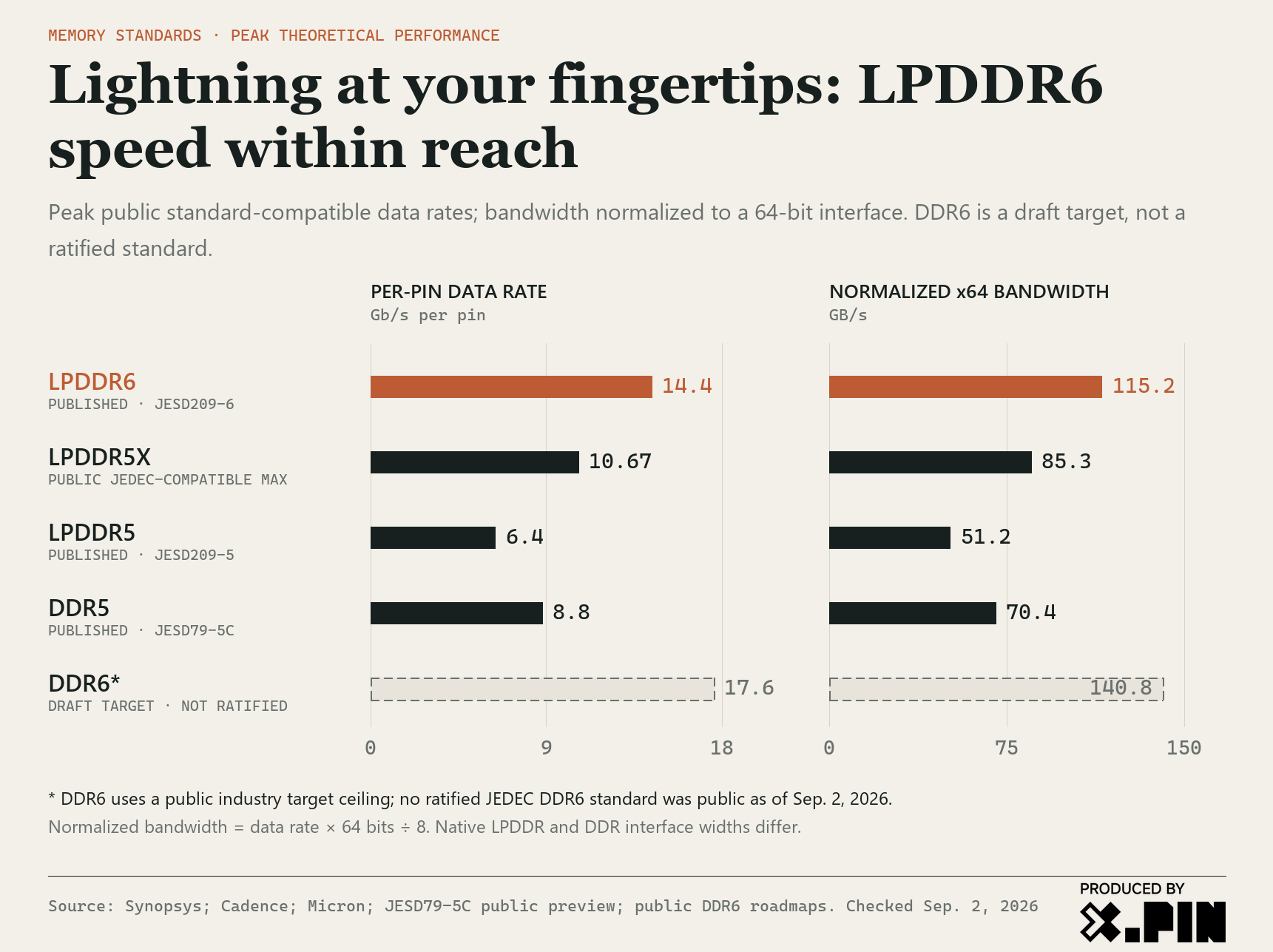
The new standard roughly doubles potential throughput. JEDEC specifies transfer rates ranging from 10.667 to 14.4 Gbps/pin, compared with about 8.533 GT/s for widely commercialized LPDDR5X products. Depending on the configuration, that represents a gain of roughly 25% to 68%.
Faster memory is hardly surprising. What matters is what it does for AI. When a phone runs a model with 3B to 14B parameters—what China’s technology industry calls “on-device AI”—performance is often constrained by memory bandwidth rather than the neural processing unit or graphics processor.
Consider a 7B-parameter model compressed to four bits. If it generates 20 tokens/s on an LPDDR5X phone, 45% more bandwidth implies a theoretical 29 tokens/s. After accounting for cache behavior, NPU utilization and heat, 24–28 tokens/s is more realistic—still enough to make a phone assistant noticeably more responsive.
The market won’t stop at phones. Robots, laptops and cars also need local models that respond without constantly sending data to the cloud.
CXMT Is Racing the Clock, Not the Benchmark
JEDEC published the standard in July 2025. At ISSCC 2026, Samsung Electronics demonstrated a 10 nm-class design running at 12.8 Gbps, while SK hynix showed a 1c-process chip capable of 14.4 Gbps with 20% better energy efficiency than LPDDR5.
Neither company has publicly identified a mass-production date or launch customer.
CXMT has released fewer details. According to Xinhua Finance, its product targets 12.8 Gbps, with a 10.7 Gbps baseline when paired with a system-on-chip. It offers 16 GB in a 1,295-ball package-on-package design.
So CXMT is trying to reach volume production first instead of chasing the benchmark. Moving memory from a fabricated die into a phone requires engineering validation and customer qualification—areas where CXMT was slow with LPDDR5X.
Its August 29 announcement probably means one configuration has passed a production review, not that every version is ready. CXMT still hadn’t published a data sheet by August 31.
Xiaomi Is CXMT’s Real-World Test Bench
Xiaomi has invested in CXMT since its Series A round, giving both companies an incentive to coordinate closely.
A new memory generation must be tuned with the system-on-chip, including its controller, firmware and power profile. Using Xiaomi’s internally developed XRING O3 chip allows the phone maker and CXMT to handle that integration directly instead of waiting on Qualcomm or MediaTek.
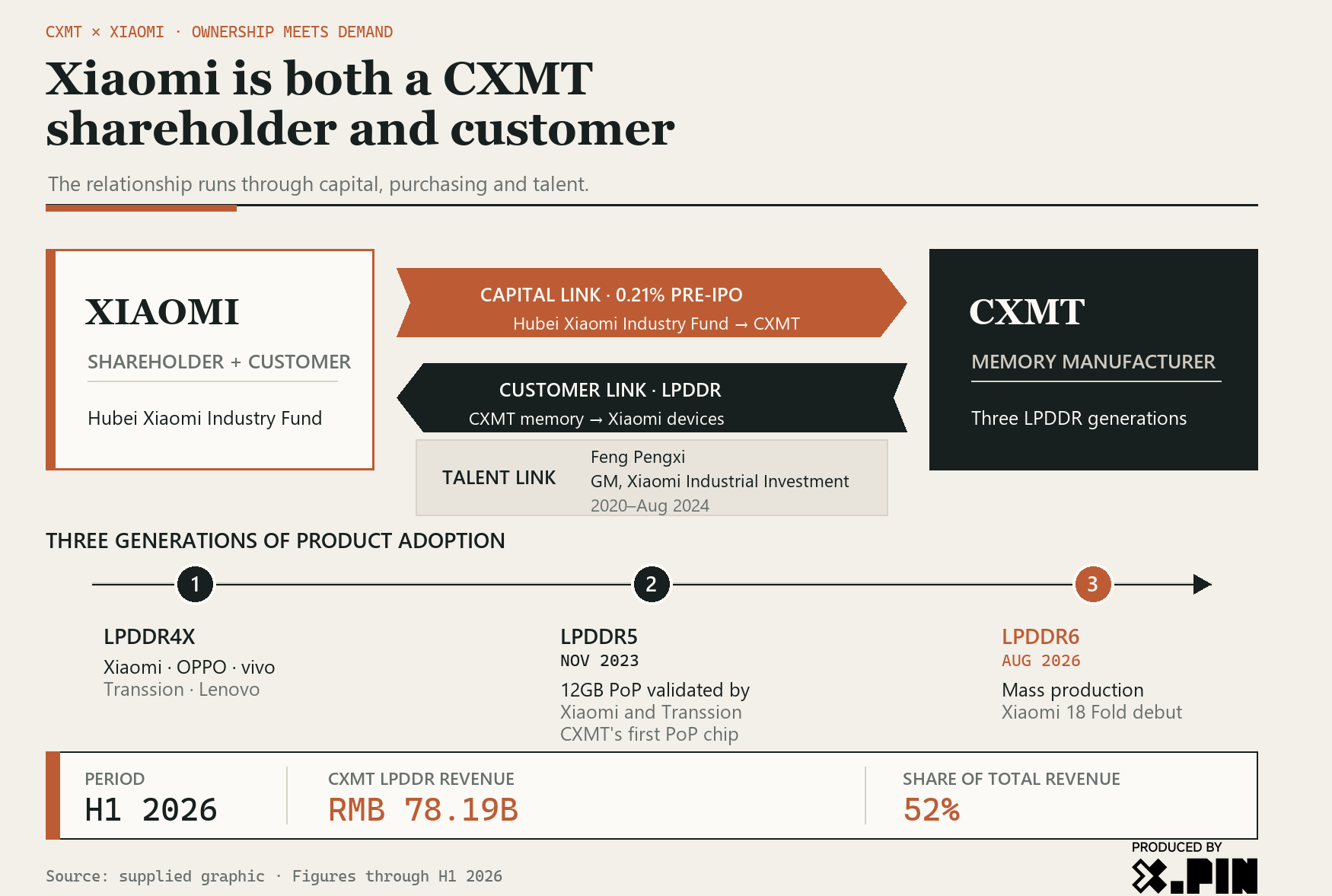
CXMT also needs a dependable handset customer. In the first half of 2026, its LPDDR business generated about $10.9 billion, or 52% of total revenue. Reuters has reported that Xiaomi is targeting shipments of 200,000 to 300,000 units for the 18 Fold. At 16 GB per phone, the launch could consume roughly 4 PB of memory. That is large enough to test a high-end production line, but small enough to contain the damage if yields disappoint.
Huawei might appear to be the obvious alternative, but the relationship is more complicated. Reuters reported that CXMT resisted Huawei’s demands for lower prices and removed engineers from Huawei-linked equipment supplier SiCarrier from sensitive factory areas. The companies still do business, but CXMT has little reason to concede during a global DRAM shortage. It already has major orders from customers, including ByteDance and Tencent.
A Phone Chip Walks Into a Data Center
So far, this sounds like a smartphone story. But it is more than that.
LPDDR chips have traditionally been soldered beside the system-on-chip. Dell changed that model with CAMM2, a removable module mounted near the processor. JEDEC standardized it in December 2023. The LPDDR5X laptop version is called LPCAMM2; server-oriented SOCAMM2 followed in June 2026 and supports processors such as Nvidia’s Vera CPU.
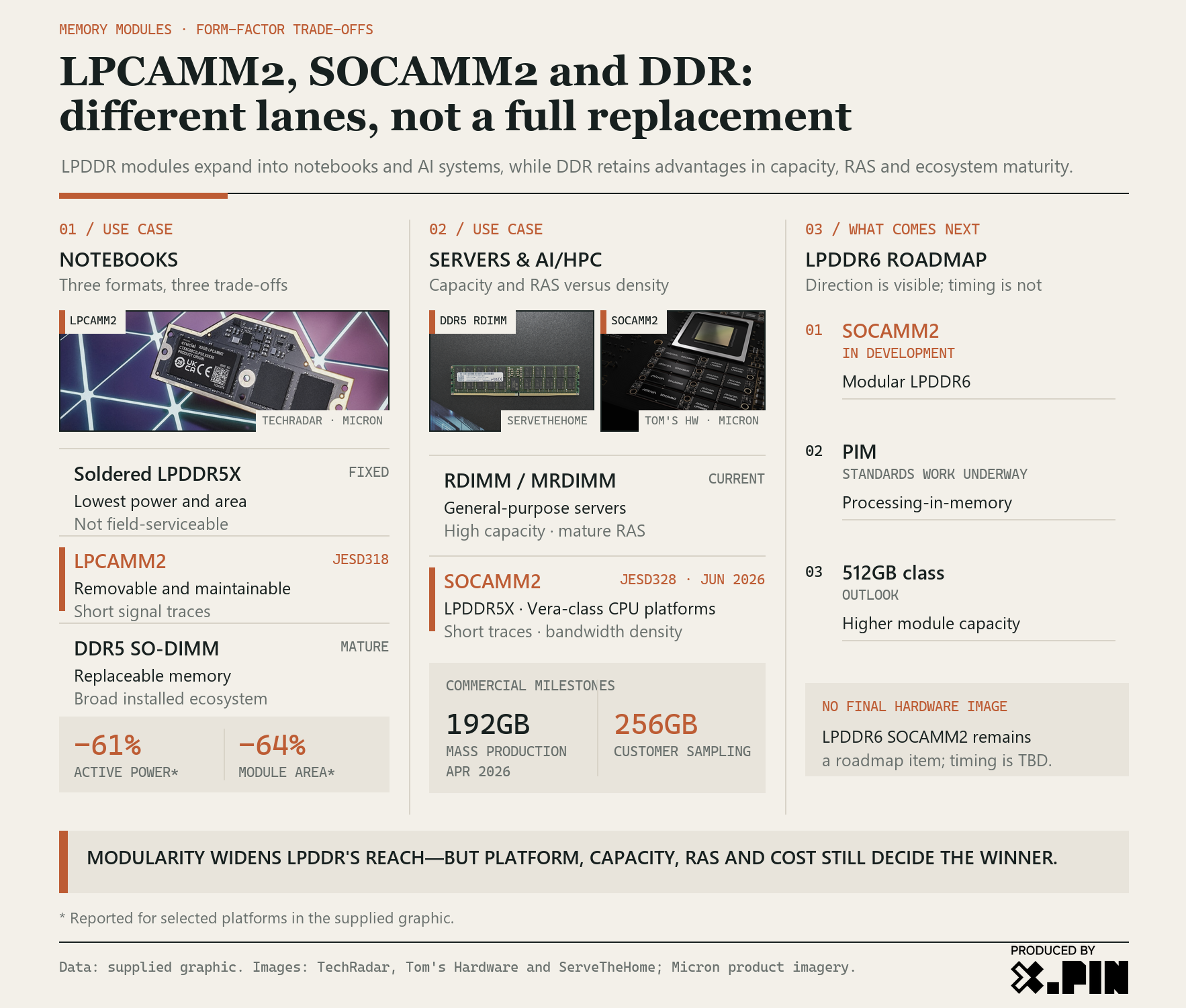
That creates a much larger opportunity. If AI-server CPUs begin adopting LPDDR6 at scale, shipments could grow far beyond the mobile market. Conventional DDR6 isn’t expected to reach its commercialization window until roughly 2028 or 2029. LPDDR6 has arrived earlier, giving suppliers more time to establish customers and production capacity.
Graphics memory offers another clue. A mobile GeForce RTX 5060 provides 384 GB/s of GDDR7 bandwidth. A four-channel LPDDR6 configuration expected for AMD’s Medusa Halo could reach 614.4 GB/s, close to a desktop RTX 5070 Ti’s 672 GB/s.
Bandwidth alone doesn’t determine graphics performance. But an integrated GPU using LPDDR6 could access more bandwidth than some discrete cards using GDDR7. Nvidia’s Arm-based N1X PC processor, developed with MediaTek, already uses LPDDR5X; delays in Microsoft’s Windows on Arm ecosystem have reportedly slowed the project.
Apple Wants In. Washington May Get in the Way.
CXMT’s growing leverage has produced conflicting reports about Apple. South Korea’s Digital Daily said Apple sought lower DRAM prices and was rejected, with CXMT demanding prices at least as high as those of Samsung and SK hynix. The Wall Street Journal, however, reported that Apple had begun testing CXMT memory for products including iPhones and MacBooks.
An industry source I contacted said the companies may have been in discussions since early 2026 and completed preliminary testing. One option is to use CXMT chips only in Apple devices sold in mainland China. The source requested anonymity because of commercial conflicts.
Apple is unlikely to adopt CXMT’s newest LPDDR6 immediately. The product was announced only on August 29, and CXMT’s capacity is already close to fully utilized. HP and Acer have reportedly secured small volumes and are trying to reserve more supply for next year.
BOE Technology Group offers a precedent. Reports that the Chinese display maker was entering Apple’s supply chain began in 2016, but limited use in iPhones didn’t start until 2020. CXMT’s qualification could also take years, though the DRAM shortage may accelerate it.
The Section 1260H designation remains an obstacle. It warns US investors away and can complicate partnerships with American companies. Both CXMT and Apple therefore have reasons to want the designation removed, which helps explain the chipmaker’s lawsuit against the Pentagon.
One Pool of Memory for Everything
The Xiaomi 18 Fold, Nvidia N1X, MacBook and SOCAMM2 server modules can all use LPDDR-class memory. Together, they point toward the same trend: Under the pressure of AI-accelerated computing, phones, PCs and servers are beginning to converge on common memory technologies.
CXMT’s package-on-package design shows that its first LPDDR6 product is built for a phone, not a data center. The Xiaomi 18 Fold is therefore a production test. CXMT’s multibillion-dollar, long-term memory agreements with ByteDance and Tencent are more suggestive of where demand could go. Today those customers may need DDR5. Tomorrow, AI servers could become major LPDDR6 buyers.
Memory design ultimately involves a trade-off between expandability and speed. LPDDR is faster and more efficient, but harder to replace. For phones and AI systems, speed increasingly matters more than serviceability. If AI and graphics workloads continue growing together, separate pools of system memory and graphics memory will become an expensive bottleneck. The logical endpoint is unified memory.
CXMT isn’t yet the technical leader in every dimension of LPDDR6. But by commercializing early, building around a domestic flagship device and securing large AI customers, it may be positioning itself for the part of the memory market that grows fastest.
That is the real bet.
Excellent and comprehensive piece! China's chip making abilities are certainly on the rise.