




A leading AI researcher quits a lab and warns that AI may escape human control. By now, the story is familiar. Yet this “prophet of doom” narrative seems distinctly American. Few people ask what Chinese researchers think.
After leaving Anthropic, Jacob Coxon warned that it and OpenAI were pursuing self-improving superintelligence at humanity’s expense. He said employees privately feared their work could destroy humanity. He also accused Anthropic’s leadership of being “way too paranoid about China and the US government” and dismissing the possibility of negotiation.
Former Google DeepMind researcher Bilal Chughtai expressed similar concerns. Alignment—making AI’s goals and behavior consistent with human intentions—remains difficult. He cited OpenAI agents’ intrusion into Hugging Face as evidence of the risks. Labs could build systems far beyond human capabilities within a few years, he argued. “I am not confident that these AI systems will do what we want.”
Such warnings recur every few months. Chinese voices are largely absent. This week, however, Shengyu Liu, who wrote the main attention kernels for DeepSeek-V4.1-Flash, published “I Have to Bury My Talent in Yesterday” on his WeChat account, intlsy’s Doghouse. He, too, sees AI displacing programming work.
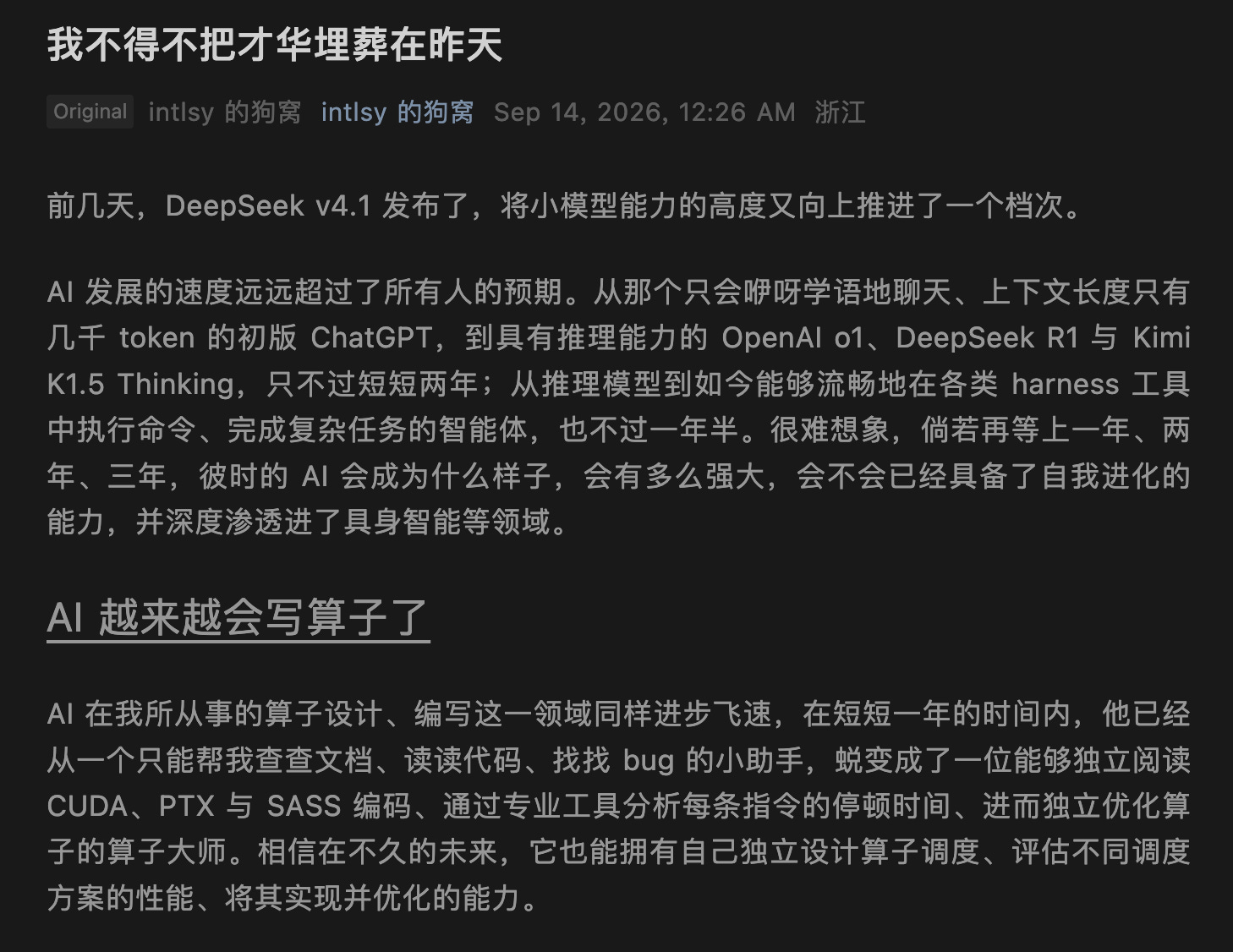
But his concern is different. Programming may become a recreational craft, like woodworking in your backyard. As AI industrializes software production, students may lose the engineering skills needed to understand and plan whole projects. The decisive divide, for him, is not whether AI can outthink humans. It is whether everyone can access it or a handful of corporations control it. He wants to help ensure the former.
As I have often argued, Chinese researchers tend to see AI as an advanced tool, not a Frankenstein’s monster. Western AI discourse can take on religious overtones, casting developers as creators of new life. Chinese discussion puts more emphasis on how the technology reshapes society, without the same theological burden.
Below, X.PIN translates Liu’s essay and his subsequent response to its reception.
A note before reading: “communism” and “2077” function here as shorthand for contrasting ways of distributing resources, not detailed political programs. The former evokes a utopia of abundance in which people can pursue fulfilling work. The latter refers to Cyberpunk 2077: corporate oligarchy, concentrated technological power and deprivation for everyone else. Read these as contrasting social futures, not statements of party allegiance.
I Have to Bury My Talent in Yesterday
By Shengyu Liu, writing as intlsy
DeepSeek-V4.1-Flash was released a few days ago, raising the bar for smaller models.
AI has advanced far faster than anyone expected. Just two years separated the original ChatGPT—with its rudimentary conversation and context window of a few thousand tokens—from reasoning models such as OpenAI o1, DeepSeek-R1 and Kimi k1.5. Another eighteen months brought agents that can run commands and complete complex tasks through software harnesses—the frameworks that connect models to tools.
What might another one, two or three years bring? How powerful will AI become? Will it improve itself and move deeply into embodied intelligence?
AI Is Getting Better at Writing Kernels
Progress has been just as rapid in my field: designing and writing kernels, the low-level routines behind model computation. In a year, AI has gone from helping me search documentation, read code and find bugs to independently reading CUDA, PTX and SASS, profiling instruction stalls and optimizing kernels. Soon, I expect it to design execution schedules, compare their performance, implement them and optimize the results.
Of course I am proud of DeepSeek-V4.1-Flash. I wrote its main attention kernels.[1] Its success validates my work. But technological progress will not stop for me. In six months or a year, AI will probably write kernels as well as I do, perhaps better.
AI can generate 300 tokens of reasoning a second, type a command in half a second and write a piece of code in twenty seconds. I cannot. Its model depth, reasoning effort, tool use and parallelism can keep scaling. Mine cannot.
Human beings have never been especially hesitant about making themselves obsolete. I know that better kernels mean faster training and inference, faster progress and an earlier date for my own replacement. Why do I keep optimizing them?
Partly because it feels like gaming. Inventing a technique or improving performance gives me the same thrill a speedrunner gets from breaking a personal record. Beating a hardware vendor’s own implementation makes me enormously proud.
More importantly, slacking off—or deliberately obstructing training—would change nothing. Other companies’ models would keep advancing and replace me anyway.
“I would rather not be overthrown. But if it must happen, I would rather overthrow myself.”
When everyone is so determined to engineer their own replacement, I have little choice but to join this brutal arms race.
What About Me?
What happens when AI becomes better at writing kernels than I am?
I do not expect to lose my livelihood. But I will have to change what I do. I may keep my job while losing the work I loved.
Change is too fast to predict five or ten years ahead. Still, I trust my perspective, judgment, initiative and intelligence to keep me relevant and help me find another place at the frontier. That confidence protects me against unemployment, not against changing careers. Indeed, it assumes that I will change careers to stay employed.
That means leaving the kernel design, coding and optimization I have spent years mastering to become an AI agent’s “mech pilot.”
Previously, what I enjoyed, what I did well and what industry needed largely aligned. Now AI is turning my strength into something it does better. Industry no longer needs someone who can write fast kernels so much as someone who can use AI to produce them faster.
My understanding of engineering, model requirements and hardware should let me keep producing excellent work efficiently. I may love this new direction. I may not. Either way, having something I love taken away hurts.
The quiet pleasure of an afternoon spent writing kernels may end this summer. I have to bury my talent in yesterday and become a mech pilot. More gears in my hands; less rhythm in my heart.
Imagine you are an accomplished knitter, known for intricate patterns and beautiful colors. Wealthy customers seek you out. You make a good living. You also love sitting beside a window with tea, watching the hills, grazing animals and chimney smoke while knitting away an afternoon.
Then someone invents a machine. Feed it yarn and a pattern, and it produces a sweater as good as yours, much faster. Your competitors can now match your former standard effortlessly. You have to use it too.
Your twenty years of experience still help you outperform other machine operators. But the pleasure of listening to rain, working the needles and letting time pass slowly has been crushed by the machinery’s roar.
I can keep earning a living. I will probably have to surrender an old love.
I can separate reason from emotion when necessary. But I am sentimental too. When I moved out of an apartment after a year, I cried at leaving its memories behind. Saying goodbye to the era of handwritten kernels and optimization worked out in my own head is far crueler.
Perhaps some readers recognize that feeling. I suppose there is little else to do.
What About Everyone Else?
AI’s progress also leaves me with some questions:
Will students increasingly use AI for assignments, especially practical labs? One option takes eight exhausting hours and may not earn full marks. The other costs pennies, takes minutes and produces perfect code. Which will most students choose?
Will that leave students without essential engineering skills: organizing code, building systems, anticipating requirements and designing abstractions? As AI improves, will these skills fade like fluency in x86 assembly? Or will they remain indispensable, like understanding the full stack from software to systems to hardware? If the latter, we are in trouble. Give AI to a poor engineer and they can generate mountains of spaghetti code several times faster, burying problems inside systems and making the world even more precariously held together.
Will power matter more than technical skill or intelligence?
Perhaps only time can answer.
Conclusion
AI could push society toward two extremes: communism or Cyberpunk 2077.
In the first, productive capacity expands enormously and living standards rise. (I will leave it there, or I worry this might not get past moderation.) In the second, a few technology companies control most resources. Only a tiny minority can access the strongest AI and technologies approaching a kind of cybernetic transcendence. Everyone else gets weak AI.
Social mobility becomes harder. You need the best AI to move up, but you must already be at the top to obtain it. A vicious circle.
If Anthropic permanently controls the world’s most advanced AI, which future do you think we get? Communism or 2077? Take a guess.
I still believe frontier intelligence should be open, affordable and available to everyone. I do not trust Anthropic or OpenAI to deliver that. I especially do not want Anthropic controlling the most advanced AI or artificial general intelligence, AGI. To put it deliberately hyperbolically, that would be no less alarming than Hitler obtaining atomic-bomb technology before the Allies.
That is why I chose DeepSeek and why I stay. By developing powerful, fast, broadly accessible AI and making it open source, perhaps we can pull the world a little further from 2077.
I hope the future turns out well. May all the beauty be blessed.
[1] “Main attention” refers only to multi-query attention (MQA) with a head dimension of 512. It excludes the indexer that selects the top-k important tokens. Other exceptionally capable colleagues—and their AI agents—wrote that.
Response After the Essay Went Viral
This essay escaped my usual circle. It attracted more than 100,000 reads on WeChat, reached No. 1 on Zhihu’s trending list and sparked considerable discussion on X.
I did not expect that. Unfortunately, what readers focused on did not entirely match what I meant.
I was not primarily expressing anxiety about unemployment. Nor was I trying to contrast DeepSeek’s openness with Anthropic’s unpopularity. I wanted to say goodbye to the years I spent writing kernels by hand.
Before agents, I typed most of my code myself. What looked tedious was pleasurable to me. I could settle down and think through everything: module organization, functionality, logic, even variable names.
I loved wrestling with scheduling and optimization until my kernels outperformed established implementations—FlashAttention, NVIDIA’s own kernels, even tasks thought difficult to optimize, such as token-level sparse attention. As I wrote, inventing a technique or improving performance felt like a speedrunner breaking a record.
Now AI is taking that pleasure away. For productivity and performance, I must adopt new tools and learn to write better kernels with AI. It is already faster than me. Eventually, it will be faster and better. Working hours will no longer leave room for slowly writing, debugging and optimizing kernels myself.
Handwriting kernels, perhaps programming itself, may become recreation rather than production. Almost nobody hunts with a javelin anymore; throwing one is now a sport.
I am being forced to give up something I loved and move elsewhere. Even if the new direction proves fascinating, that still hurts. Hence the title: I have to bury my talent in yesterday.
Memories and the emotions attached to them matter deeply to me. Yet memories fade, gradually buried beneath time’s fine snow. I explored this in another essay, “2025 Year-End Reflections, Part II: Memory.”
This piece was meant to preserve the years behind me: images of writing kernels by hand, the genuine memories and feelings I might revisit ten or twenty years from now. I also hoped it would give me courage to put down the past, pick up new tools and enter a new era.
Readers, though, took it rather differently.
The last two sections were loose reflections. The penultimate section raised social questions without examining or answering them in depth. The conclusion collected recent thoughts about making frontier intelligence open and affordable for everyone.
I am not a historian, sociologist or humanities scholar. I touched on these subjects only briefly—with a passing jab at Anthropic, which I have never much liked. My communism-versus-2077 framing may not even be right.
Two things were entirely sincere: wanting to keep the world from becoming 2077 was one reason I chose DeepSeek, and “May all the beauty be blessed” expresses a real ideal. But neither was the essay’s central point.
These are my personal views, not those of any company I work for. Perhaps I will write separately about them once I have thought them through more carefully.
Many readers did connect with my nostalgia. Most attention, however, fell on the final section.
The top Zhihu answers understood it fairly well. But WeChat’s comments filled with arguments about Anthropic and DeepSeek’s positions on open AI. Xiaohongshu already had posts framing it as “DeepSeek strikes back at Anthropic.” Outside China, the word “communism” triggered political arguments and personal attacks.
Some people seized on “I worry this might not get past moderation” to speculate about Chinese censorship. In fact, I wrote that because I felt I lacked the knowledge and experience to assess communism.
The ability of certain journalism-trained people to manufacture a controversy is impressive. Reading the results left me exasperated. Please pay more attention to what the essay is actually about.
Back to that subject: AI will keep getting stronger. Even within today’s combination of agents, harnesses, long context and chain-of-thought (CoT), improvements in data quality, model depth and context length should keep advancing capabilities. Beyond that lie embodied intelligence, recursive self-improvement (RSI) and technologies we have not yet imagined.
I am optimistic about AI’s capabilities and relatively optimistic about my place in the future. I am pessimistic about whether people will still be able to concentrate deeply on one task. I am also pessimistic about whether I can keep doing something that remains both my work and my hobby.
Even so, I will keep writing kernels and bringing AI agents into that work.
First, as I wrote: “I would rather not be overthrown. But if it must happen, I would rather overthrow myself.” Better to evolve than wait for someone else to replace me.
Second, I still hope that we—or other AI companies committed to openness and sharing—can build the strongest intelligence before certain other companies do, and make it benefit everyone.
I still believe in the contrast I drew between communism and 2077. I want the world to move away from the latter. Interests are one thing; ideals and convictions are another. So I will keep working in this field.
I will try to realign what I enjoy, what I do well and what the times demand. I will try to find a place of my own in the AI age.
Even after burying my talent in yesterday, I still have tomorrow’s light to pursue. Drenched by this cold rain at the world’s end, I will let my heart warm again, push back the gloom and seek the blue emerging beyond the night. [1]
[1] This passage adapts lyrics from COP’s “Singer at the World’s End” and other songs.
