



Montage Technology’s prospectus contained an unusual admission. The Shanghai-based chip designer had consulted its legal advisors, who determined it qualified as a “covered foreign person” under U.S. Treasury rules governing outbound investment into sensitive Chinese tech. The implications were pointed: for certain American investors, buying its shares could require notifying the federal government. Montage disclosed this on page one. Then it listed on the Hong Kong Stock Exchange anyway. Its cornerstone investor was J.P. Morgan.
I’ve been following China’s semiconductor story for a while now, and the Montage case stopped me cold. Not because it was shocking, but because it was so perfectly ordinary. This is just how things work now.
It also forced me to rethink what Hong Kong actually is. I used to think of it as a diminished version of its former self: less global, more Chinese, gradually losing the qualities that made it matter. But that framing misses something. Hong Kong isn’t becoming less useful. It’s becoming useful in a different way. It has evolved into something like an operating system for Chinese tech companies that America no longer wants but can’t quite cut off. The listings are the interface. The capital flows are the output. And the architecture underneath, largely invisible, is what makes the whole thing run.
The Kind of Company Washington Worries About
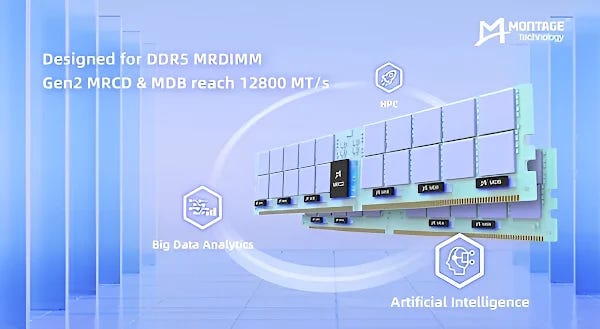
Montage doesn’t build AI chips. It builds something more mundane: the memory interface components without which AI servers cannot function. There are only three serious players in the world. Renesas of Japan. Rambus of the United States. And Montage, headquartered in Shanghai. That is enough to put it on Washington’s radar.
Montage’s decision to list in Hong Kong wasn’t really a decision. It was the elimination of alternatives.
Shanghai’s STAR Market suspended its listing channel for unprofitable tech firms in August 2023. A domestic listing would have meant profit thresholds Montage couldn’t meet, political scrutiny it didn’t need, and a renminbi raise that couldn’t fund overseas R&D or foreign hires. None of that works for a company trying to compete with Renesas and Rambus on a global stage.
New York was simpler to rule out. I kept coming back to a line from Samuel Bickett, a former compliance director at Bank of America Merrill Lynch who spent years working in Hong Kong’s financial system and has testified before Congress on the subject. His read on the situation was direct: “A company that was big enough would previously have tried to list in New York. Now, a lot of them really can’t do that. It’s too risky.” The same Treasury rule that flagged Montage as a “covered foreign person” makes a U.S. listing a compliance nightmare before a single share changes hands.
So Hong Kong. Not as a preference. As the only door still open.
Montage is not alone. The more I looked at recent Chinese AI IPOs, the clearer the pattern became: almost all of them were ending up in Hong Kong. Twenty-three of twenty-seven Chinese AI-related companies that have gone public in 2026 listed there, a rate above 85%, according to Kharon’s analysis. The scale of the shift is hard to overstate: More than $14 billion was raised in the first quarter alone across 40 listings, a 489% increase from the same period last year — the strongest Q1 performance the exchange has seen in five years, according to KPMG’s official quarterly review. Analysts expect the full-year total to approach $60 billion. More than 400 companies are in the queue. Hong Kong’s Chapter 18C rules, introduced in 2023, allow pre-profit companies in AI, semiconductors, robotics, and autonomous driving to list on the main board without mandatory profit forecasts. The door that Beijing closed on the mainland, Hong Kong reopened offshore.
When the Entity List Becomes a Marketing Document
If Montage represents the quiet end of this story, a chip company slipping through a legal gap with minimal fanfare, then Biren Technology represents the loud end.
Biren makes GPUs. Not the kind that render video games, but the kind that train AI models: the direct category Washington has spent the most energy trying to keep out of Chinese hands. Founded in 2019, the Shanghai-based company built its BR100 chip as an explicit domestic alternative to Nvidia’s processors, targeting data centers, AI inference, and cloud computing workloads. It was, by design, exactly the kind of company the U.S. export control regime was meant to contain. In October 2023, Washington added Biren to the Entity List with a strict designation that complicated its access to overseas foundries and chip manufacturing equipment.
Then it went public in Hong Kong on January 2, 2026, the exchange’s first listing of the year.
Retail investors oversubscribed the offering 2,347 times. Institutional demand hit 26 times available shares. The stock opened at HK$35.70 against an IPO price of HK$19.60 and briefly surged 119% intraday. By the close of its first trading day, Biren was worth roughly $11 billion.
The Entity List designation is there, in the prospectus, disclosed as a risk factor. Investors read it. They bought anyway.
This is the detail I keep thinking about. Washington’s logic is that designating a company disrupts its access to capital, technology, and global markets. In Biren’s case, the designation appears to have done the opposite: it confirmed the company’s strategic importance, signaled it was a serious player in the domestic GPU race, and made it a more compelling story for investors betting on China’s self-sufficiency drive. The Entity List, intended as a wall, functioned instead as a validator.
Biren couldn’t have achieved this on a mainland exchange. Its losses were widening, its revenues still nascent. Under normal STAR Market rules, the listing would have been impossible. Chapter 18C made it happen in Hong Kong. And the dollars it raised, not renminbi, dollars, will fund the next generation of chips that Washington is trying to prevent from being built.
Most coverage of this IPO boom focuses on the listings. The more important story is the mechanism underneath them.
China maintains strict capital controls. Foreign investors cannot easily buy shares on the Shanghai or Shenzhen exchanges directly. But through Stock Connect, the cross-border trading link between Hong Kong and the mainland exchanges, they can. A foreign investor with a Hong Kong brokerage account can buy A-shares listed in Shanghai or Shenzhen, and mainland investors can access Hong Kong stocks the same way. The exchange functions as a revolving door: not just a listing venue, but a bypass around China’s capital controls in both directions.
This is what makes Hong Kong structurally irreplaceable for Beijing, and structurally inconvenient for Washington. As I was digging through research on Hong Kong’s role in global finance, one statistic kept resurfacing: roughly two-thirds of Chinese entities sanctioned under U.S. law still have securities accessible through Hong Kong’s markets, either through direct listings or through Stock Connect, according to a Hong Kong Watch report presented at the Hudson Institute. The implication is one that rarely gets stated plainly: you cannot import goods from these companies because of forced labor concerns, but you can invest in them. That cognitive dissonance is not accidental. It is built into the architecture of the system.
Bickett offered what I think is the clearest description of what’s actually happening: “What we’re seeing in Hong Kong is a pretty clear shift from a global financial center to a very China-focused instrument for Chinese companies to interface with the world.”
The System Is Designed This Way
There is a reason the shift happened in Hong Kong and not somewhere else.
One small regulatory change says a lot about the direction Hong Kong has taken. The exchange quietly removed a prospectus requirement to disclose risks arising from China’s political and legal system, standard disclosure on any U.S. exchange, but deemed too politically sensitive in the current climate. That sits alongside Chapter 18C, accelerated listing approvals, and lowered thresholds. Since 2023, Hong Kong has systematically reduced the friction for mainland companies to raise international capital, and the pipeline has responded accordingly.
Wu Minghui, the founder of MiningLamp Technology, a Chinese enterprise AI software company that listed in Hong Kong in November 2025, described the city as a “data compliance transfer station,” a place where mainland firms can test cross-border data flows, build compliance processes, and establish international credibility before moving into other markets. Not a destination. A rehearsal space.
What these companies are buying when they list in Hong Kong is not just dollars, though they need those too. It is legitimacy. A Hong Kong listing signals to investors in the UAE, Singapore, South Korea, and Switzerland, all of whom participated in the January wave of AI IPOs, that a company can operate within a recognizable legal framework and attract institutional capital. J.P. Morgan as cornerstone investor in Montage’s offering is not incidental. It is the point.
Here is what makes this more than a China story.
Washington’s restrictions are less coherent than they appear. Export controls limit what American companies can sell. Financial sanctions limit what Americans can buy. Most Chinese firms now listing in Hong Kong sit in the gap between the two.
American companies can’t supply them. American investors can own them.
The bureau that administers export controls is chronically underfunded and has only been doing this work for about a decade. The gap between what it designates and what Treasury sanctions is wide, and companies move through it freely. It is not a loophole someone found. It is a gap that was never closed.
None of this makes Hong Kong a safe haven. The Entity List follows these companies wherever they list. The reputational overhang travels with the prospectus. And the system itself is more fragile than the numbers suggest.
The IPO boom runs on regulatory tolerance: Beijing’s tolerance for which companies get waved through, Hong Kong’s tolerance for what gets disclosed, and Washington’s tolerance for how wide it lets the gap between its export controls and its investment restrictions remain. Any of those tolerances can be withdrawn.
The story of Hong Kong’s IPO boom isn’t really about Hong Kong. It’s about what happens when two superpowers try to decouple without fully letting go. Walls are easier to build than systems are to unwind. And until someone actually closes the door, capital will keep walking through it.
For now, Montage trades on the Hong Kong Stock Exchange. J.P. Morgan holds a cornerstone position. And on page one of the prospectus, buried in the risk disclosures, is the acknowledgment that any American buying these shares may need to tell the Treasury Department they did so.
The wall has a door. The door has a sign. And the sign says: please notify us on your way through.
