



Mention Huawei, and the conversation quickly turns to U.S. sanctions and China’s drive for technological self-sufficiency.
That story usually revolves around two products. One is the premium smartphone, often priced above $799, powered by Huawei-designed chips and competing with Apple and Samsung. The other is the AI processor, designed to meet China’s growing computing needs and challenge Nvidia. Together, they embody China’s effort to reduce its dependence on foreign technology, including chip manufacturing by TSMC.
But another question gets less attention. Huawei is, ultimately, a business. Can it still make money outside China when Washington has restricted so much of what it can buy and sell?
The initial damage was severe. Revenue across its three reported overseas regions fell by more than a third between 2019 and 2021. By 2025, however, it had climbed to about $35.6 billion, up 9% year over year and back to roughly three-quarters of its 2019 level. Huawei has also resumed promoting its phones more actively in Southeast Asia and the Middle East.
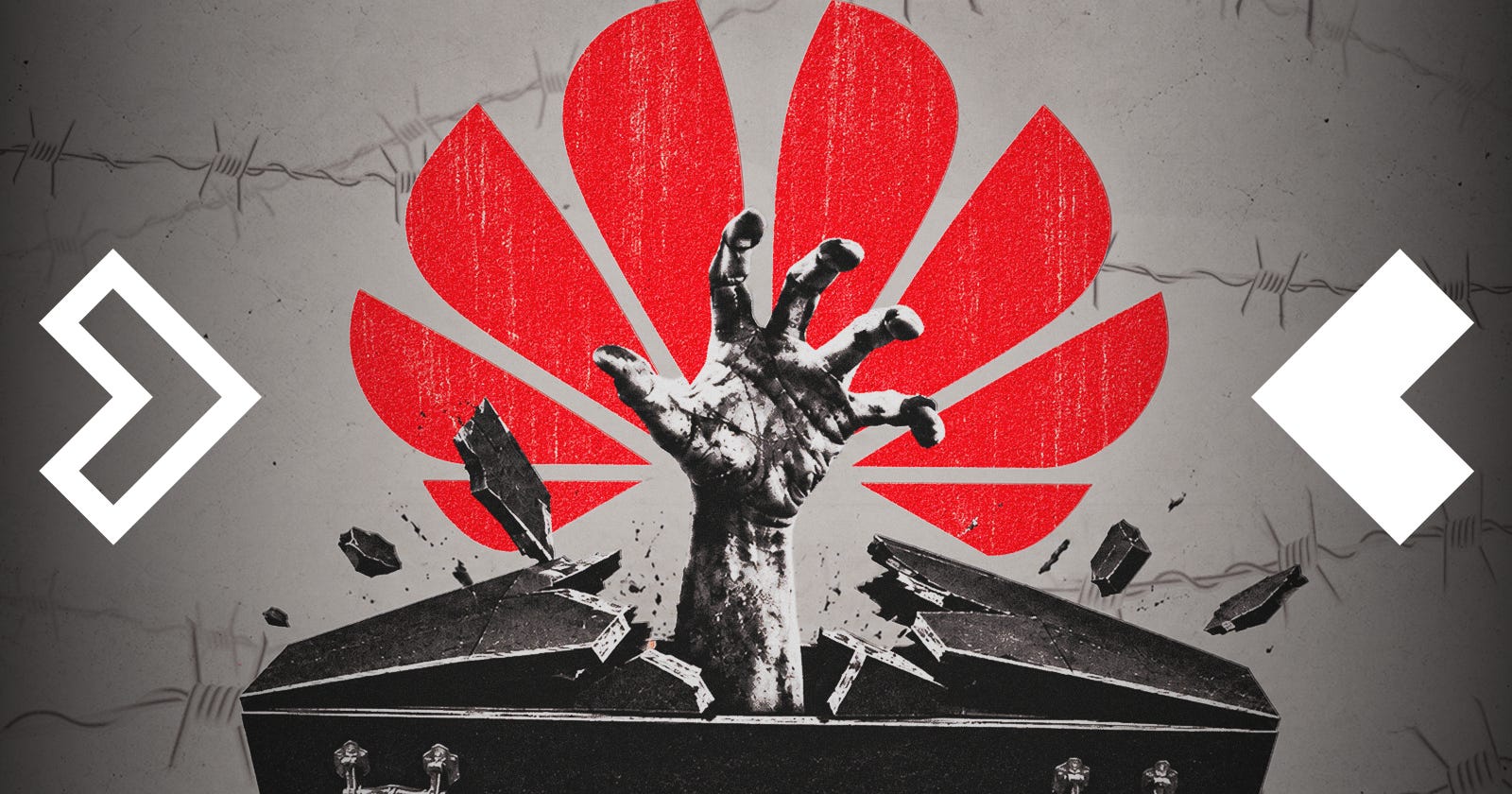
Has its overseas business finally reached a Lazarus moment?
Before the Smartphone, There Was the Network
To understand the recovery, start with what Huawei actually does.
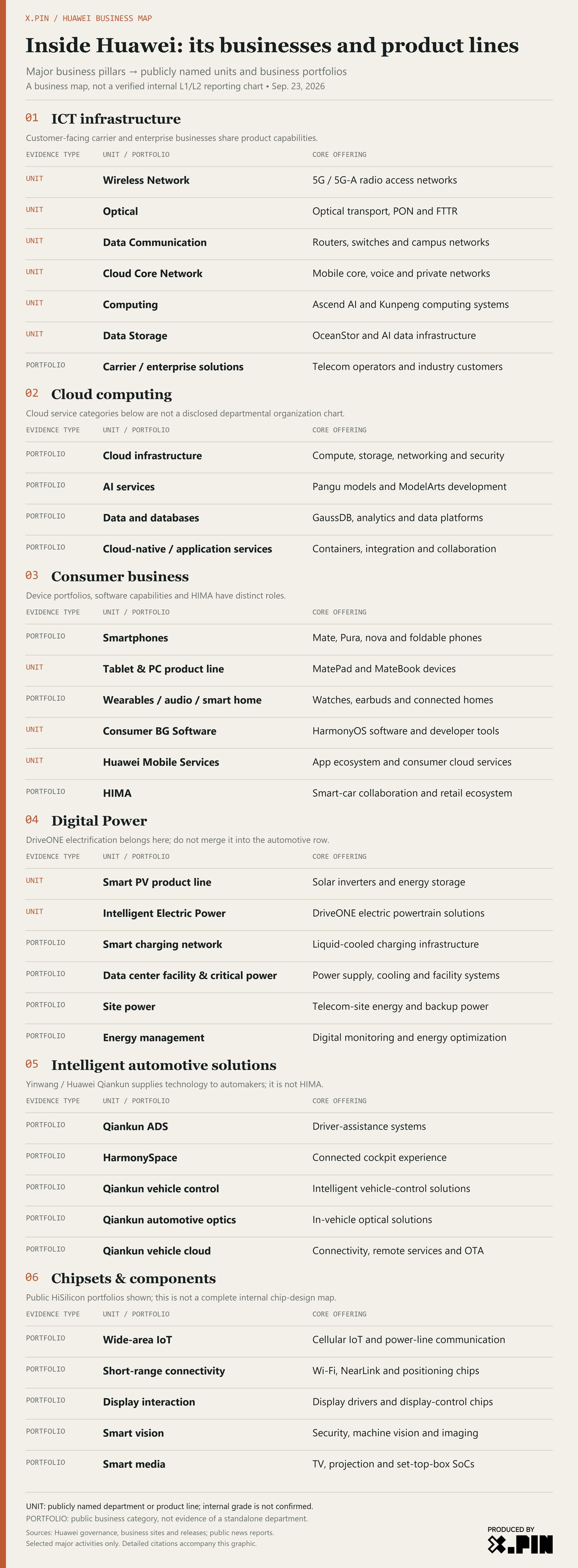
Ren Zhengfei founded a telecom equipment company, not a smartphone brand. Huawei built its business around telephone switches and network infrastructure. It entered handsets through carrier-branded devices in the 2000s. Richard Yu later helped turn it into a consumer brand in its own right.
Much of the company still follows that original logic: build an adjacent business from technology it already understands. Expertise in powering telecom networks extended into data center power systems and solar inverters. Smartphones produced an ecosystem of watches and earbuds. Connectivity, electronics and China’s EV boom created an automotive business supplying lidar, vehicle components and assisted-driving technology. That operation is now housed in Yinwang Intelligent Technologies.
This breadth matters when assessing the sanctions.
Washington’s restrictions did not strike every business equally. Telecom equipment faced exclusion in the U.S. and mounting restrictions in parts of Europe, driven by national-security concerns. Huawei’s addition to the Entity List in 2019 cut off access to Google Mobile Services, or GMS, for new phones. Tighter chip controls in 2020 severed its manufacturing relationship with TSMC.
The phones still worked. But outside China, losing convenient access to Google’s services made them much harder to sell.
Nor did every European country adopt the same policy toward Huawei’s network equipment. Elsewhere, its sales teams still had customers in Latin America and Africa who needed to expand or replace their networks.
None of that could reverse the damage overnight. Huawei went from the world’s second-largest smartphone vendor in 2019 and third-largest in 2020 to outside the top five in 2021. Revenue across its overseas regions fell to roughly $30.7 billion that year, using the same exchange rate as the 2025 figure.
Huawei needed something to sell while it rebuilt.
The Long Way Back
U.S. sanctions crippled Huawei’s overseas smartphone business, but they did not close every route to its customers. Watches and earbuds could still reach consumers. Solar equipment could still serve energy projects. Telecom operators in countries that had not excluded Huawei could still buy its network infrastructure. These businesses faced different constraints—and offered different ways to keep earning revenue abroad.
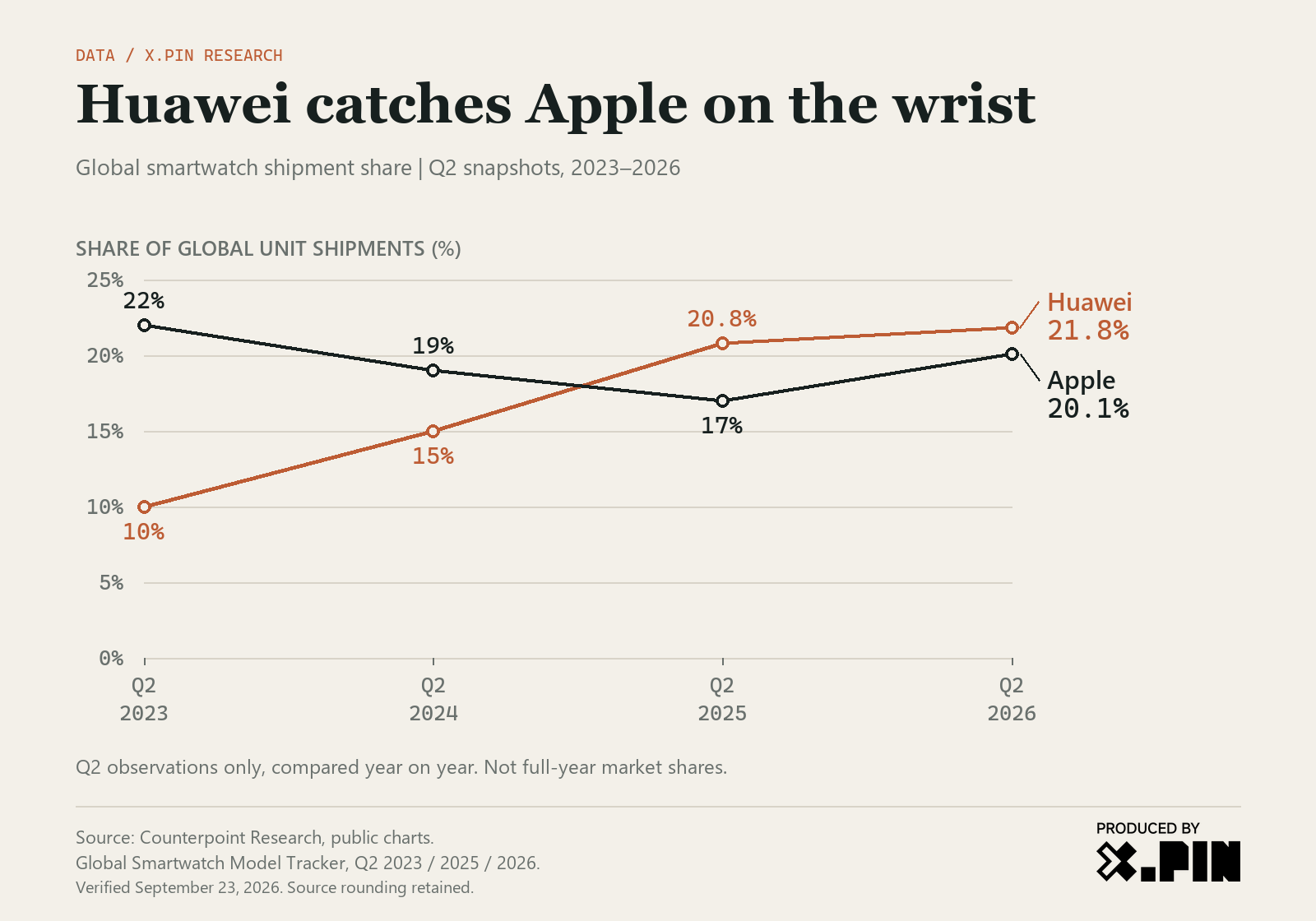
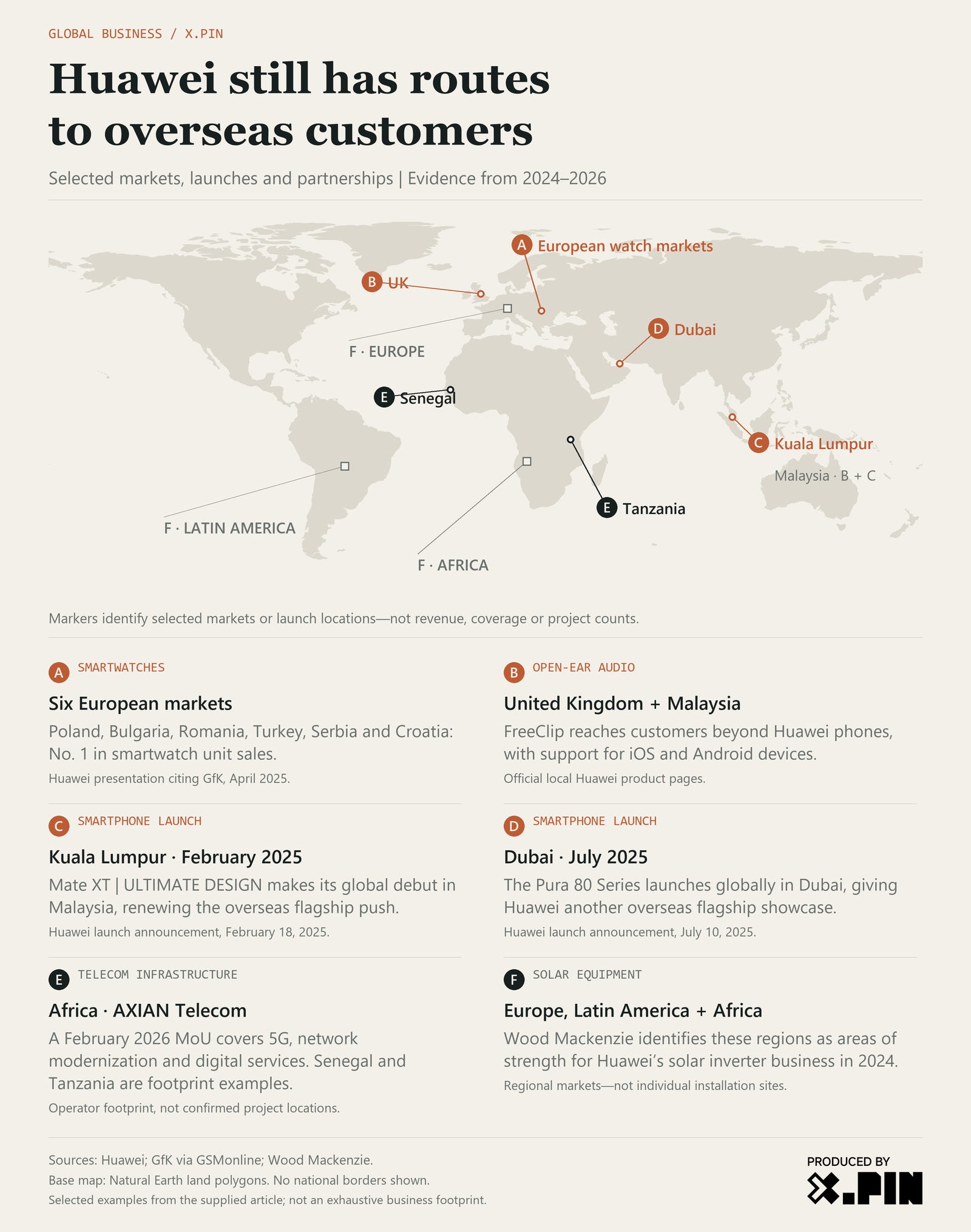
Start with smartwatches. Huawei’s WATCH FIT line targeted buyers seeking affordable fitness and health features, while the WATCH GT series served customers willing to pay more for design, materials and battery life. Together, they gave Huawei a broad offering across Europe, rather than limiting it to the premium customers its flagship phones once pursued. In a presentation citing GfK’s April 2025 data, Huawei said it led smartwatch unit sales in Poland, Bulgaria, Romania, Turkey, Serbia and Croatia.
Open-ear earbuds offered another route to consumers. FreeClip targeted listeners who wanted comfortable audio without sealing off their surroundings, whether at work or while exercising. It reached markets including Malaysia and the UK, and could connect to Apple and Android devices. Customers did not need to buy a Huawei phone to buy Huawei audio.
The first-generation FreeClip sold more than 3.7 million units globally in roughly 21 months. That is a worldwide figure, not an overseas sales tally, but it shows the product had found an audience. Omdia reported that global open-ear shipments grew 69% in Q3 2025, identifying Huawei and Shokz as leaders in the category’s advanced products. Huawei’s premium consumer ambitions had survived, even where its phones had struggled.
On the business side, solar equipment addressed a different customer base: power-project developers, commercial and industrial users, and installers serving households. Huawei’s FusionSolar portfolio spans all three markets. Its opportunity was particularly strong in Europe, Latin America and Africa, where demand for solar installations gave it customers far removed from the smartphone market. Wood Mackenzie estimates that Huawei shipped 176 GWac of solar inverters in 2024, ranking first worldwide, and specifically highlights its strength in those regions.
Telecom equipment followed a similar geographic logic. Operators in emerging markets still needed affordable ways to expand coverage and upgrade networks. Huawei’s technology, pricing and established sales teams kept it competitive. In Africa, AXIAN Telecom—which operates in countries including Tanzania and Senegal—signed a strategic agreement with Huawei in February 2026 covering 5G, network modernization and digital services.
The broader numbers suggest resilience, too. Dell’Oro estimates that Huawei captured 41% of telecom equipment revenue outside North America in 2025. That includes China, so it cannot establish the scale of an overseas recovery on its own. But agreements such as AXIAN’s show that demand also extended beyond Huawei’s home market.
These businesses gave Huawei something more useful than a claim to technological self-sufficiency: customers it could still serve. Europe remained open to parts of its consumer and energy portfolio. Emerging markets supplied opportunities in infrastructure. Its overseas recovery did not require every business to return to every country.
Even smartphones retained a foothold. During a visit to Thailand in 2024, I saw users accessing some Google-dependent apps through microG. The workaround had limitations and did not restore licensed Google Mobile Services, but it helped keep Huawei phones usable for customers unwilling to leave the brand.
In 2025, Huawei began turning that foothold into a renewed overseas consumer push. It launched the Mate XT | ULTIMATE DESIGN globally in Kuala Lumpur in February, followed by the Pura 80 Series in Dubai in July. The new flagships anchored a fresh round of launches, retail activity and marketing in Southeast Asia and the Middle East. This was not yet a return to its former sales volumes. It was a return to actively seeking new smartphone customers abroad.
Washington’s Unintended Opening
The biggest new variable, ironically, came from the U.S.: AI chips.
Restrictions on Nvidia’s exports created an opening for domestic alternatives. They also changed Huawei’s priorities. Reuters reported in 2024 that demand for Ascend processors, combined with manufacturing constraints, had led Huawei to prioritize AI chips over processors for its Mate 60 phones.
This was not just another product launch. Limited chipmaking capacity had become a resource Huawei had to allocate between two strategically important businesses.
The resulting market opportunity is substantial. Bernstein estimated that Huawei roughly matched Nvidia’s approximately 40% share of China’s AI-chip market in 2025. That is an analyst estimate, not a confirmed share of data center GPU shipments; Ascend products are AI accelerators, and different market definitions produce different figures.
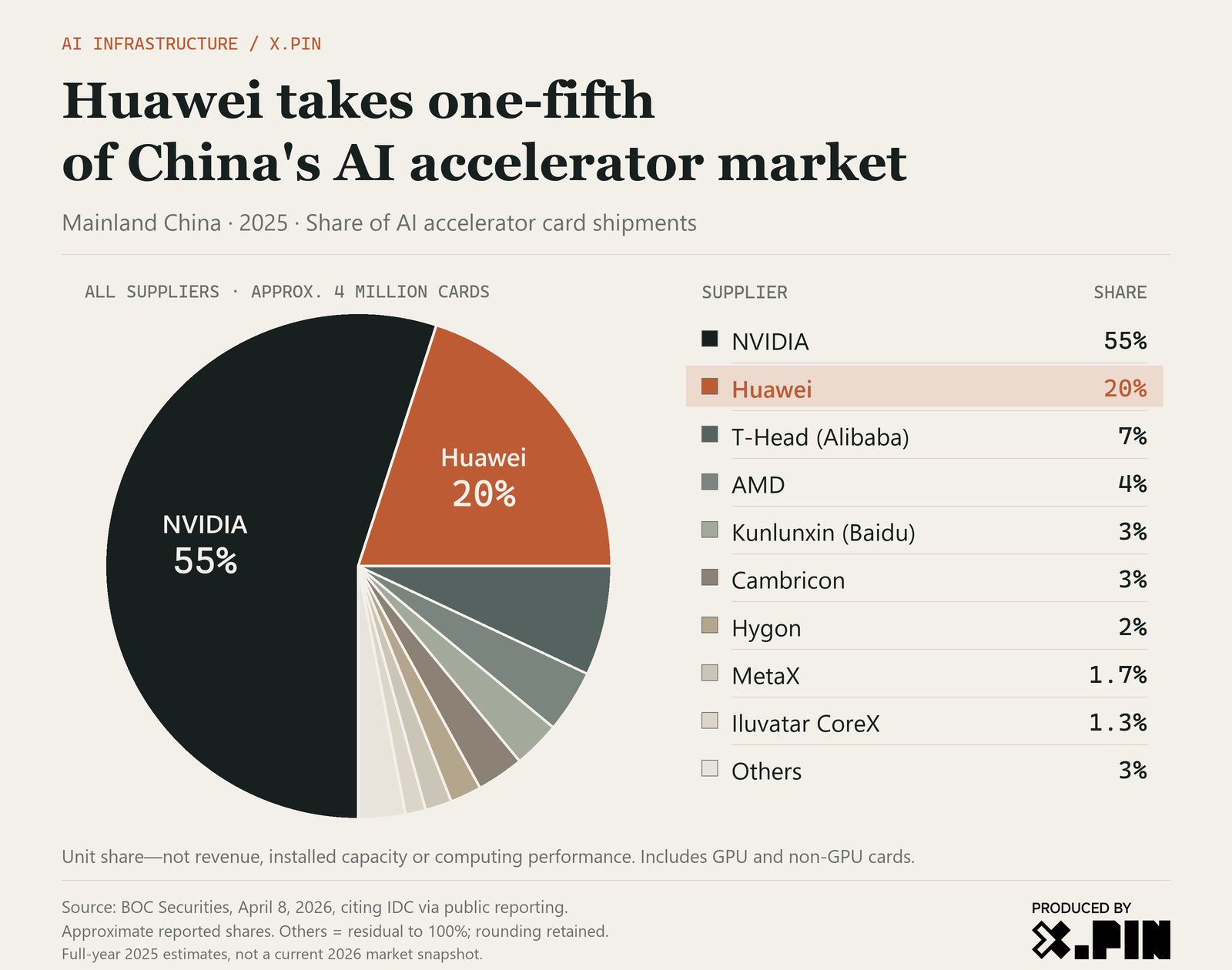
The overseas possibility is more interesting still. Huawei could try to repeat its telecom strategy: develop a large home market, then offer infrastructure to customers in Southeast Asia, the Middle East and beyond.
Bloomberg reported that Malaysia was considering Huawei chips for a sovereign-AI project. Separately, Huawei pitched Egypt on AI data centers using Ascend 950-series processors, with additional chips for inference systems. These were prospective projects, not evidence of completed deployments.
The appeal is nevertheless clear. Governments seeking sovereign AI do not necessarily want every layer of their computing infrastructure tied to U.S. suppliers. Huawei offers another option. Buying Chinese equipment does not eliminate technological dependence, but it can diversify it.
A policy designed to constrain Huawei has helped create demand for an alternative it can sell.
A Second Life, Not the Old One
There is another irony in this story. The image of Huawei as an exclusively nationalist enterprise leaves out much of its commercial history.
Ren borrowed heavily from IBM’s management practices. Huawei built campuses inspired by European towns. And it once sought a deal with AT&T to enter the lucrative U.S. smartphone market—the same prize many Chinese handset makers wanted.
That distribution agreement collapsed in 2018. The broader U.S. restrictions that began the following year made a return to the old expansion plan increasingly implausible.
Huawei did not respond with one breakthrough that undid everything. Its overseas business contracted sharply. It spent years rebuilding. By 2025, it was again pushing outward, but with a different mix of products and customers.
Watches and earbuds kept its consumer brand visible. Solar inverters and telecom equipment sustained its industrial presence. Emerging markets offered room that the U.S. and parts of Europe no longer did. AI infrastructure may provide another opening.
Washington tried to hammer the nails into Huawei’s coffin. Six years later, its overseas business was showing signs of life.
The remaining question is whether this new strategy can turn survival into sustained growth.