


Three Broken Brake Pedals
Outside China, Huawei is known for its phones and for its place on a U.S. sanctions list. At home, it also puts its name on cars. On Oct. 8, one of those cars failed a brake test on camera.
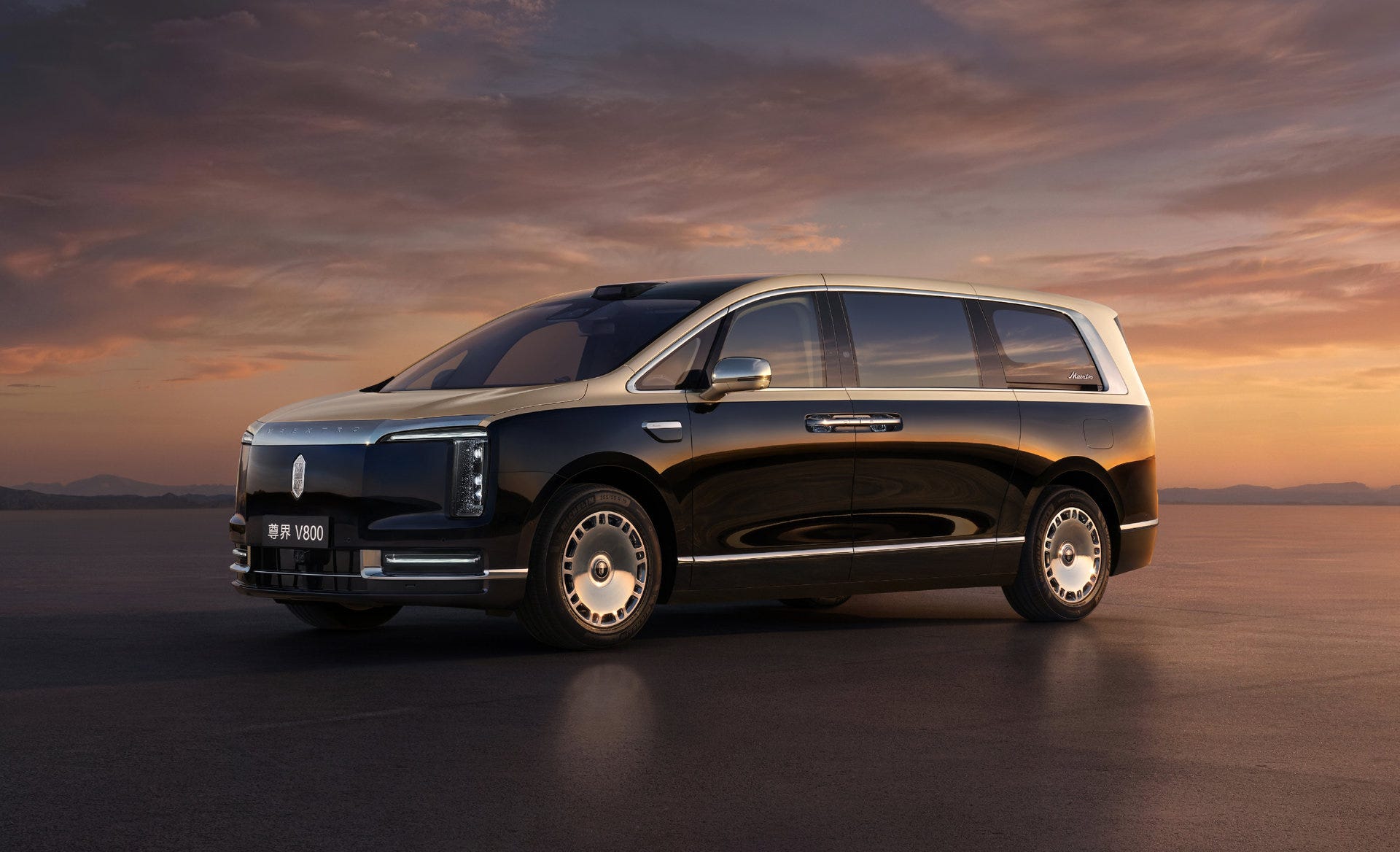
Dongchedi (懂车帝), one of China’s largest car-review platforms, ran three Maextro (尊界) V800 minivans through repeated emergency stops from highway speed. On all three, the brake pedal bracket snapped, leaving the pedal useless. Eight other models in the same test came through fine.
The V800 sits at the top of Huawei’s car alliance, the Harmony Intelligent Mobility Alliance (HIMA, 鸿蒙智行), and starts at RMB 766,000 (about $108,000), a price aimed at the Toyota Alphard. Huawei supplies the software and the brand, while JAC Motors (江淮汽车), a state-backed automaker, builds the car.
Maextro responded that evening. The brake system exceeds national standards, it said, and no bracket had broken in real-world use. It called the test non-standard and extreme, but offered owners a free upgrade and promised to review how the part was validated and made. It did not announce a recall or say what caused the brackets to snap.
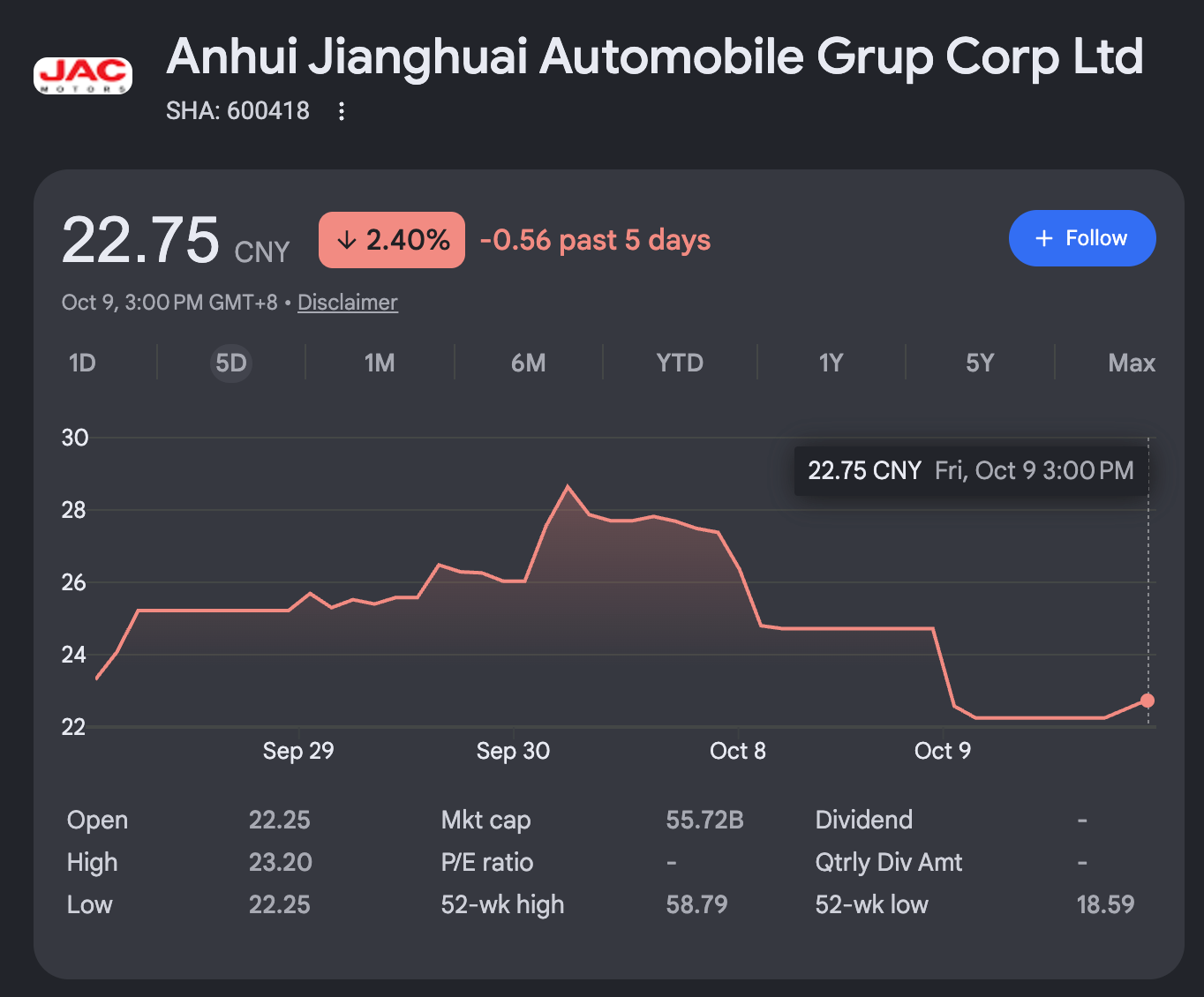
By then the video was trending on Weibo, China’s closest equivalent to X. Some buyers who had put down deposits on a V800 canceled their orders, and by the close of trading on Oct. 9, JAC had lost more than RMB 10 billion (about $1.4 billion) in market value.
Bigger Than a Brake Pedal
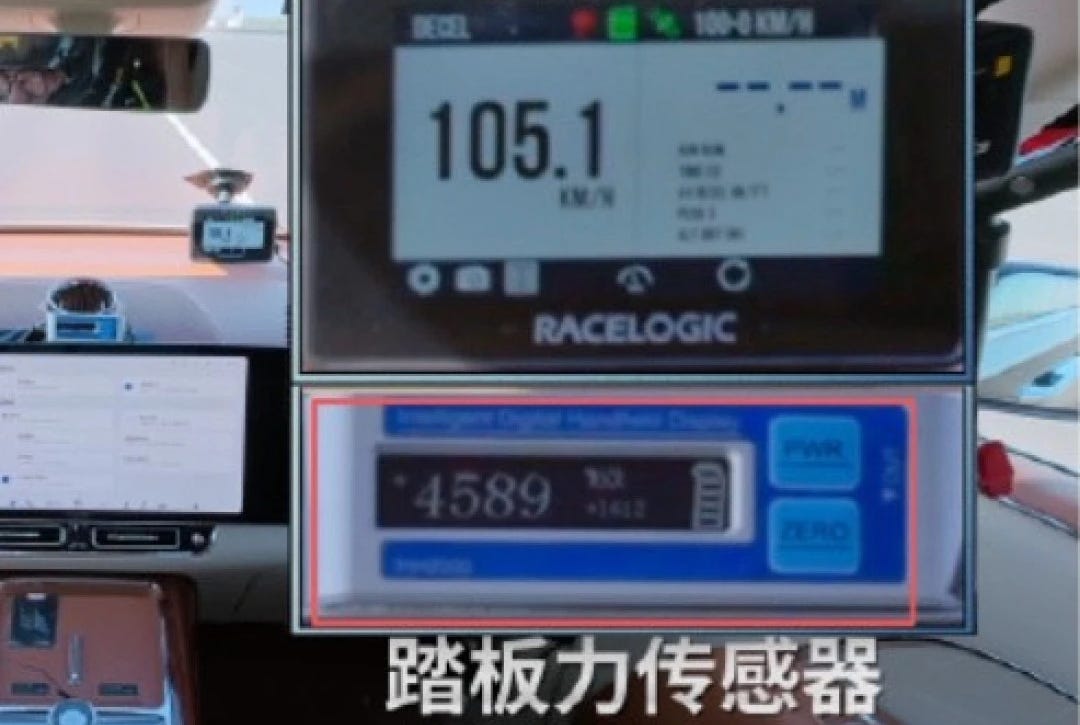
On Weibo, Huawei supporters called the test unfair. They shared a screenshot showing 4,589 newtons (about 1,030 pounds) on the pedal, which they said no real driver could produce. Dongchedi called the number a display glitch and put the real peak at 1,612 newtons (about 360 pounds). Hard braking from highway speed, it said, is among the most basic tests it runs.
Huawei won a devoted following at home partly by surviving years of U.S. sanctions, and its fans had specific reasons to doubt Dongchedi. The platform is owned by ByteDance, TikTok’s parent company, and has clashed with Huawei before. In 2023, its winter range test ranked an SUV from AITO (问界), another HIMA brand, last, and Richard Yu (余承东), who runs Huawei’s car business, called it “a test that cheats people.” Paid smear campaigns are common enough in China’s car market to have a name, “black PR” (黑公关).
Late on Oct. 8, the main test video began disappearing from major platforms. By the next afternoon it was gone even from Douyin, ByteDance’s Chinese version of TikTok, and from Dongchedi’s own app. Dongchedi has not explained. Many users, Huawei’s critics among them, assumed Huawei or Maextro had it removed. No evidence has surfaced that either did.
Those critics have long accused Huawei of trading on patriotism. Their sharpest complaint is that criticism of the company tends to disappear.
Last November, a local government report on a fatal crash involving an AITO car disappeared from an official website soon after it went viral. Users blamed Huawei, though nothing tied the company to it. This summer, Huawei asked video platforms to remove clips mocking Yu. More than 100 came down, and the mockery only spread.
A broken pedal bracket became a national argument because each camp took the episode as confirmation of what it already believed about Huawei.
On Oct. 9, the China Automotive Technology and Research Center (CATARC, 中汽中心), a state-backed body that helps write auto standards, sent automakers an urgent survey asking what their brake pedals are made of. The Chinese tech outlet 36Kr (36氪), which reported the survey, said such steps usually come before new rules.
Speed-built Cars
The V800 video landed in the middle of an argument China’s car industry has been having all year, over sucheng che (速成车), or “speed-built cars,” models taken from drawing board to showroom far faster than the industry used to move.
Behind that argument is a market with more new cars than buyers can absorb. Chinese brands put 282 new or updated electric and plug-in hybrid models on sale in the first half of this year, nearly 11 a week, according to the car-data platform Yiche.
We reported on that debate earlier this year for Chaping (差评), X.PIN’s Chinese-language parent.
A quality engineer at a leading automaker argued that a car developed over five years can be just as rushed as one built in 18 months. What has changed, in his view, is how much risk the industry will accept.
An executive at a chassis-parts supplier told us some domestic automakers wrap up road and corrosion testing at 30,000 to 40,000 km (about 19,000 to 25,000 miles). Volkswagen runs 100,000 km or more. That is probably enough, he said, though the cars may not last as long as the over-engineered models of the past.
Cost-cutting has changed even more, he said. Joint ventures between foreign and Chinese automakers used to look for savings two or three years after a model went on sale. Now cheaper versions of some parts are already in road testing before the car reaches showrooms. Once they pass, they can go into production without any announcement. Two cars of the same model built months apart may use different materials or processes.
He traced the pressure to annual price cuts, which he called steep and widespread. “My margin isn’t even 20%, and you want me to cut 20%. How?” he said. The answer is usually a cheaper design. Every cheaper part still has to pass the automaker’s tests. But one that once cleared them by 30% to 40% might now clear them by perhaps 10% to 20%.
A bench-testing engineer told us about a car that was still failing tests two weeks before production began. It was never retested. Joint ventures, he said, would keep fixing a part until it passed. Newer brands are more likely to rate how serious the problem is, then decide whether it’s worth fixing.
“Haste makes waste,” the quality engineer told us. “But if you don’t adapt, your car is behind the day it launches. There’s no real choice.”
Sources
Brake test results (three V800s, repeated emergency stops from 100 km/h, all three brackets broke): Chuanguan News, Oct. 8, 2026 (in Chinese). https://cbgc.scol.com.cn/news/8036075
Eight other models passed the same test: Huxiu, Oct. 8, 2026 (in Chinese). https://www.huxiu.com/article/4895989.html
V800 pricing and Aug. 5 launch: IT Home, Oct. 8, 2026 (in Chinese). https://ithome.com/1/010/570.htm
Maextro’s Oct. 8 statement: The Paper, via Sohu, Oct. 8, 2026 (in Chinese). https://www.sohu.com/a/1085249337_260616
JAC’s two-day market-value loss: The Beijing News, via Sina Finance, Oct. 9, 2026 (in Chinese). https://finance.sina.com.cn/tech/roll/2026-10-09/doc-iniuquqp7064675.shtml
Dongchedi on the 4,589-newton reading and the 1,612-newton peak: Cailian Press, Oct. 8, 2026 (in Chinese). https://www.cls.cn/detail/2499850
Dongchedi’s 2023 winter range test and Huawei’s response: ETNet, via Anue, Dec. 11, 2023 (in Chinese). https://news.cnyes.com/news/id/5406844
Government campaign against “black PR” in the auto industry: Yicai, Sept. 10, 2025 (in Chinese). https://www.yicai.com/news/102817689.html
Maextro’s defamation ruling over the S800: CarNewsChina, Feb. 24, 2026. https://carnewschina.com/?p=254221
Removal of the test video across platforms: Qilu Evening News, Oct. 9, 2026 (in Chinese), https://www.ql1d.com/general/28182335.html ; Guancha, Oct. 9, 2026 (in Chinese), https://www.guancha.cn/qiche/2026_10_09_903670.shtml
Xiaomi SU7 crashes and door handles: The Paper, Oct. 15, 2025 (in Chinese). https://www.thepaper.cn/newsDetail_forward_31779213
Door-handle standard GB 48001-2026: Yicai, Feb. 2, 2026 (in Chinese). https://www.yicai.com/news/103035587.html
CATARC’s brake-pedal survey: 36Kr, via IT Home, Oct. 9, 2026 (in Chinese). https://www.ithome.com/1/011/091.htm
New-model launches in the first half of 2026: CNR, citing Yiche, July 24, 2026 (in Chinese). https://tech.cnr.cn/techgd/20260724/t20260724_527727634.shtml
Interviews with a quality engineer, a chassis-parts supplier executive and a bench-testing engineer: conducted for Chaping (差评), X.PIN’s Chinese-language parent, in 2026.
One major safety scandal can undermine years of effort by hundreds of Chinese manufacturers to establish trust in overseas markets.
So I agree that the government should strengthen mandatory safety testing, independent verification, and component traceability across the industry. China’s automotive ambitions depend on more than competitive prices and technological innovation. Long-term reliability and consumer trust will ultimately determine whether Chinese cars become globally respected products.