



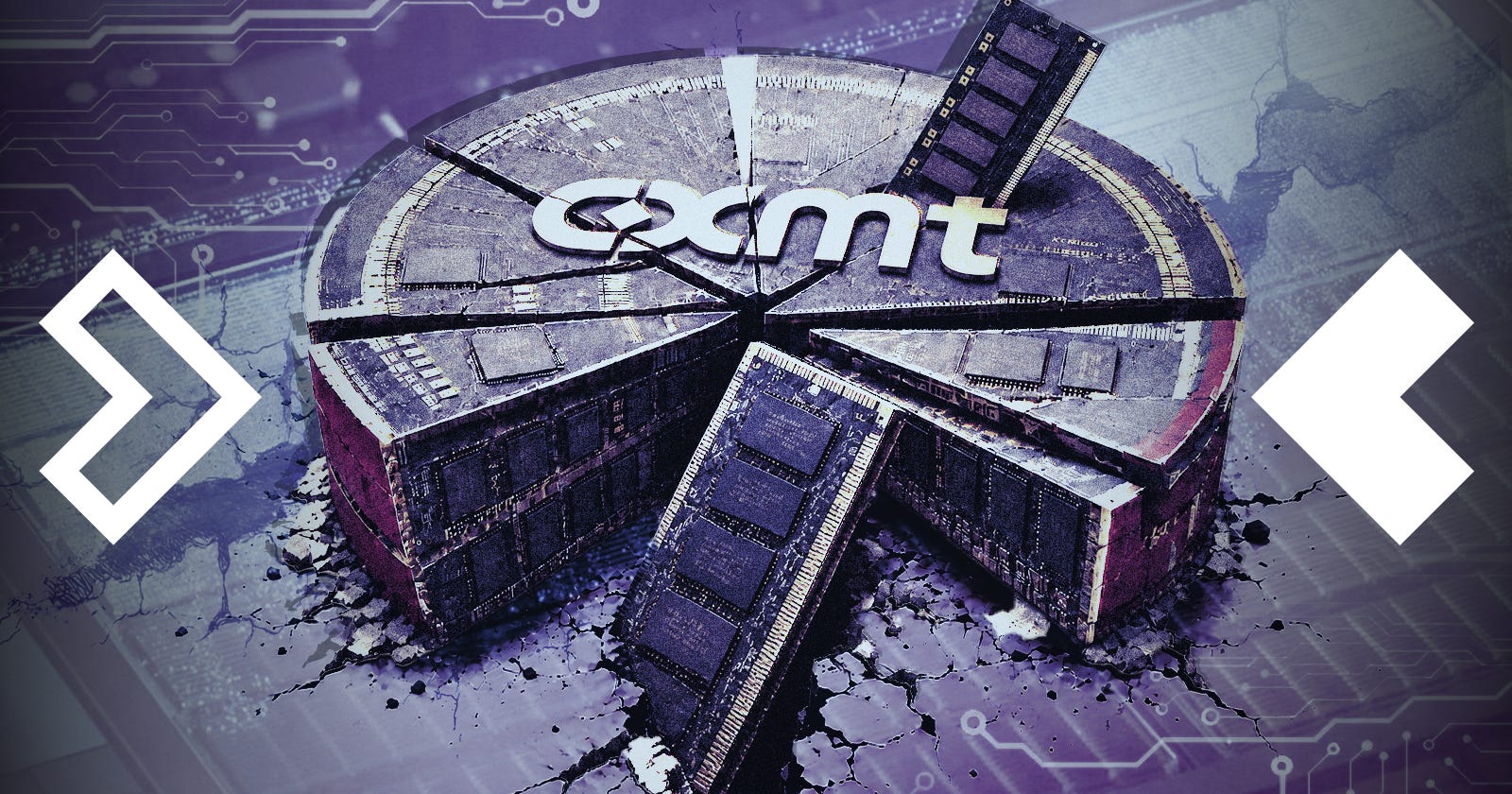
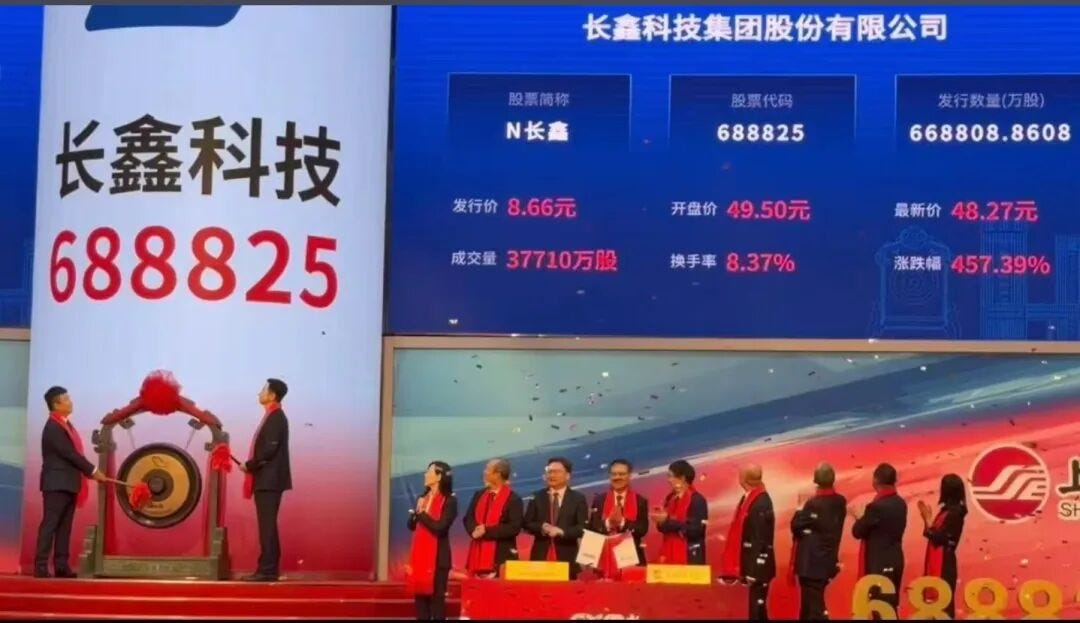
On July 27, CXMT, formally known as ChangXin Memory Technologies, went public on Shanghai’s STAR Market. The company priced its IPO at $1.28 a share. By the close of its first trading day, the stock had reached $7.24, a gain of 465.82%.
CXMT ended the session with a market capitalization of $485 billion, overtaking Industrial and Commercial Bank of China to become the most valuable company listed on mainland China’s exchanges. The IPO raised at least $8.6 billion, making it the largest offering in STAR Market history. The initial free float was just 6.73%, helping turn limited supply into a spectacular first-day rally.
The company’s own numbers are almost as dramatic.
Founded in 2016, CXMT is now China’s largest DRAM manufacturer and the fourth largest in the world. Its first-quarter revenue rose more than eightfold year over year to $7.5 billion. Net income attributable to shareholders reached $3.66 billion. SemiAnalysis estimates that CXMT’s share of global DRAM shipments could rise from 9% in 2025 to 12% in 2027.
Western coverage will naturally focus on China’s push for semiconductor self-sufficiency: export controls, lithography equipment, manufacturing technology, and CXMT’s efforts to challenge Samsung Electronics, SK hynix, and Micron Technology.
But there is another question worth asking: Who paid for CXMT to get this far?
The answer is not a single founder, venture capital firm, or even one level of government. CXMT’s shareholder list maps a much larger coalition. It includes municipal and provincial investment funds, China’s national semiconductor fund, state banks, insurance companies, employee partnerships, internet platforms, customers, and suppliers.
Each group wants something different. And for many of them, the returns extend well beyond gains in CXMT’s share price.
A Coalition Built Around One Chipmaker
Before the IPO, investment vehicles linked to the Hefei municipal government collectively owned about 36.79% of CXMT. After dilution from the newly issued shares, that fell to roughly 33.11%. Based on the first-day closing price, the stake was worth more than $160 billion.
That is paper wealth, not cash. But the city is already receiving returns that do not appear on a brokerage statement: factories, suppliers, jobs, tax revenue, housing demand, and an industrial cluster built around China’s largest DRAM producer.
The Anhui provincial government represents a separate layer of state capital. Anhui Investment Group held 7.91% before the offering. Hefei is the capital of Anhui,they have different mandates, budgets, and performance targets. In practice, local-government investors can cooperate on the same deal while remaining institutionally separate.
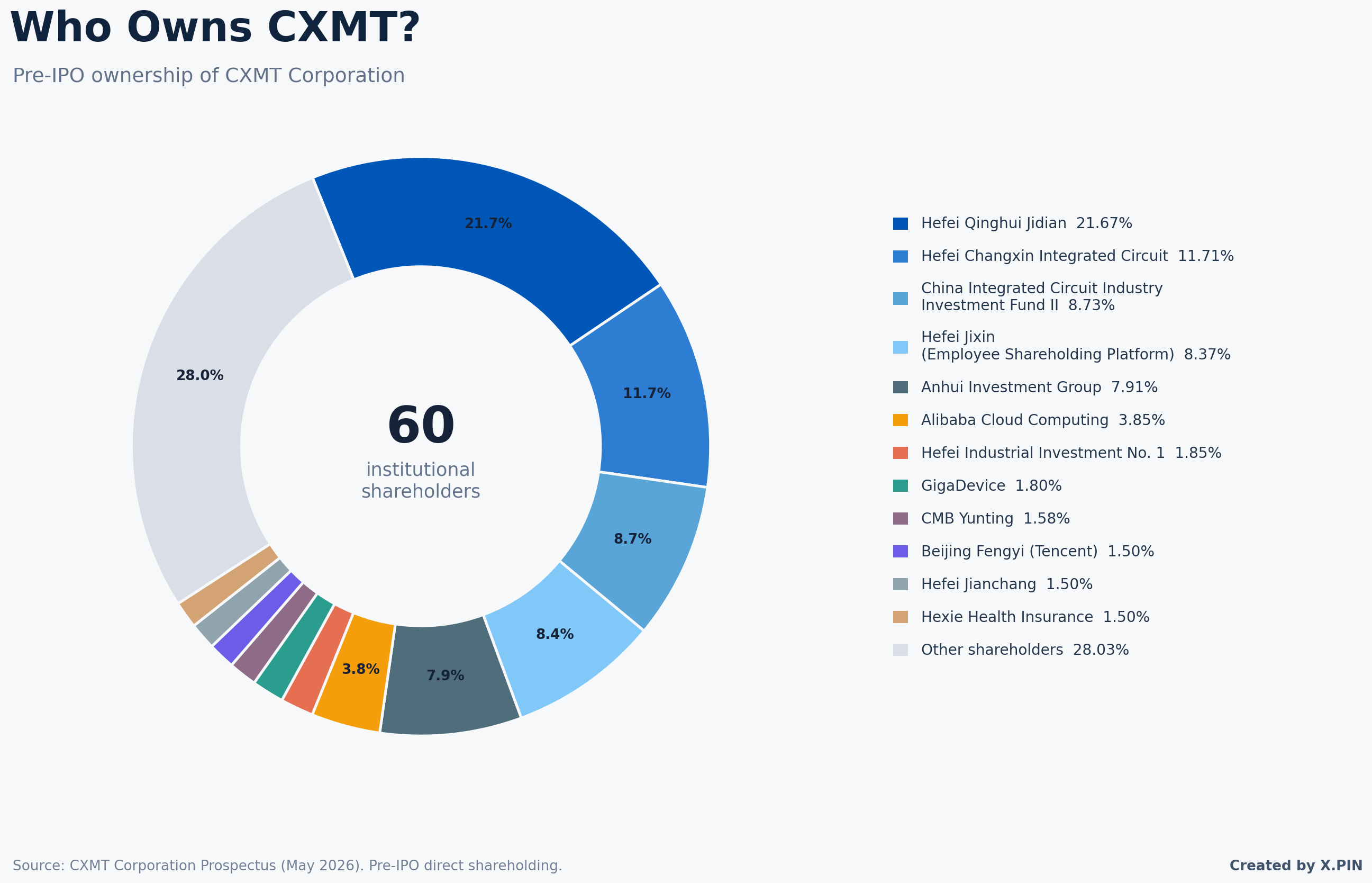
The National Integrated Circuit Industry Investment Fund Phase II, better known as the Big Fund, owned another 8.73%. Its money matters, but so does its name. The fund’s participation signals that CXMT is a nationally backed project, not merely a local industrial gamble. It also nominated two directors to CXMT’s 11-member board, giving the central fund a role in corporate governance without making it the controlling shareholder.
CXMT’s employee stock-ownership vehicle held 8.37%. The company has carried out two major employee stock plans, covering 6,760 grants in all. The arrangement was designed to retain engineers and managers through years of losses, expansion, and technical uncertainty. The rewards will not arrive all at once: lockup restrictions on some employee-held shares will not begin to expire until 36 months after the listing, with releases staggered over a decade.
Then there are the corporate investors. Alibaba Group owned close to 5% before the IPO through Alibaba Cloud and another affiliate. Alibaba Cloud is also a CXMT customer. The strategic logic is straightforward: cloud computing and AI data centers need enormous amounts of memory, and a reliable domestic supplier reduces exposure to shortages and geopolitical disruption.
Tencent Holdings held about 1.5% through an investment vehicle. Midea Group held 0.75%, while a Xiaomi-backed fund owned 0.21%. GigaDevice Semiconductor, a chip designer founded by CXMT chairman Zhu Yiming, owned 1.8%. GigaDevice helps design and market some DRAM products, while CXMT provides manufacturing services.
These are not merely financial bets. They are attempts to bind customers, suppliers, and manufacturers together before the industry’s structure is fully settled.
The IPO brought in another wave of strategic capital. Affiliates of Meituan, Tencent, Xiaomi, and Alibaba Cloud each received roughly $23 million worth of shares. Semiconductor suppliers, automakers, insurers, and 36 portfolios managed by China’s National Social Security Fund also participated. The social security fund portfolios alone received about $1.1 billion worth of stock.
CXMT, then, is more than a company. It is a carefully constructed coalition of stakeholders.
How Hefei Learned to Play the Venture Game
To understand this structure, it helps to understand Hefei.
Zhu Yiming followed a classic path for an elite Chinese technology founder: Tsinghua University, a stint in Silicon Valley, and then a return to China. He founded what would become GigaDevice, starting with NOR flash memory. GigaDevice went public in Shanghai in 2016.
DRAM was a much harder target. It required fabs, equipment, intellectual property, and billions of dollars in upfront investment, with no guarantee of a competitive product. Neither Zhu nor China’s private capital markets could easily finance a project on that scale. But Hefei could.
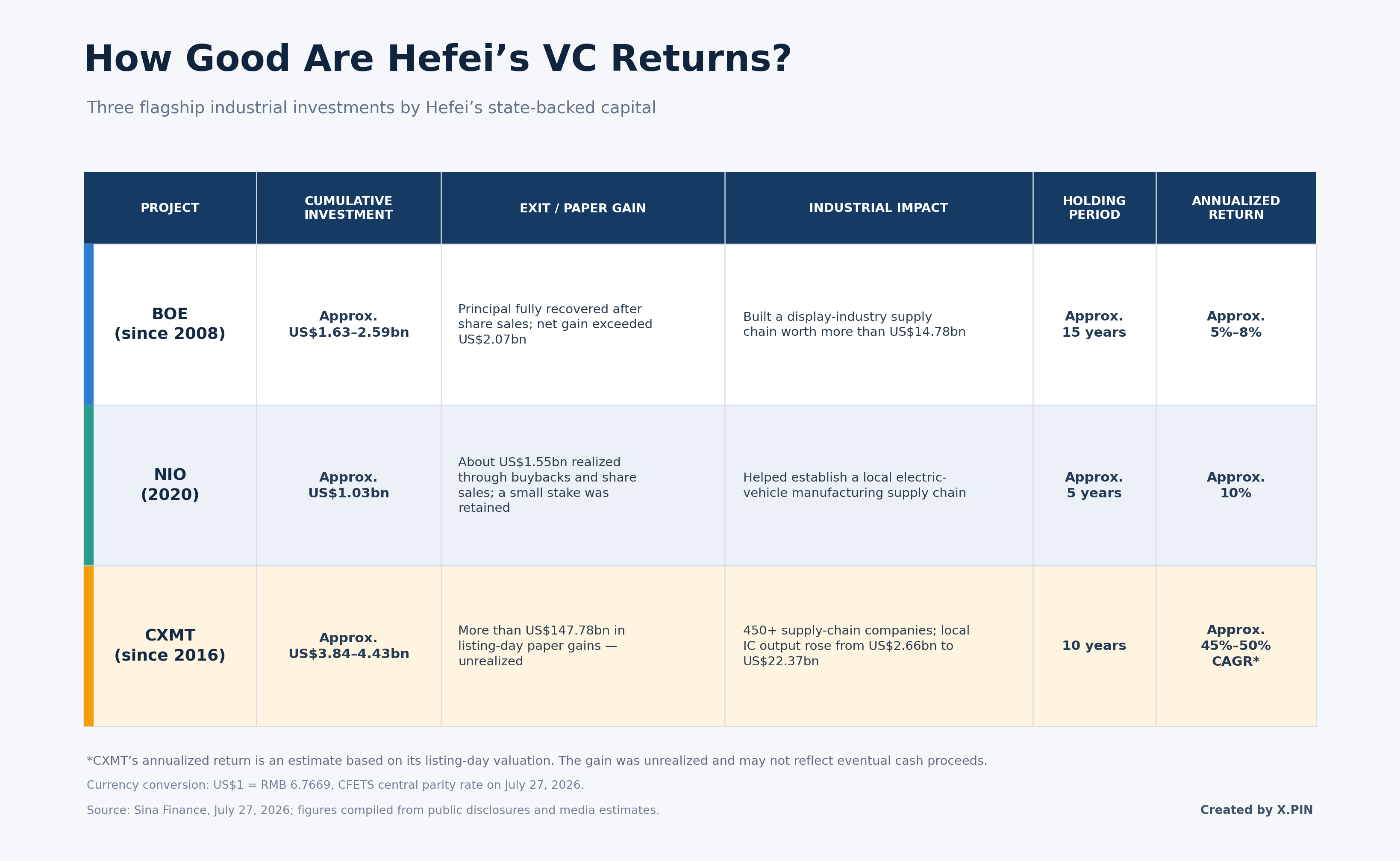
The original CXMT project had an initial investment budget of about $2.7 billion. A Hefei government investment vehicle provided roughly $2.1 billion, about four-fifths of the initial capital. The project broke ground in 2017, then spent years expanding capacity while absorbing heavy losses. Between 2022 and 2024 alone, the company lost more than $4.4 billion.
This was not Hefei’s first experiment with government-backed venture capital. In 2008, when China still relied heavily on Japanese and South Korean display panels, Hefei committed roughly $1.3 billion to help BOE Technology Group build a new LCD production line. The investment gave BOE credibility, allowing it to raise more money and attract suppliers. Around the factory, Hefei developed a display cluster that eventually included more than 100 companies and generated annual revenue measured in the tens of billions of dollars.
In 2020, Hefei joined other state investors in committing $1 billion to rescue NIO. The electric-vehicle company agreed to locate its China headquarters and core domestic operations in Hefei. NIO later bought back some of the investors’ shares for about $1.5 billion, while Hefei retained part of its stake and gained a growing EV supply chain.
The Hefei model has three basic steps.
First, invest countercyclically, when an industry is weak and private investors are wary. Second, use government money and credit to attract banks and outside capital. Third, turn one leading company into an anchor for suppliers, customers, and related factories.
In China, this approach is sometimes described as an “equity-based fiscal model”: the local government behaves less like a tax collector and more like a long-term industrial investor.
It is much harder than it sounds. A city needs money, technical judgment, and political continuity. A project may take 10 or 15 years to pay off. The officials who approve it may be gone long before the results become visible.
Hefei has also benefited from a powerful feedback loop. Successful industrial investments increase employment and housing demand, strengthening the city’s finances and giving it more resources for the next investment.
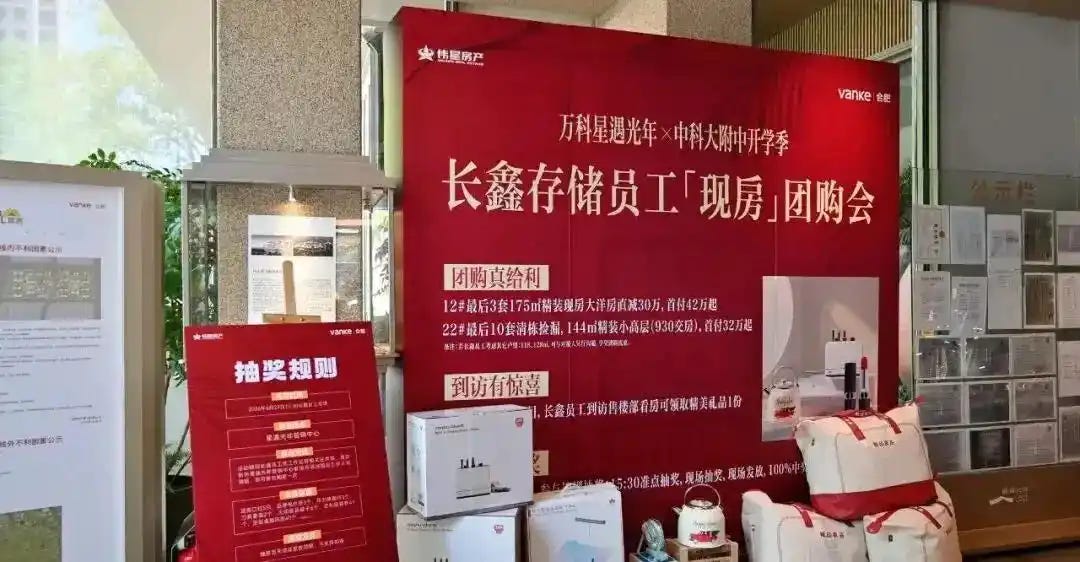
CXMT employees have reportedly bought up large numbers of apartments near the company’s offices and factories. Restaurants, hotels, and landlords benefit long before the government sells a single share. For Hefei, CXMT’s value is not just its market capitalization. It is the local economy growing around it.
Why Nobody Controls CXMT
CXMT says it has no controlling shareholder and no “actual controller,” a formal designation under Chinese securities regulation. That structure will remain in place after the IPO.
The immediate explanation is simple: DRAM manufacturing is too capital-intensive for a founding team to retain control. CXMT had to raise money repeatedly from local governments, the Big Fund, financial institutions, industrial companies, and employees.
Its ownership is therefore dispersed. Before the IPO, its five largest direct shareholders held stakes of 21.67%, 11.71%, 8.73%, 8.37%, and 7.91%. No shareholder could appoint a majority of the board. Even the Hefei-linked vehicles were legally separate and had not entered into an acting-in-concert agreement.
But the arrangement may be more than a byproduct of financing.
Dispersed ownership spreads the enormous early-stage risk. It also prevents any one company, founder, or government fund from claiming exclusive control over an asset considered strategically important. The result is a company governed through negotiation among several powerful blocs.
That can slow decision-making. It can also make CXMT harder for any one faction to capture.
The Success—and the Trap
CXMT is not only a victory for China’s semiconductor industry. It is also a victory for a particular investment model—one in which government funds act as venture capitalists, build a national champion, create an industrial cluster, and eventually use an IPO to create an exit and redeploy capital.
Cities across China are now trying to replicate it. Jiangsu is betting on commercial spaceflight. Hangzhou and other cities are funding robotics. Many local governments want their own version of Hefei.
But CXMT’s IPO also exposes the risks of the model.
Government capital is ultimately backed by public assets, land-sale revenue, government borrowing, and taxpayers. When a project succeeds, the gains look enormous. When it fails, however, the cost does not disappear. It lands on public balance sheets.
In 2024, Hefei’s GDP grew 6.1%. But its general public budget revenue rose only 2.7%, while tax revenue was almost flat, increasing just 0.2%. Public spending, meanwhile, rose 12%.
That creates an obvious mismatch. Hefei’s stakes in companies such as CXMT and BOE, along with its metro and industrial-park projects, may take more than a decade to fully pay off. But loans and bonds have to be serviced much sooner.
The risk became clearer in 2025, when Chinese EV maker Neta Auto entered bankruptcy restructuring. Six state-backed investment platforms had put about $1.58 billion into the company, most of which now faces a near-total write-down. Another $157 million in convertible bonds is also at risk, though the final losses remain uncertain because the restructuring is still underway.
An IPO can shift some of that risk from early state investors to public-market buyers. CXMT’s tiny initial free float helped produce an extraordinary valuation. The company became worth nearly $500 billion even though its business remains highly cyclical and its technology still trails global leaders in some areas.
That does not mean CXMT is a bad company. It means the first-day price was shaped by scarcity, policy support, and investor enthusiasm as much as by conventional valuation.
Dependence on state capital creates another problem. China’s private investors have become less willing—or less able—to fund companies in sectors increasingly shaped by national-security priorities. As industries become more strategic, startups depend more heavily on government money.
Government money, however, comes with a hidden condition: failure becomes politically dangerous.
A venture fund expects some companies to collapse. A local government cannot treat the loss of billions in public capital as a routine experiment. Once officials have declared a project strategically important, they face pressure to keep it alive, refinance it, or push it toward an IPO. The company becomes something that cannot be allowed to fail.
CXMT was unusually well suited to this model because memory-chip markets move in recognizable cycles. The company endured seven painful years between its initial production efforts and large-scale profitability. Then the market turned.
AI infrastructure drove up demand for memory, while Samsung, SK hynix, and Micron directed more capacity and investment toward higher-margin high-bandwidth memory. Supplies of conventional DRAM tightened, prices rose, and CXMT reached the public market at an almost perfect moment.
Robotics and commercial spaceflight offer no such comfort. Nobody can confidently forecast how many humanoid robots will sell over the next five years, or how reliably China’s private launch companies will put rockets into orbit.
Hefei’s earlier bets benefited from demand that China already knew it had: displays, cars, and memory chips. The next generation of investments is aimed at industries whose markets may not yet exist.
That changes the task facing China’s stock market. Investors are no longer being asked to finance a clear industrial trend. They are being asked to price an uncertain future.
Chinese markets have historically struggled with that distinction. Investors often crowd into a fashionable sector, drive its leading companies to extreme valuations, and then spend years waiting for profits to catch up. In China, this slow and painful process is often described with a polite phrase: “repricing.”
CXMT’s success may therefore be a dangerous signal.
Its IPO proves that China’s state-led technology investment system can produce a global competitor and spectacular returns. But it may also encourage cities, funds, and retail investors to assume that every strategic industry can follow the same path. They cannot.
CXMT had a real product, a huge domestic market, an identifiable global shortage, and a cycle that finally turned in its favor. The companies that follow may have none of those things.
China has shown that it can invest in a future it believes is certain. The harder test begins now: whether it can invest rationally in futures that may never arrive.