



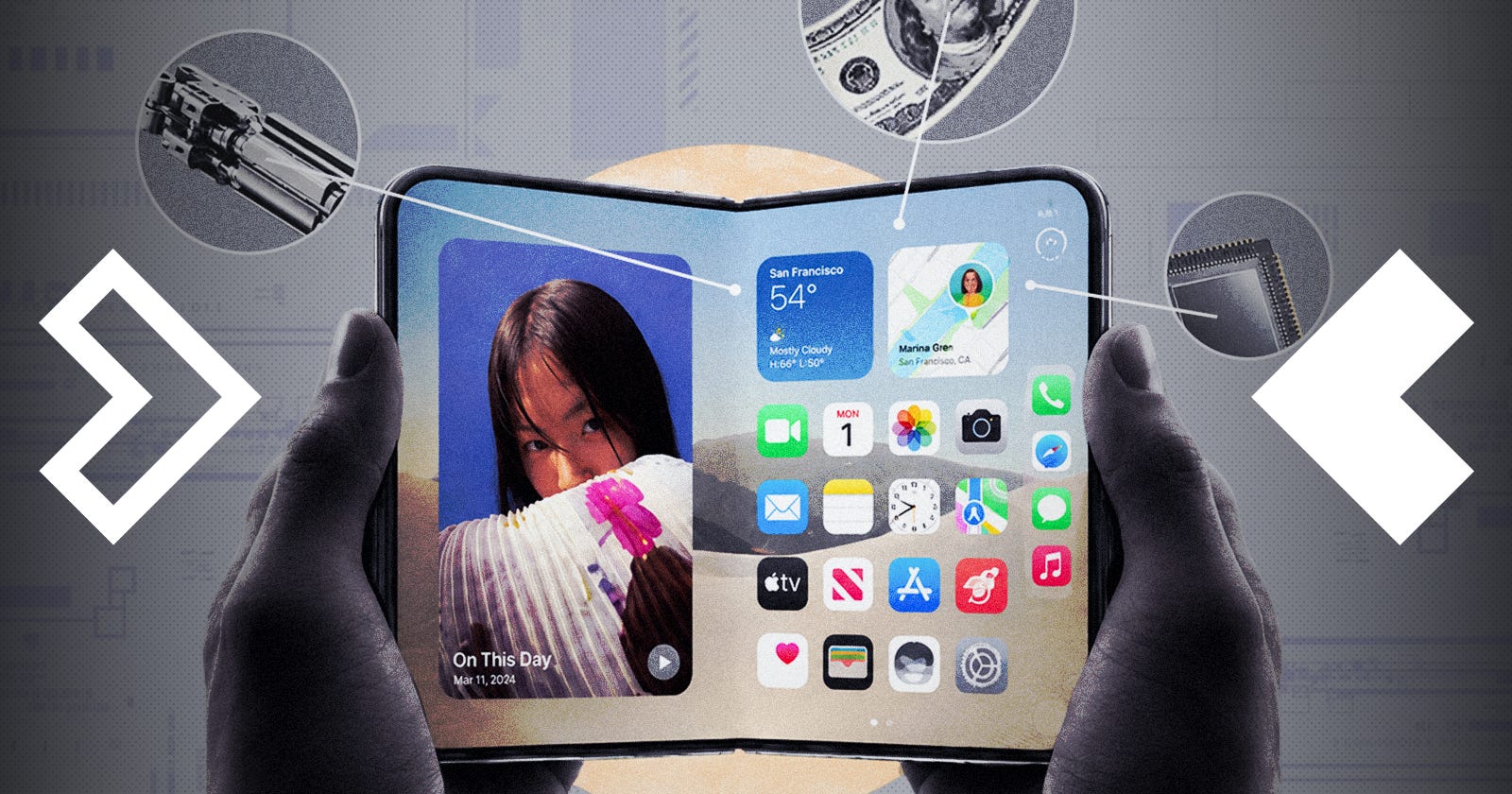
With the arrival of iPhone Duo, the global foldable-phone war has a decisive battleground: China. Apple, Samsung, Xiaomi and Huawei will compete in one of the world’s largest smartphone markets. Their fortunes there will help determine whether foldables become a substantial business—or remain an expensive niche.
Apple seems to have borrowed a page from America’s world-war playbook: join late, bring better hardware. Samsung and Huawei launched foldables in 2019; Apple waited until 2026. But arriving seven years later also raises expectations. Apple’s hardware has to justify the wait.
Its requirements—minimal creasing, durability, a flat display, thin construction and reliable manufacturing yields—have pushed suppliers hard. Many of the companies supplying its newest weapons are Chinese.
The Price of Arriving Late
Apple’s development demands fall into five categories:
An almost invisible crease. The approach combines a matte finish with ultrathin glass, or UTG. Glass helps address weaknesses associated with earlier polyimide-based covers, but processing sheets just tens of micrometers thick is difficult. This does not eliminate polymers: Apple’s finished display still has a polymer surface layer.
More than 100,000 folds. Reported development targets went beyond surviving repeated opening and closing. The screen also had to retain its appearance afterward. Mechanical endurance means little if the crease becomes increasingly obvious.
A surface flat enough to write on. The Information reported in 2024 that Apple wanted a foldable display without a central ridge or depression that would interfere with Apple Pencil. That report concerned an iPad prototype, but the same challenge applies here. Duo’s Apple Pencil support is scheduled for later this year.
Almost no room to spare. At 5.2mm unfolded, Duo leaves little space for its internal components. Its eSIM-only design eliminates a physical SIM tray, helping preserve precious room.
An approximately 85% hinge yield. Counterpoint identified this target during development, alongside yields of roughly 65% at the time. Producing an impressive prototype is one thing; producing enough acceptable hinges is another.
Those requirements slowed Apple while Huawei and Samsung improved successive generations. They also gave Chinese suppliers years to refine the manufacturing processes Apple now needs.
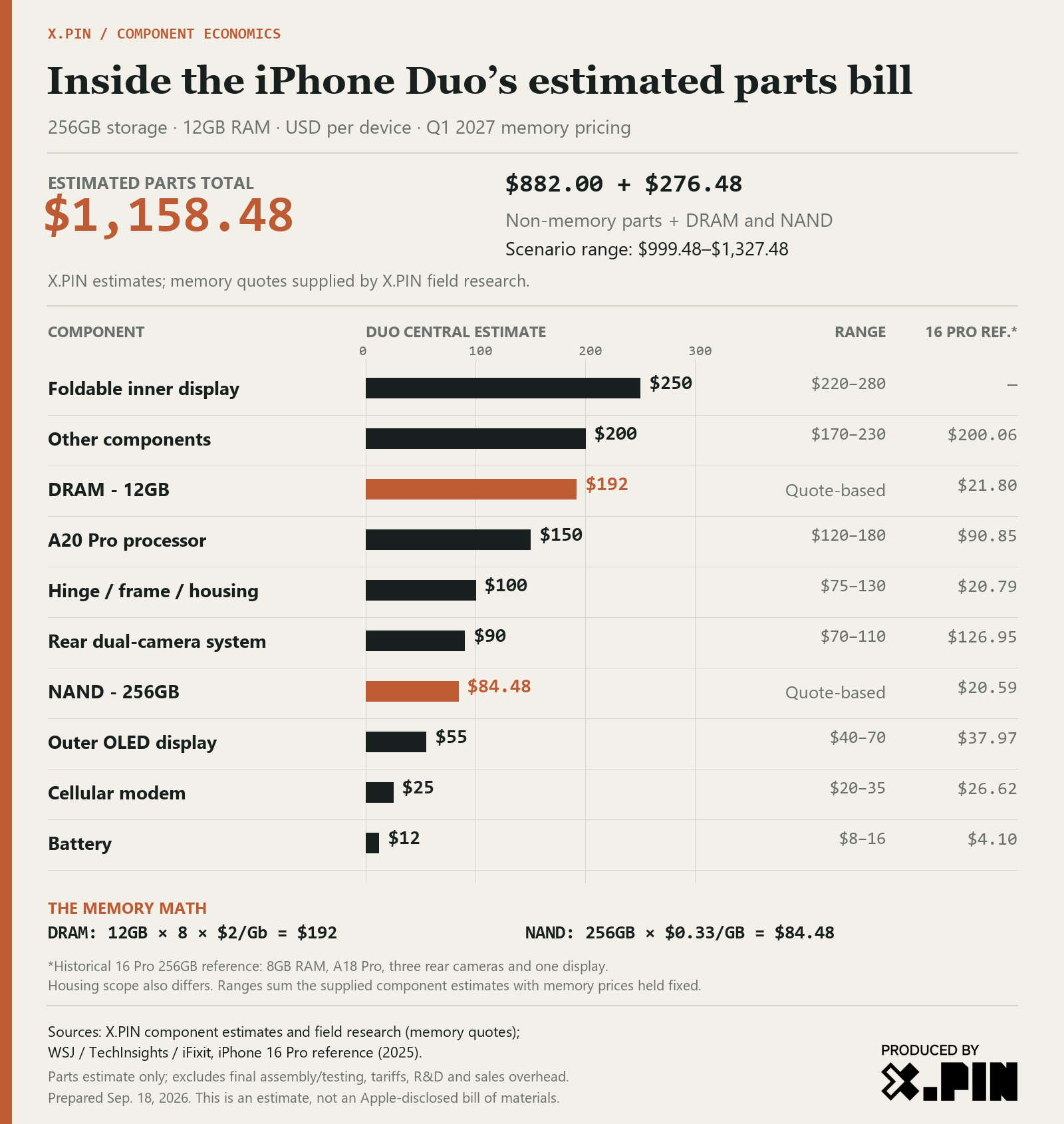
Samsung’s Q1 2027 quotes put DRAM at $2/Gb and NAND at $0.33/GB, up 30–40% from Q3 2026. That means roughly $277 for 12GB of RAM and 256GB of storage. The squeeze also affects iPhone 18 Pro: its memory costs—not retail price—reportedly rose nearly 400%.
My estimates put the complete inner-display module at $250, the outer display at $55 and the hinge above $75. Together with the other components and manufacturing expenses, these produce a midpoint cost estimate of $1,214 against a $1,999 starting price. The implied hardware spread is about 39%, not an Apple-disclosed gross margin; it excludes expenses that a teardown-style model cannot reliably capture.
Strip out memory, and the biggest cost centers are the inner display, A20 Pro, and the hinge-and-enclosure assembly. That points to a more useful investment question than simply listing “foldable iPhone stocks”: which suppliers have meaningful exposure, and which merely benefit from the association? I will leave chip foundries such as TSMC aside.
The Glass Behind the Fold
The inner display is less a single component than an extraordinarily thin layer cake. Glass sits above and below the OLED panel, adhesives hold the structure together while accommodating movement, and a titanium plate provides support. A protective polymer layer and Apple’s nano-texture finish sit on top.
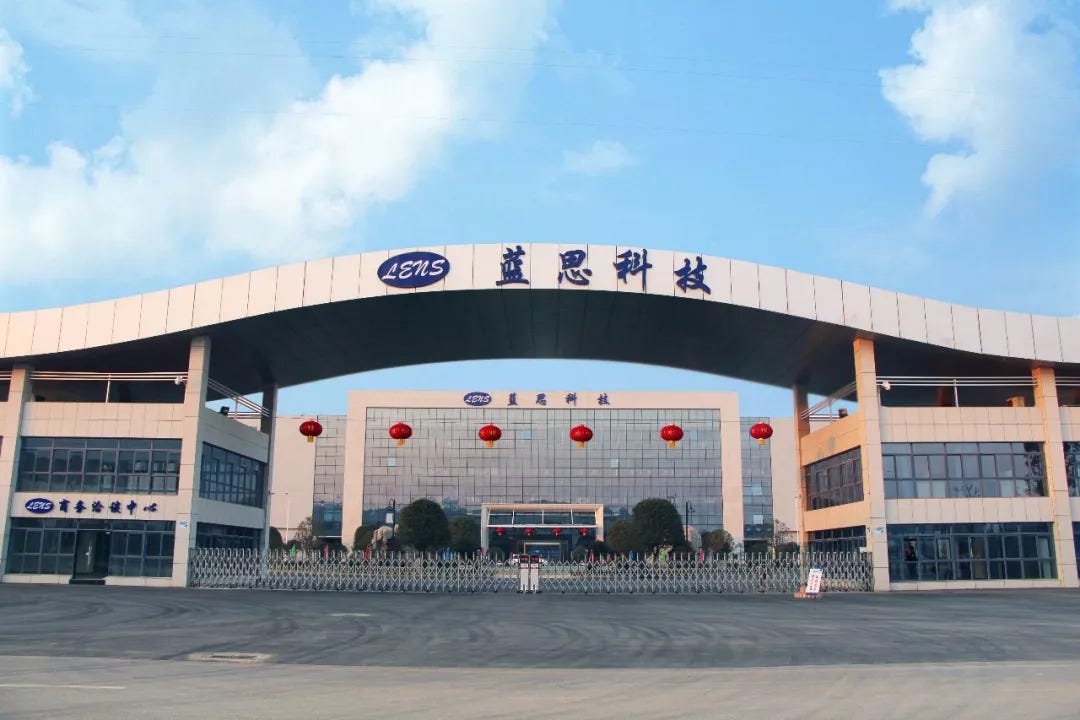
Lens Technology is expected to be the principal UTG processor, with BIEL Crystal a potential alternative. Processing glass at roughly 30–50μm without breaking it is the central challenge.
Lens’s expertise includes protective films used during hydrofluoric-acid etching, a process for thinning glass. Its patents document that capability. The commercial advantage lies not simply in producing a thin sample, but in keeping breakage low enough to manufacture it consistently.
Analysts at CMB International have estimated that Lens could capture about 70% of Apple’s foldable UTG orders. That remains an analyst forecast, not a confirmed allocation.
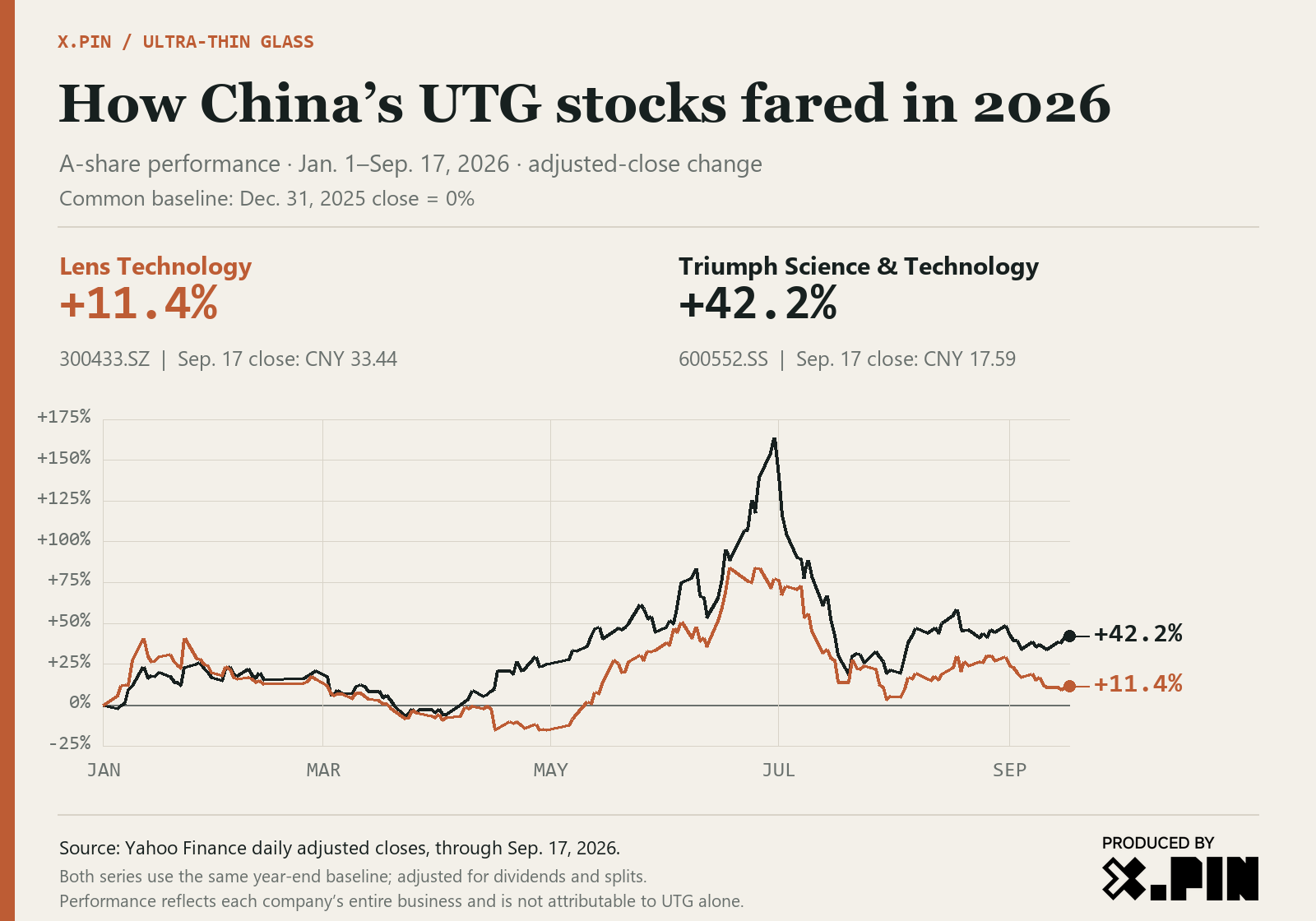
One possible upstream beneficiary is Triumph Science & Technology, a specialty-materials company under China National Building Material Group. Lens and Triumph have an established relationship, although that alone does not establish whose raw glass is used in every Duo display.
Germany’s SCHOTT has long been important to the UTG supply chain. Triumph’s work with Huawei helped establish a domestic alternative, including materials used in HUAWEI Mate XT ULTIMATE DESIGN. That gives Chinese processors access to a nearby source of specialized glass.
It remains unclear whether Lens’s role is limited to processing or extends further through the display assembly. Nor should a possible raw-material relationship be mistaken for a confirmed Apple contract.
My revenue estimate uses $100 per set and assumes a longer supply period than the initial shipment window. On that basis, Duo-related business could generate $400–600 million for Lens. This is not a forecast derived solely from the first 5–7 million phones.
Everything Hinges on Yield
The hinge supply chain has already undergone a reshuffle. Metal injection molding, or MIM, and precision metal components make manufacturing yields a constraint on production. Apple’s disclosed use of a 3D-printed hinge cover adds another specialized manufacturing requirement.
Supply-chain reporting identifies U.S.-based Amphenol and Taiwan’s Shin Zu Shing, or SZS, as contenders, with SZS taking the leading role after Amphenol struggled to meet yield requirements.
SZS already makes hinges for notebooks and audio products. A new iPhone program would arrive at a useful moment: its revenue fell 12.5% in the first eight months of 2026. Rival Jarllytec’s exposure to Huawei foldables illustrates the opportunity available to hinge suppliers beyond the slower-growing PC market.
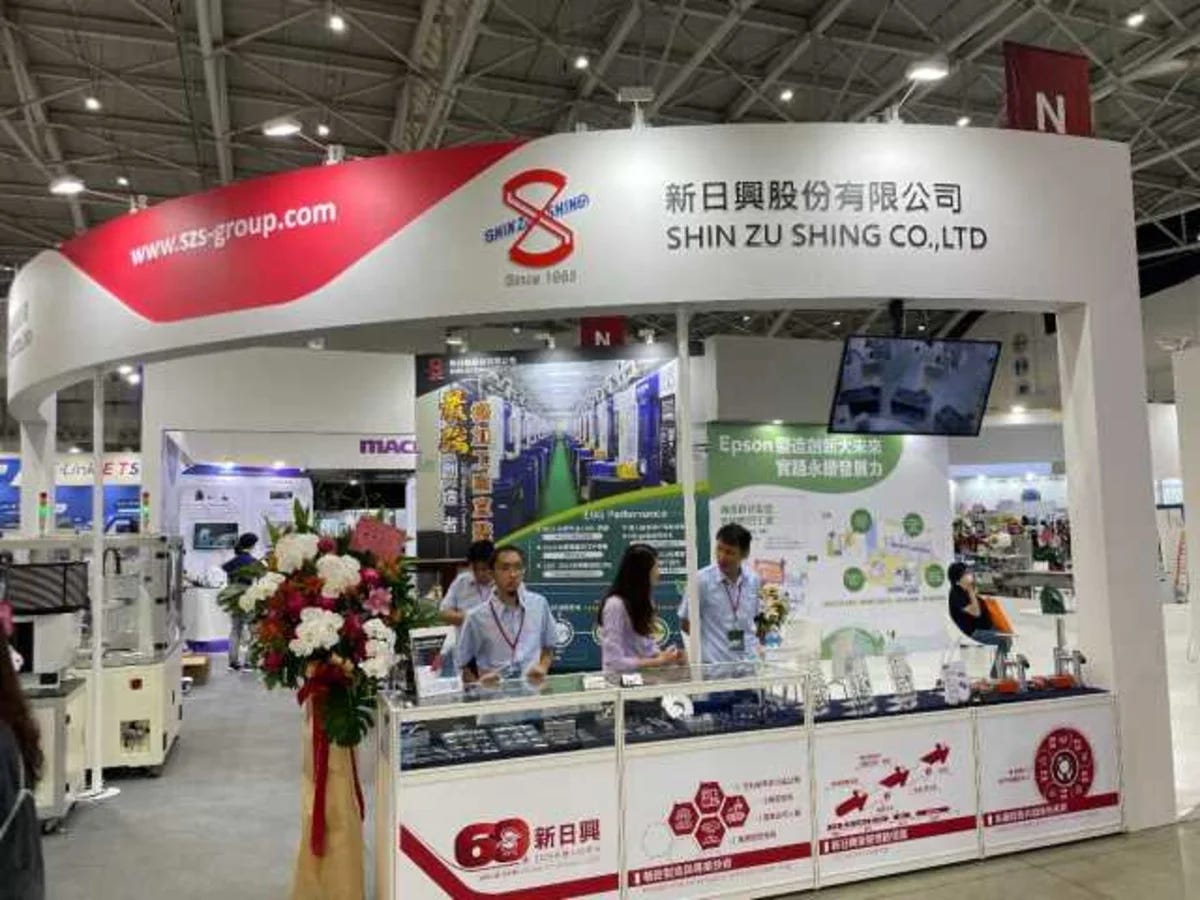
But being selected does not mean production is running smoothly. Reports that SZS is screening individual components for acceptable “golden samples” suggest that consistent yields remain elusive. Apple has an obvious reason to cultivate alternatives.
Among mainland companies, LY iTECH has declined to identify customers when asked about Apple orders, citing confidentiality agreements. Investors may interpret that as suggestive, but an NDA is not confirmation. The company’s precision-manufacturing capabilities also make it a potential supplier of titanium display-support components.
Materials add another complication. In 2025, analyst Ming-Chi Kuo predicted extensive use of liquid metal in Apple’s foldable hinge. Here, “liquid metal” means an amorphous alloy that is solid at room temperature, not a fluid inside the mechanism. Turning its material properties into consistently manufactured, tightly toleranced components is the difficult part.
Dongguan Eontec has disclosed progress involving P1 and P2 engineering samples and efforts to secure volume production. Those milestones matter, but they do not establish a confirmed Apple mass-production order. They also cannot, by themselves, prove whether Apple has adopted or rejected the material elsewhere in the assembly.
Jiangsu Gian Technology, meanwhile, specializes in MIM precision components. Its capabilities fit the manufacturing demands, but technical suitability and confirmed order volume are different things.
Mainland suppliers are deeply embedded in the foldable supply chain. In hinges, however, much of their exposure remains one tier below the companies delivering complete assemblies. That distinction matters when estimating how much revenue actually reaches each supplier.
China Will Decide the Winners
Ultimately, all these supplier forecasts depend on how many Duos Apple can sell—and build.
The 5–7 million-unit range circulating in market forecasts is plausible as a demand scenario. Counterpoint’s May forecast put 2026 shipments at 6.6 million, explicitly assuming a smooth production ramp. Some of those buyers will inevitably come from competing brands.
The inner display and hinge could keep supply below that potential. My supply-chain checks suggest that, while Apple and its manufacturers fine-tune production, qualified output is only a few hundred phones a day.
More than 500,000 units delivered to Apple in Q3 would therefore be an ambitious target requiring a substantial ramp—not an estimate of retail sales. Consumer availability begins October 23. Whether daily production can move beyond 10,000 units in Q4 will be a crucial test, though merely reaching that threshold would not deliver several million phones before year-end.
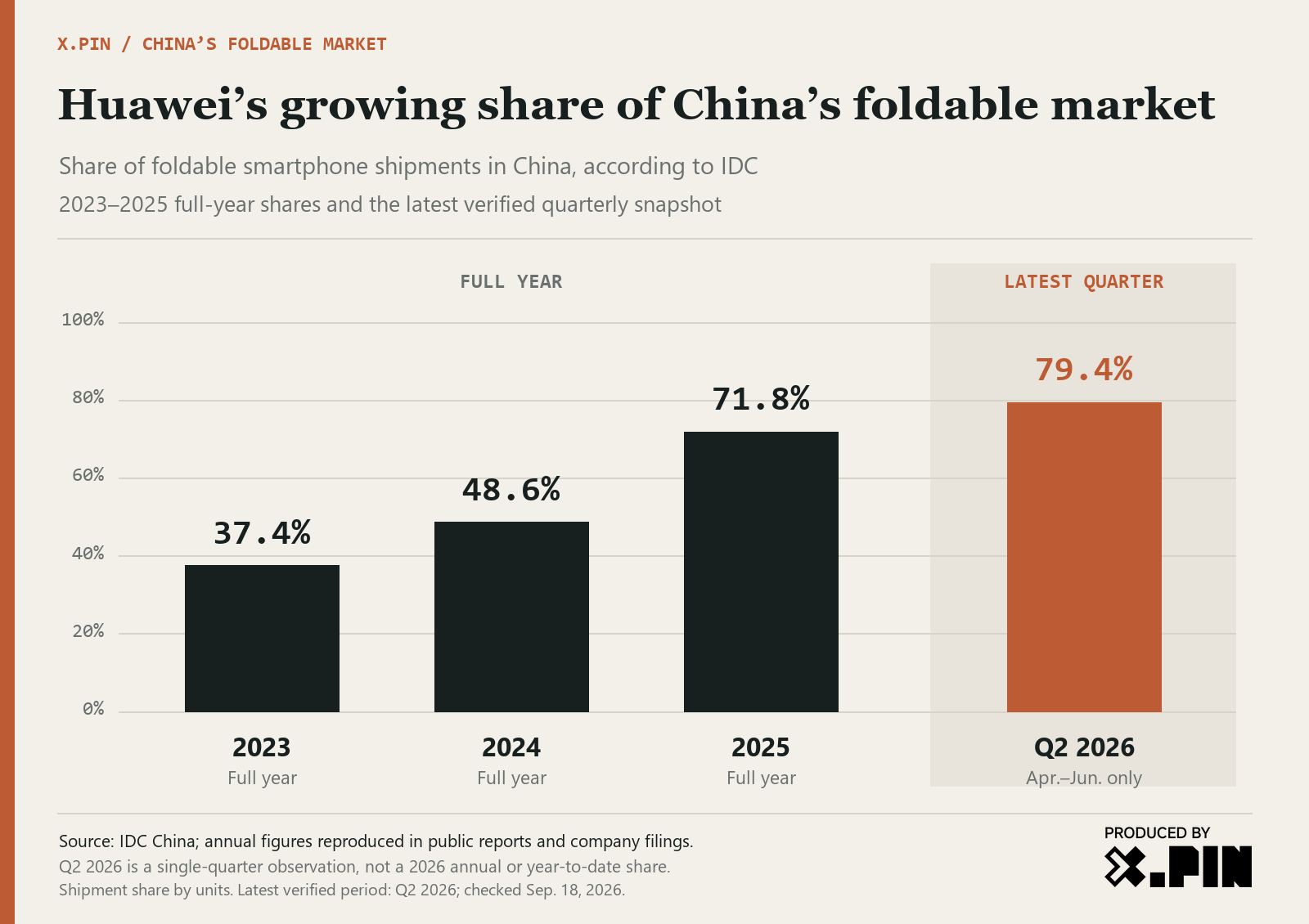
In China, Apple’s unavoidable rival is Huawei. IDC figures put Huawei’s share of China’s foldable market at 37.4% in 2023 and 71.8% in 2025.
Samsung is a marginal player there. The damage from its handling of the Galaxy Note 7 battery crisis remains part of the story, alongside formidable domestic competition. As other brands reconsider expensive foldable programs, Huawei has gained room to consolidate its position.
The irony is that Huawei’s long investment in foldables has created precisely the supplier base Apple can now draw on. Huawei has tested manufacturers across successive product generations and given the strongest ones sustained orders. Its combination of demanding specifications and attractive business increasingly resembles Apple’s.
In a 2024 interview, Triumph told me that it developed UTG materials with Huawei before supplying other handset makers. Those other customers generally preferred buying a mature solution to financing the early development of a new material.
That distinction matters. A supplier that helps fund and solve a difficult engineering problem needs a customer with the volume, patience and pricing power to make the investment worthwhile.
Huawei has also demonstrated how far China alone can take a foldable brand. IDC figures reported by the Associated Press put Samsung’s global share at 33% in 2024 and Huawei’s at 23%—a gap of 10 percentage points.
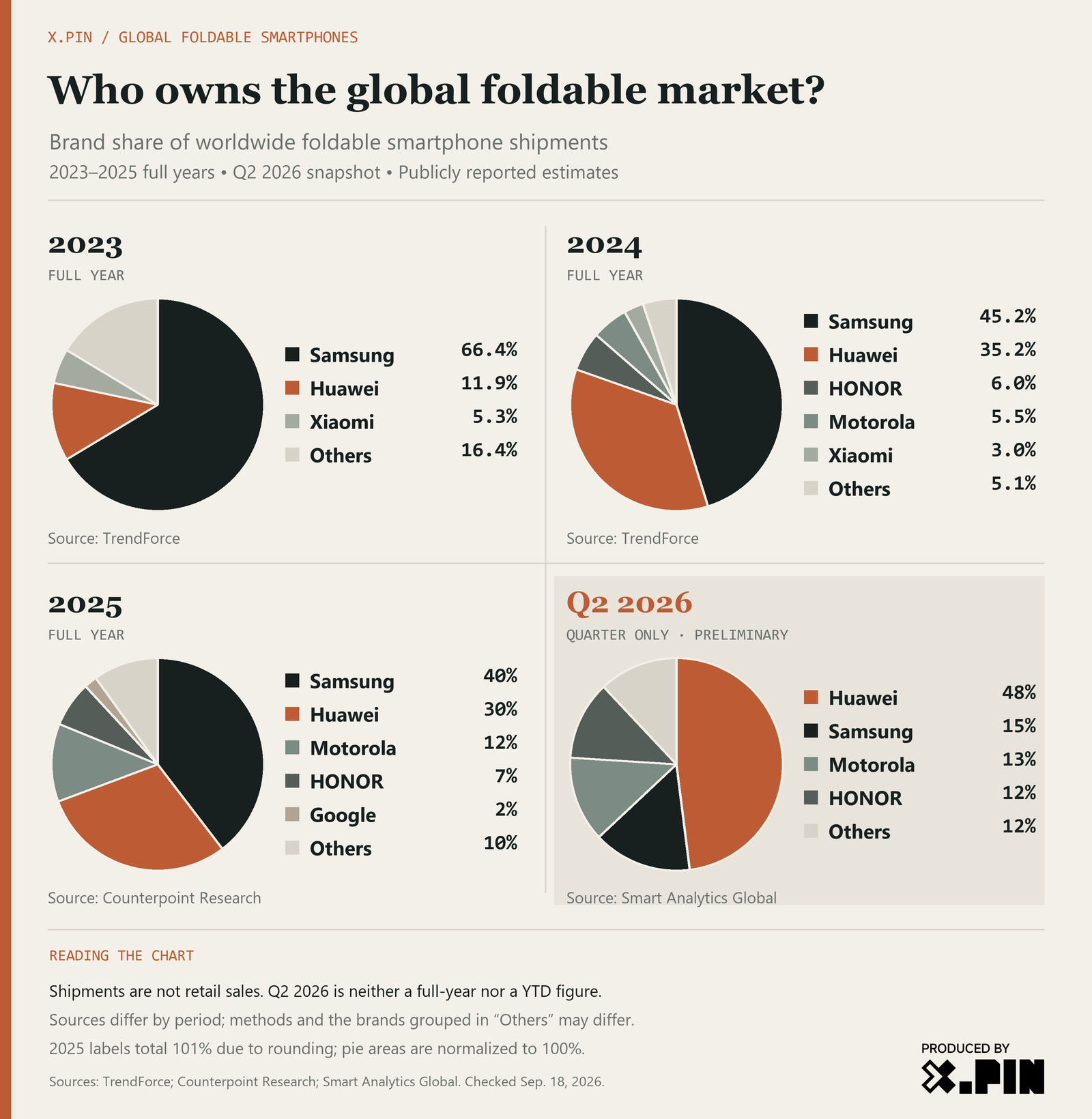
Roughly 6 million Duos would give Apple more than a fifth of the global market under current forecasts. China represented about 44% of worldwide foldable shipments in 2025, according to Counterpoint. Apple’s reception there will therefore be central to its global prospects.
For mainland suppliers, the likely outcome is a widening divide. Those serving Apple and Huawei are best positioned to secure large orders at attractive prices. Suppliers tied to weaker brands may face smaller production runs and repeated demands for price cuts, leaving too little profit to sustain development.
My expectation is a global market increasingly dominated by Samsung, Huawei and Apple. In China, the decisive contest will be between Huawei and Apple.
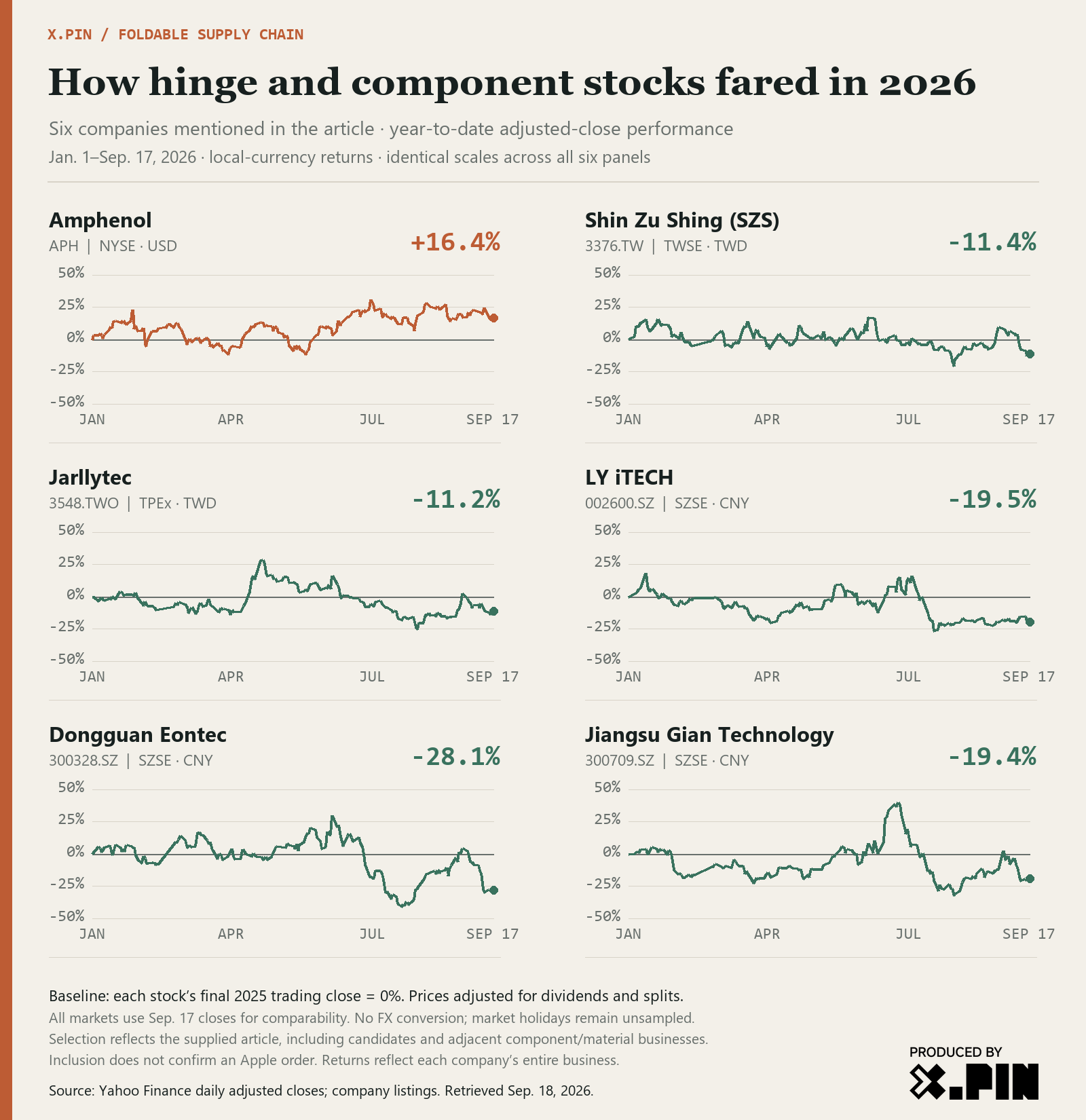
The supplier share-price charts accompanying this analysis reflect more than foldable demand. Money moving into and out of AI, semiconductor and consumer-electronics stocks also affects their performance. A rising share price is not evidence that a factory has solved its yield problems.
The real questions are simpler: Will consumers pay $2,000 for an iPhone Duo? And can Apple make enough of them quickly enough?
Or you could just buy Apple.
