



On August 25, shares of Unitree Robotics, China’s best-known robot maker, were trading 45 per cent below their post-IPO high. The company had listed in Shanghai at a valuation of roughly $8.5 billion, only for its stock to surge 629.4 per cent on the first day, briefly making Unitree a $61.8 billion company. When almost half that value disappeared within a week, angry investors began asking whether Unitree itself was a bubble.
Some users compared Unitree founder Xingxing Wang with Hui Ka Yan, the founder of China Evergrande Group, whose property empire accumulated some $278 billion in liabilities before he was sentenced to life in prison. They argued that Wang was building a fraud of similar proportions.
But the sell-off says less about the quality of Unitree’s robots than about the market surrounding them. Unitree manufactures real products, earns a profit and leads China’s robotics industry. However, is that Unitree’s share price is no longer only about Unitree. The company has been forced into the role of pricing anchor for China’s entire humanoid-robot industry.
Unitree’s Stock Is Not Unitree
When a company’s shares rise more than sixfold, the natural assumption is that its founder must be celebrating a windfall. From my own encounters with Wang, that is not how he appears to see it.
At the 2025 World Robot Conference in Beijing, Wang attended a group interview with the media. As the session ended, a reporter asked how he viewed a potential IPO. He answered with characteristic reserve: “For us, an IPO is like the college entrance exam. It gives the company’s early investors a reasonably good outcome.”
Right up to the listing, Wang described going public primarily as a way to give venture investors an exit. What he clearly underestimated was the complexity of China’s secondary market—and, in particular, Shanghai’s STAR Market.
Launched in 2019, the STAR Market was designed to help frontier-technology companies raise capital. That mandate has also made the board a magnet for speculation. Regulators scrutinize applicants more closely, and relatively few are allowed through. In the first seven months of this year, just 21 companies listed in Shanghai, compared with 104 in Hong Kong.
The STAR Market comes with an elaborate set of guardrails intended to contain risk and keep the focus on fundraising:
An IPO typically floats only a small portion of a company’s equity, often around 10%, limiting the ability of controlling shareholders to cash out early.
Founding shareholders face a 36-month lockup, preventing founders with large stakes from freely selling their shares.
Strategic placement investors, including national industrial funds and local state-owned investors, cannot exit easily.
There is no daily price limit during a stock’s first five trading days, allowing institutions to establish a market price.
Individual investors must hold at least about $69,000 in financial assets and have two years of investing experience to trade directly on the board.
Anyone familiar with equities will recognize the paradox: The restrictions meant to control risk can intensify the bubble. Few investors are eligible to trade, only a sliver of the company’s shares are liquid, and prices are unconstrained during the first five sessions. That combination encourages frantic turnover and sudden price spikes.
Unitree has 404 million shares outstanding. At the start of trading, only 30.09 million unrestricted shares were available, or 7.44% of the total. About 90% of the offering had been allocated offline. Eleven institutions submitted bids worth roughly $125 million over the course of a week and secured most of the shares on offer.
On its first day, Unitree’s turnover rate reached 85.28%, with $3.22 billion worth of shares changing hands. In effect, nearly the entire free float was recycled in a single session. Chinese trading data showed a net inflow of about $613 million through “extra-large” orders, while large and medium-size orders recorded net outflows of roughly $308 million and $304 million, respectively. It was the most extreme order-flow split anywhere in the A-share market that day.
The implication is hard to miss. Institutions and investors who received IPO allocations passed richly priced shares to individual buyers on day one. Once the supply of fresh money thinned out, the 629.4% rally could not hold. The subsequent 45% decline was dramatic, but it was also a move back toward something resembling a normal valuation.
Wang did little to keep the frenzy alive. On the second day of trading, he told the 2026 World Robot Conference that robotics may still be five to 10 years away from a “ChatGPT moment” in which machines can learn and improve autonomously. If he had wanted to inflate the bubble, he could hardly have chosen a less promotional message.
Another piece of the story has received little attention in Western coverage. On August 24, the Shanghai Stock Exchange held talks with brokerages and pressed them to tighten standards for loss-making, low-quality listing candidates. The new approach would favor the three leading companies in each industry and rely more heavily on invitations initiated by regulators, further reducing the number of businesses able to list.
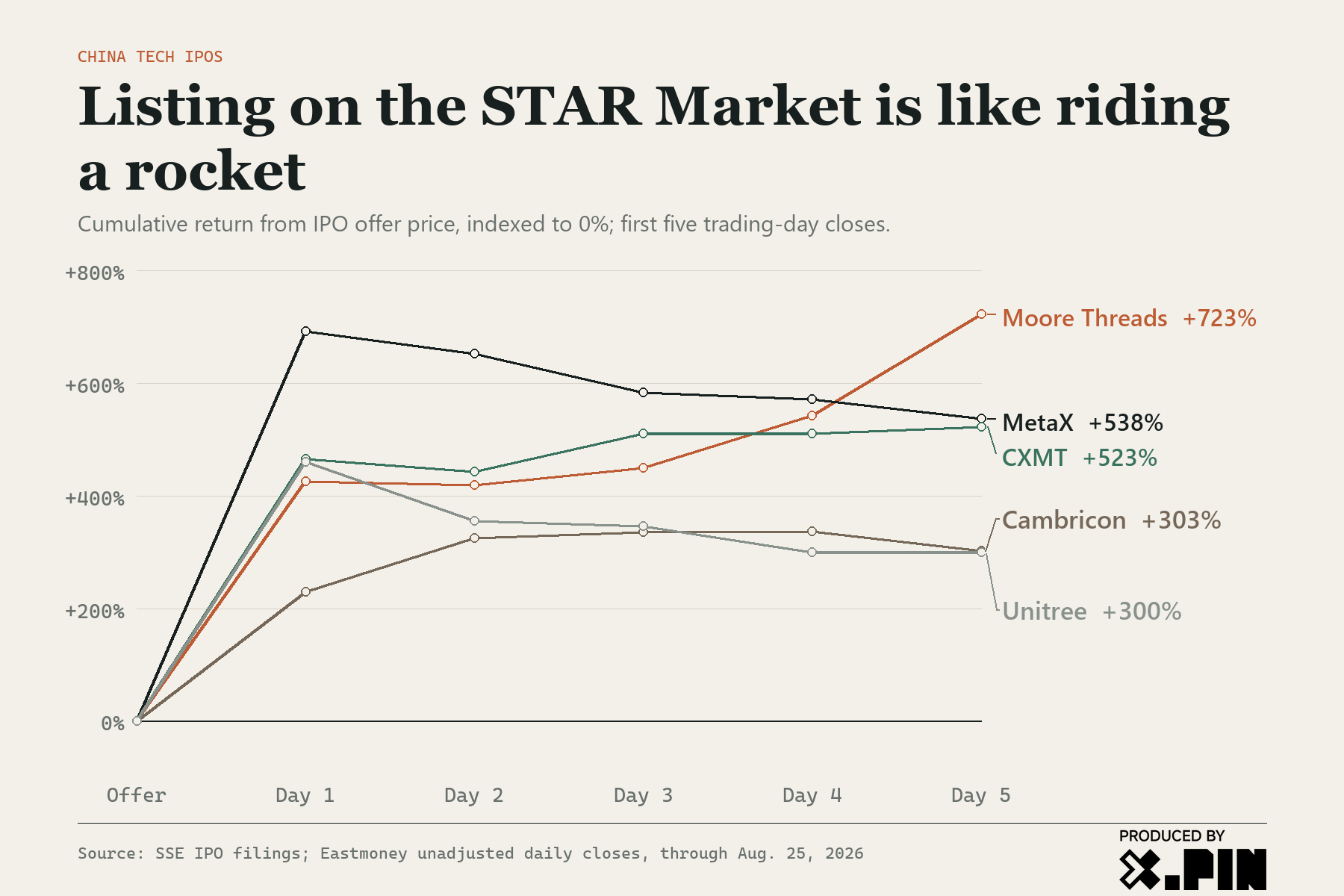
In my view, this model will make the bubble in technology shares larger, not smaller. Look at the trading patterns of Cambricon Technologies, Moore Threads, MetaX and CXMT. On the STAR Market, a company with a pioneering technology or a dominant position in its industry can expect an extraordinary first-day surge simply because it made it through the gate.
From $8 Billion to $33 Billion
Before Unitree listed, I made a rough estimate of what the company might be worth.
Unitree reported 2025 revenue of about $236 million. Net income attributable to shareholders was approximately $38.6 million, while adjusted net income was around $82.1 million. Apply an earnings multiple of 60 to 80, assuming current margins hold, and the company would be worth roughly $4.9 billion to $6.9 billion. If profits continue to rise, the valuation could approach $8.3 billion. That is an optimistic estimate, but it is also broadly consistent with Unitree’s IPO valuation.
Another approach produces a similar result. On a trailing basis, battery giant CATL trades at about 25 times earnings, while surveillance-equipment maker Hikvision trades at about 22 times. Factor in Unitree’s growth of nearly 50% and assign it a premium for its dominant industry position, and a valuation of $7.6 billion to $8.7 billion looks defensible.
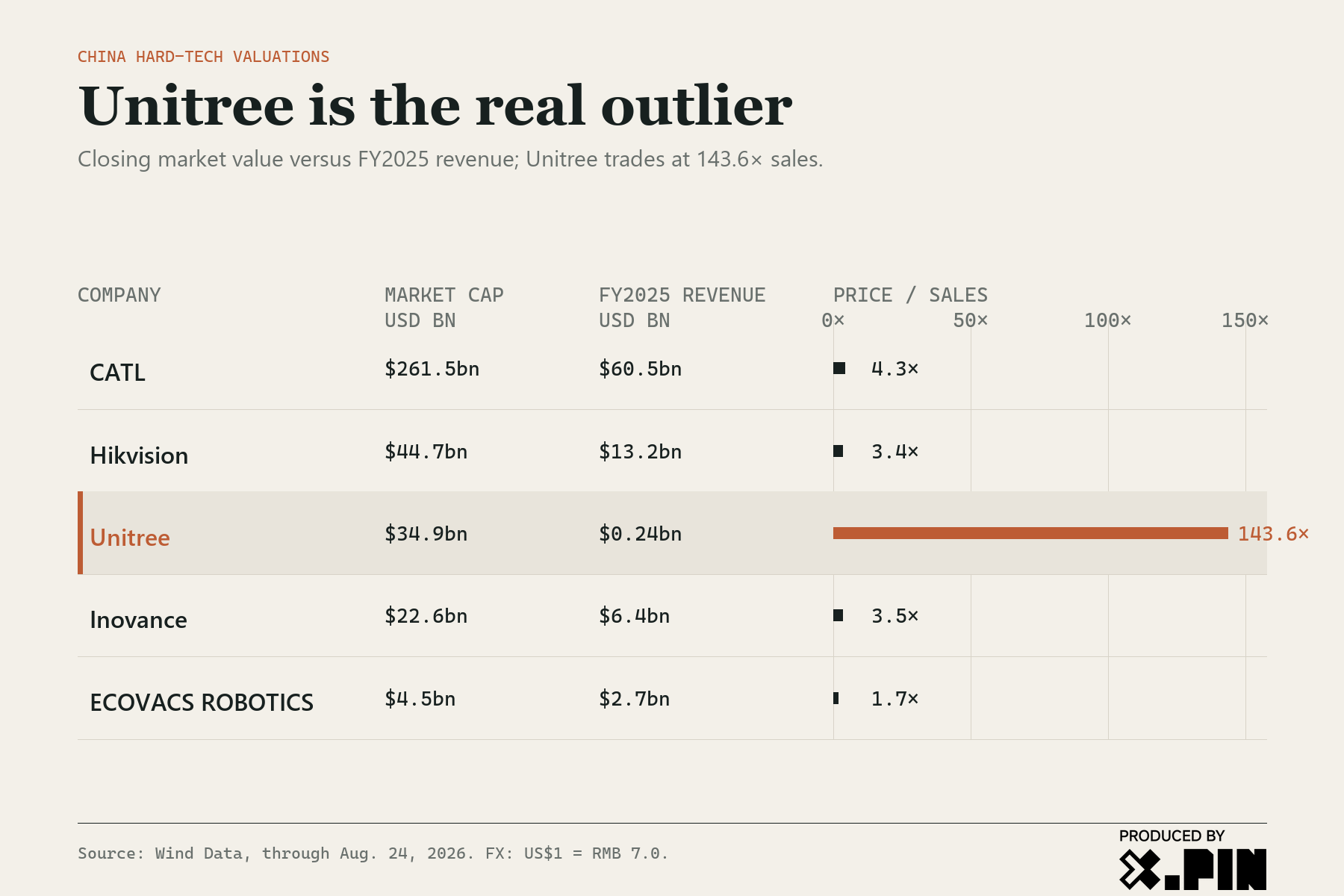
The market has moved far beyond that range. Even after the 45% drop, Unitree was still worth roughly $33.7 billion. If investors valued it only as a robot manufacturer, its market capitalization would be about 300% above a reasonable estimate.
Who is supporting such an extreme price? Once again, the answer is institutional capital. CCB International, using a target multiple of 32 times 2026 sales, arrived at a valuation of roughly $15.1 billion. Nomura gave the stock a buy rating and set a price target of about $51.40, implying a market value of approximately $20.8 billion. The STAR Market’s trading constraints can support a premium, so Unitree may plausibly remain worth more than $13.9 billion. A value of $33 billion, however, will be difficult to sustain.
Who, then, needs Unitree to be worth more than $27.8 billion? Wang has already supplied the answer: venture-capital investors.
Unitree’s investor roster expanded rapidly beginning in 2024, and its private-market valuation jumped from about $431 million to $1.76 billion. That was also the year Unitree introduced the G1, China’s first humanoid robot to be openly sold and delivered at scale. The launch triggered a rush for stakes in the company. Investors who could not get into Unitree backed its peers instead—or funded robotics startups assembled by teams crossing over from other industries, especially automotive. Within two years, some of those companies had reached valuations of around $1.4 billion.
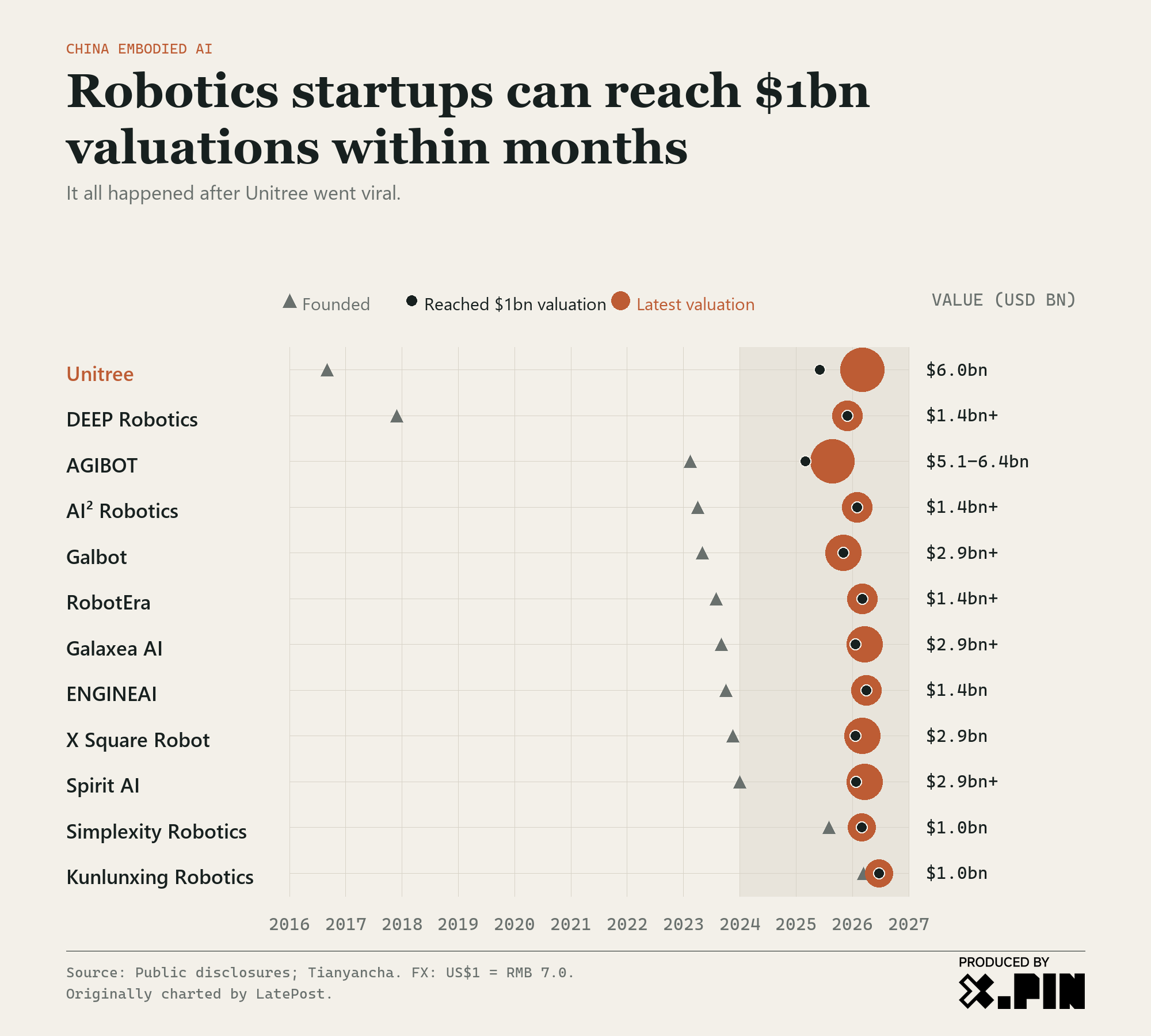
If Unitree controls 32.4% of the global robot market and deserves a $33 billion valuation, then another company that has shipped only a few hundred robots can still claim to be worth several billion dollars. A venture fund may not have billions in cash, but it can own a miniature version of Unitree. The higher Unitree trades, the more valuable every other robot stake on the fund’s books appears to be.
The reverse is just as important. If Unitree’s market capitalization falls to $13.9 billion, the valuations of other Chinese robotics companies become much harder to defend. Caixin has estimated that between 30 and 50 privately held robot makers are preparing to list in Hong Kong. Many were valued at several billion dollars before turning a profit. Their only credible exit is an IPO, and Unitree’s listing has accelerated the countdown.
One fact rarely mentioned by Western media is that only 152 days passed between the acceptance of Unitree’s IPO application and the start of trading—a record under the STAR Market’s “pre-review” mechanism. Other robotics companies cannot count on approval that fast. In the meantime, the private shares held by their backers are constantly at risk of being marked down.
Are Robots Really Just Toys?
Investors who bought Unitree or robot-themed shares have every right to be angry. They discovered that today’s humanoids are not yet mechanical servants and that many still need to be operated with a controller. Some have channeled that frustration into calling these early machines “remote-controlled toys,” shorthand for something crude, unremarkable and badly made.
That criticism badly underestimates Unitree’s real strength.
Robots are difficult to manufacture. Their reducers, motors and lead screws often have to meet far tighter requirements than ordinary industrial components. During an experimental production run, a young robot company may need parts for only a few hundred units. Most contract manufacturers have no interest in taking an order that small.
I have interviewed Zheyuan Jiang, founder of Noetix Robotics, and Cheng Hao, founder of Booster Robotics. Both told me that their current monthly production capacity tops out at a few hundred machines. In both cases, the production floor sits close to the R&D office. That may sound more like a workshop than a modern factory, and in some ways it is: Robot makers must design and assemble basic components themselves or spend enormous time and effort persuading suppliers to customize them.
This also helps explain the rough-looking internal wiring in some Unitree machines. Wang has followed a consistent engineering principle: Get the robot to operate reliably at the lowest possible cost. Unitree has developed the high-torque motors unique to robots in-house and has at times obscured identifying marks on sourced components. Customizing parts through outside suppliers can require more than $13.9 million in upfront adjustment costs. Only inexpensive components and high shipment volumes can bring the unit cost down.
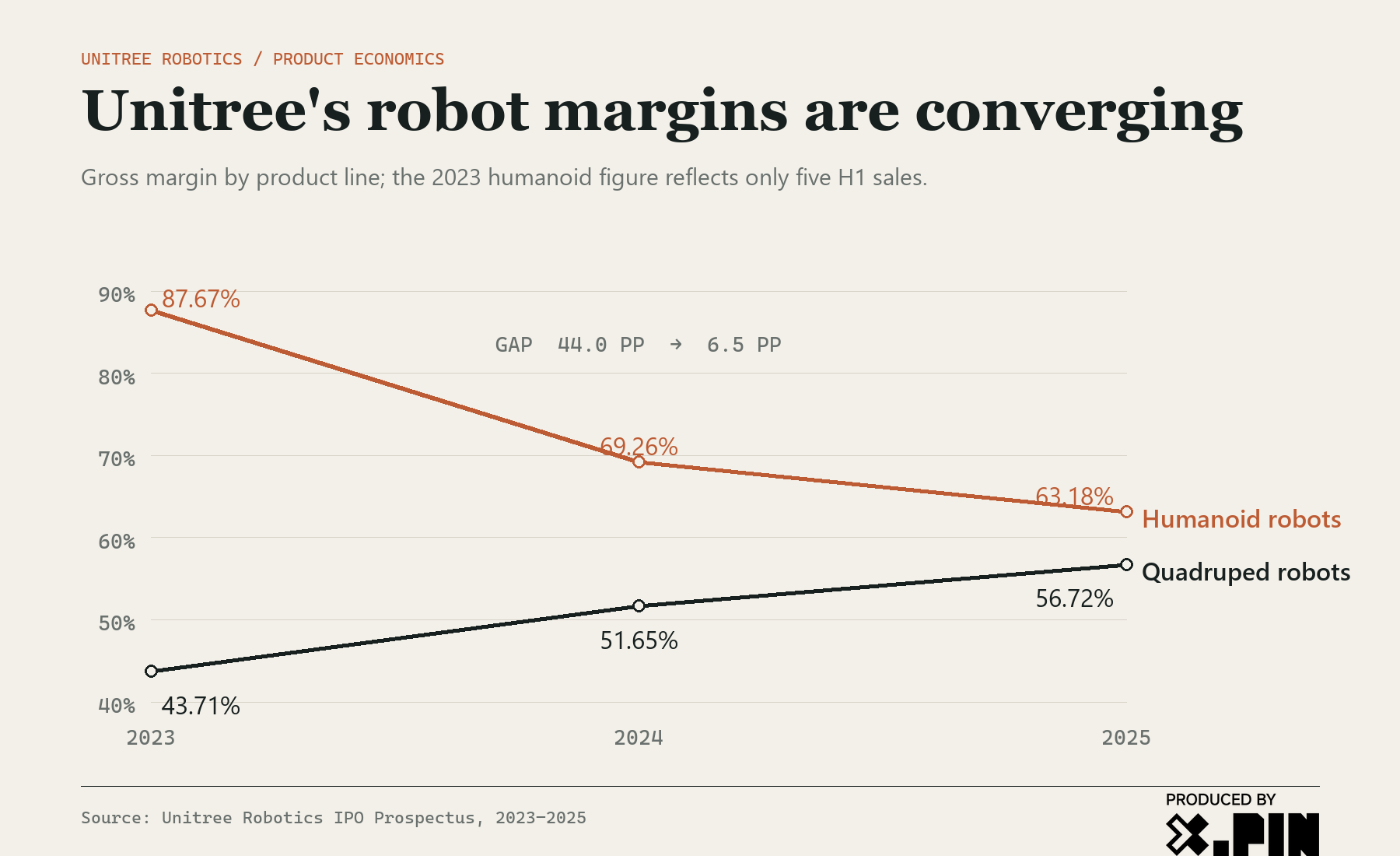
That is a very different proposition from building a remote-controlled toy. Unitree is the only company in China’s robotics industry willing to publicly report gross margins of 60%. It has also submitted financial statements showing that it can make a profit.
A robot is a physical product, and physical products require real customers and dependable delivery. Actual orders are the ultimate stress test for any valuation. Even at a market value 300% above what its fundamentals appear to justify, Unitree remains the most useful public benchmark for anyone trying to invest in humanoid robotics.
According to its prospectus, Unitree shipped 5,511 humanoid robots, capturing 32.4% of the global market. Its quadrupeds hold a similar share, while the G1 has become a widely used research platform—not a toy.
But the revenue mix shows how immature the market remains. From January through September 2025, universities and research institutions generated $65.2 million, or 73.6% of Unitree’s humanoid-robot revenue. Research and education also contributed 31.58% of quadruped sales.
Commercial applications accounted for just 16.71% of combined robot revenue, mostly from inspection and guided-tour projects. Most Unitree humanoids are still headed for laboratories and classrooms, not factory floors.
The second criticism is that Unitree spends too little on R&D. The figure usually cited is about $20.1 million—less than the roughly $226 million spent by Barbie maker Mattel.
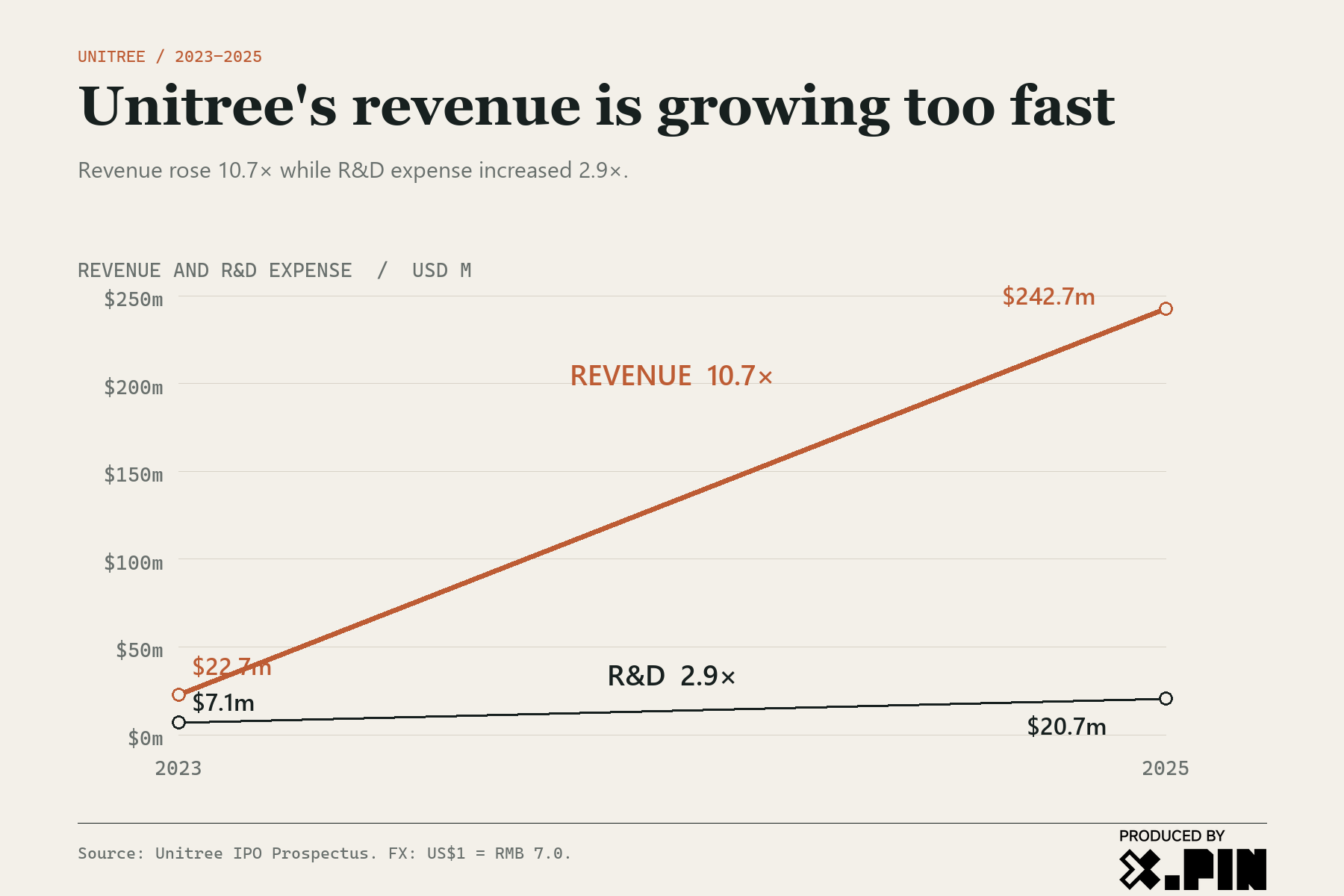
That comparison ignores the denominator. From 2023 to 2025, Unitree’s R&D expenses nearly tripled, from about $6.9 million to $20.1 million. Over the same period, revenue surged from $22.1 million to $236 million. R&D as a share of sales fell from 31.39% to 17.83% and then to 8.53%. The problem is not that Unitree stopped investing. It is that revenue grew far faster.
Unitree’s prospectus seems to support criticism that it spends heavily on promotion. In 2025, advertising cost about $9 million—42.87% of selling expenses and more than sales-staff compensation. Yet it represented only 3.56% of revenue, down from 4.41% in 2024. The high share reflects Unitree’s use of demonstrations, videos and events to market standardized products, rather than a diversion of R&D funding.
DEEP Robotics highlights the distinction. It spent 24.98% of revenue on R&D and just 2.74% on advertising. But its specialized inspection, firefighting and rescue robots require contract-by-contract sales and delivery support. Its overall selling-expense ratio was about 13%, higher than Unitree’s. The difference lies mainly in how the two companies sell their robots, not in their engineering ambitions.
Wang has said that, even before Unitree put a humanoid robot on sale, customers were offering to fund its development. That may help explain the sudden jump in 2025 performance. When demand explodes in a short period, the income statement can become distorted. Judged solely by R&D intensity, Apple spent 8.3% of revenue on research in fiscal 2025, while Tesla spent about 7%. Few people would argue that either company is less innovative than Unitree.
The composition of Unitree’s spending matters too. In 2025, compensation for R&D employees increased by about 48%. Spending on materials grew more than fivefold, while cloud services and computing expenses rose more than twelvefold. Salaries accounted for a smaller share of the total not because engineers were being paid less, but because the cost of materials and compute was rising much faster.
Robots Still Need Remote Controls
Wang’s expertise lies in motors and mechanical systems. He has been far less certain about how Unitree should develop foundation models for robots. The company began and then halted research into video-based world models in both 2020 and 2024. Only this year did it start publicly discussing a renewed effort to build self-learning models for its machines.
That helps explain why Unitree often chooses teleoperation in live demonstrations. Wang has acknowledged that current robots lack the intelligence models needed to match their physical capabilities. Demos released by rival manufacturers suggest that progress in locomotion has not been matched by comparable gains in fine manipulation, especially in the hands. Robots therefore remain unable to perform complicated tasks such as sorting differently shaped components quickly, smoothly and at anything close to human speed. For now, remote control is the most dependable way to operate them.
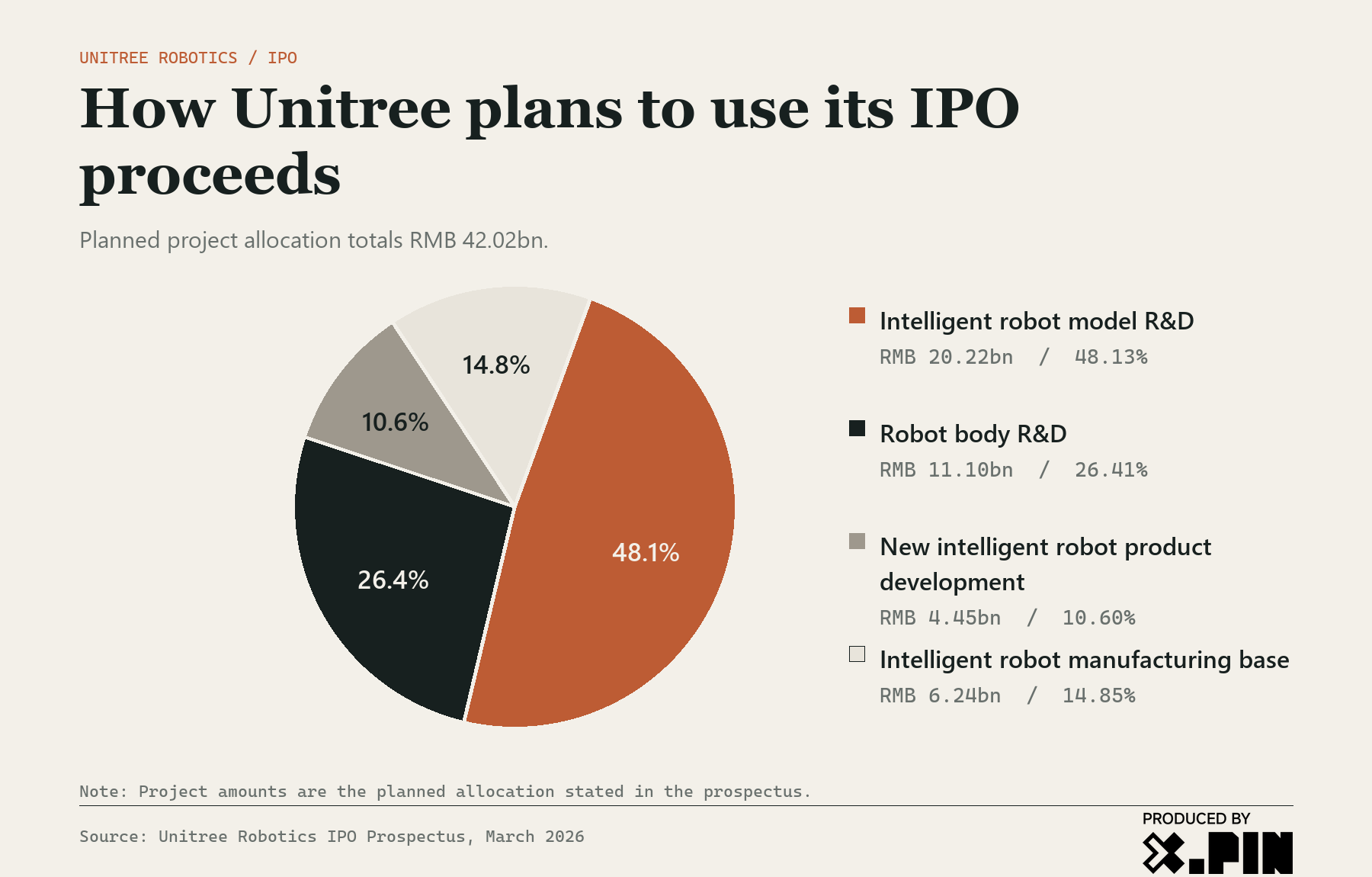
Closing that gap is also one of the main purposes of Unitree’s IPO. The company plans to spend approximately $281 million on an “intelligent robot model R&D project” over three years. Of that, about $55.8 million is earmarked for equipment and installation, $100.1 million for R&D personnel, and $124.9 million for implementation costs, including compute rentals, research materials and technical services.
At its IPO roadshow, Unitree confirmed that it had signed a memorandum of strategic cooperation with DeepSeek. The agreement covers joint research into general artificial intelligence, high-performance general-purpose robots and large AI models. When DeepSeek expands into embodied intelligence, it will give Unitree’s robots priority under otherwise equal terms. When Unitree needs model adaptation, inference access or integrated development support, it will likewise give priority to DeepSeek’s training services and technical solutions. DeepSeek, in turn, will provide support in areas including model architecture and AI-computing clusters.
This creates a possible path for Unitree’s valuation story to reverse. One possibility is a genuine breakthrough in the ability of embodied AI models to generalize across tasks. Another is the arrival of large, repeatable orders from industrial customers, rather than recurring purchases of robots as research and teaching tools. A third is that Unitree beats expectations for several quarters in a row and grows into its valuation the hard way.
So far, none of those signals has appeared.
The Bubble Belongs to the Industry
After Unitree’s robot videos went viral, Chinese robotics companies copied the same promotional formula. The result was an unrealistic public fantasy. Many vendors blurred the line between factory testing and commercial delivery, encouraging people to believe that robots were about to move rapidly into factories and homes. They made it appear as though physical agility and machine intelligence were advancing in lockstep.
The reality is almost the opposite. Humanoid robots are unlikely to enter factories at scale in the near term, and their intelligence remains far behind their ability to move.
That gap is also why the public has grown tired of Unitree. Many people assume it is no different from the companies producing carefully staged demos without real customers or reliable deliveries. They fear that Unitree will raise a huge sum of money and disappear. The question Unitree must answer is how quickly it can develop the next generation of robot customers. That does not erase the customers it already has.
There is an enormous bubble in robotics. But Unitree did not create it. The company itself does not appear eager to promote the frenzy. Capital will do that without its help.
Just look: Investors have already moved on to hyping world models.
In plain sight the cliff drop for these type of hyped tech IPO is rather obvious, not just in China but also US ( CXMT, SpaceX) it’s hard to value a tech company when there is so much to prove and yet little evidence to back it up just yet.
In China, it’s more difficult with the amount of stakeholders who looks to make a quick exit after investing in later stage series. They never had a long term perspective to the company it’s self and we also have many local governments who needs to make the return in time. No matter what initial IPO price bank set per share at the opening day it’s always going to pick up greatly but in the US there is a great story and a capital environment to supports story. In China it’s more tied up with results if you want to survive