


Just when everyone thought the Jensen Huang drama had finally run its course, another plot twist dropped last night.
The former Nvidia chief posted a long, emotional message pouring his heart out to the public. Right at the end, just as readers figured this was his final goodbye, Huang dropped a stunner: “If the board determines that my return serves the best interests of our shareholders, our employees, our company, and the United States, I would be deeply honored to answer those calls and return as chief executive officer.”
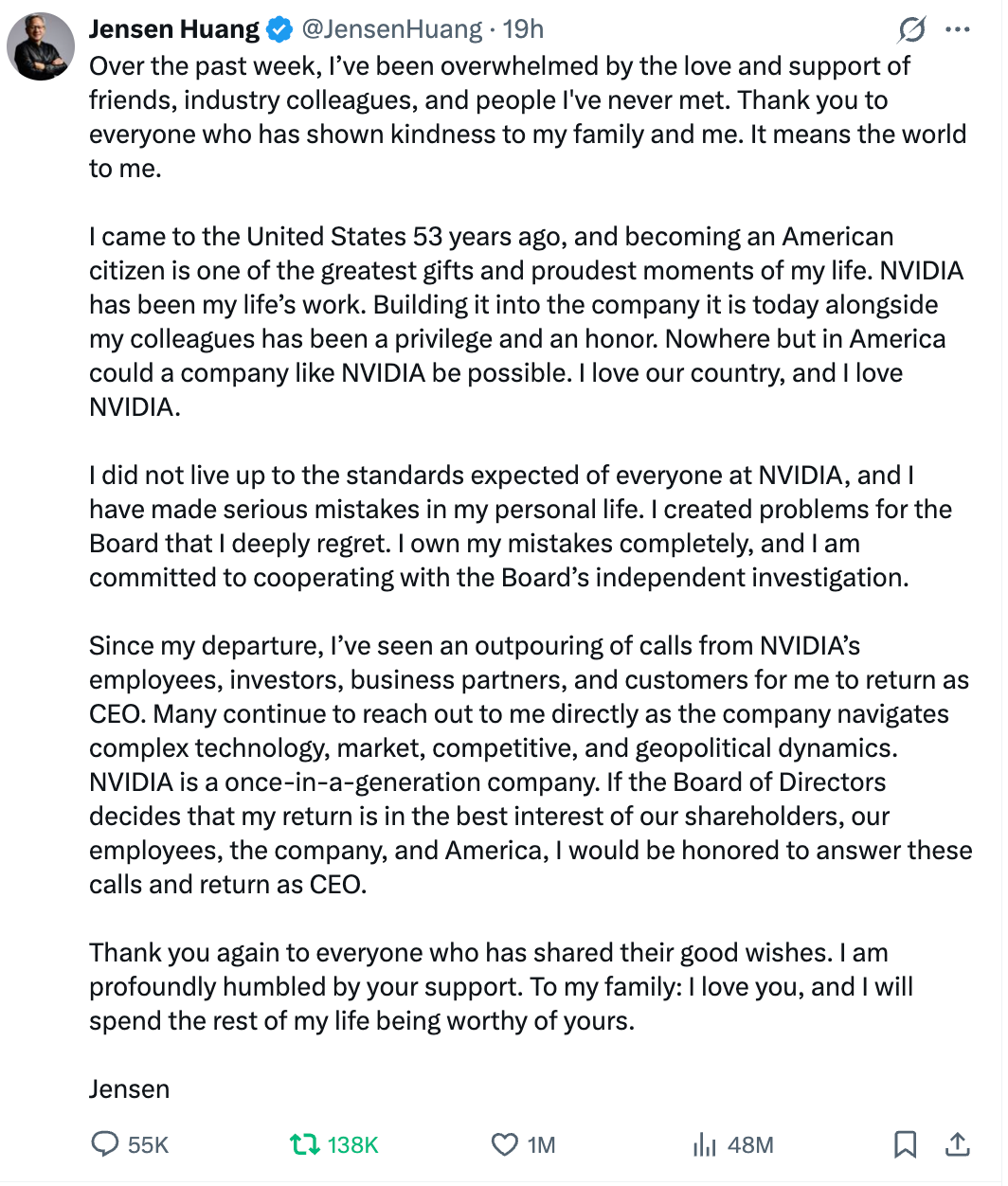
Wait. Could there actually be a comeback? Honestly, looking at how fast the narrative is falling apart, don’t rule it out.
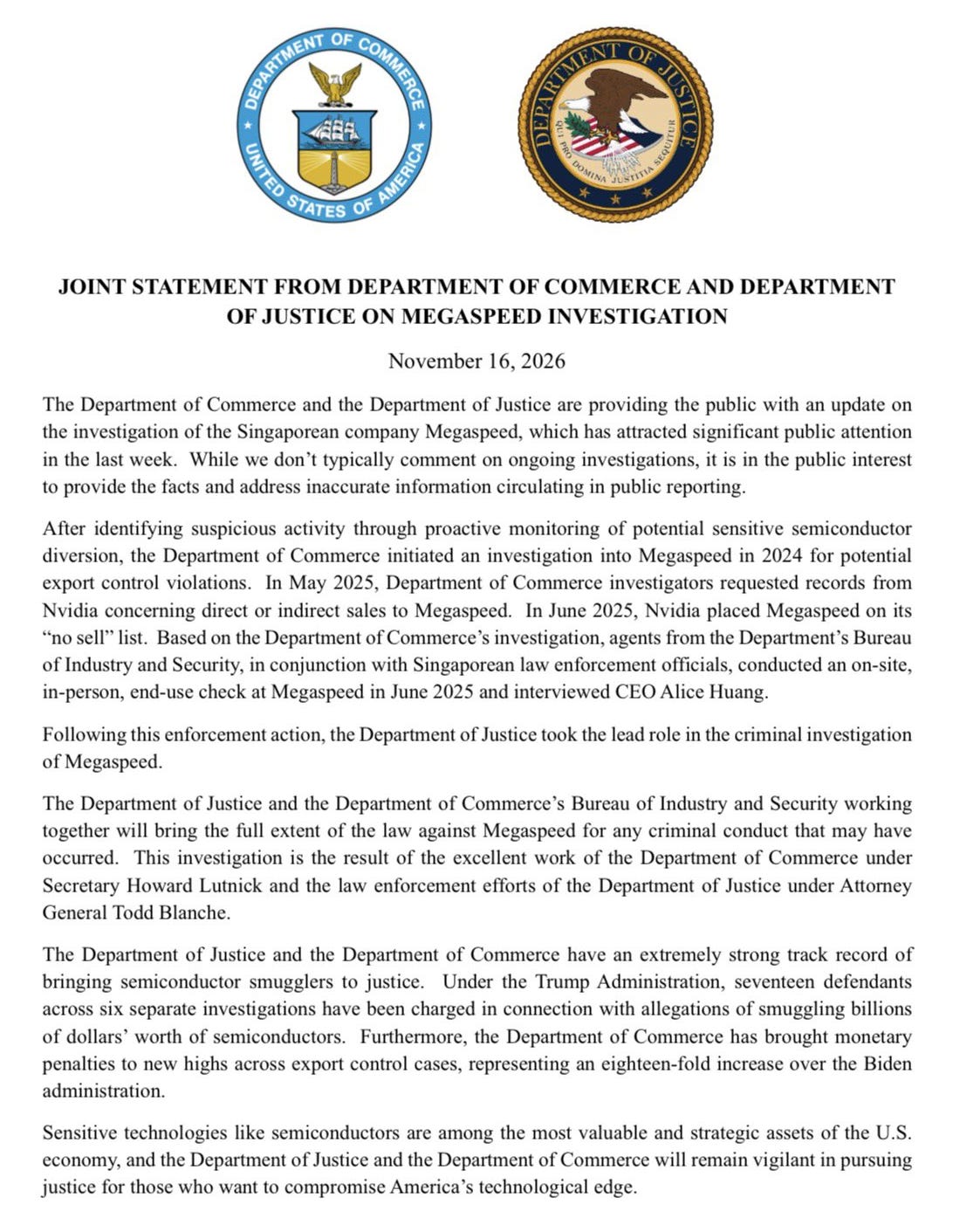
Yesterday, the U.S. Department of Commerce and the Department of Justice (DOJ) put out a joint statement addressing Megaspeed, the company at the center of the AI chip transshipment rumors.
The statement opened with a blunt confession. Normally, the Commerce Department and the DOJ keep their mouths shut when an investigation is still ongoing. This time, though, they had no choice. The circus had gotten so out of hand that both agencies had to break protocol “to provide facts to the public and correct inaccurate information circulating in public reporting.”
So what is this “inaccurate information” floating around in the press?
Obviously, it is the blockbuster storyline pushed wall-to-wall by Western mainstream outlets led by The New York Times: that Beijing sent a female spy to seduce Jensen Huang in a classic honeytrap, infiltrated Silicon Valley and the White House, and successfully walked away with restricted U.S. AI chips.
In their joint statement, federal officials talked about Megaspeed and mentioned its CEO, Alice Huang, once. Yet after all that, they reached no conclusion that any illegal chip sales had occurred, and they didn’t put Megaspeed on the U.S. Entity List. In fact, Nvidia itself had proactively cut off Megaspeed a full year ago.
And here is the kicker: not a single word in the entire document mentioned spies or espionage.
In fact, long before and right after Huang stepped down, every official body remotely connected to this story was already busy knocking down the spy rumors.
China’s Ministry of Foreign Affairs and the Chinese Embassy in the U.S. repeatedly called the espionage claims pure fabrication. Meanwhile, Singapore’s Ministry of Home Affairs (MHA) published a marathon statement walking through its own investigation into Alice Huang, stating flatly that authorities had “never investigated her for espionage.”

Even on the question of flipping restricted AI chips, Singaporean investigators found nothing to back up the claims.

Better yet, Singapore threw in some barely disguised shade at Washington. According to the MHA, Singaporean authorities reached out to both the U.S. DOJ and the FBI while looking into the matter, and the Americans completely ghosted them. Then, out of nowhere, U.S. media started blasting out a pile of unverified spy stories. Make that make sense.

Back in Washington, top U.S. officials were saying the exact same thing. U.S. Attorney General Todd Blanche told a press conference that authorities had “never concluded she was a spy.” By November 16, President Donald Trump was also telling reporters that nobody had proven she was a spy.
Over in Britain, a journalist at The Guardian saw right through the hype, pointing out that this painfully fake “honeytrap” script sounded less like real life and more like a third-rate 1970s pulp spy novel.
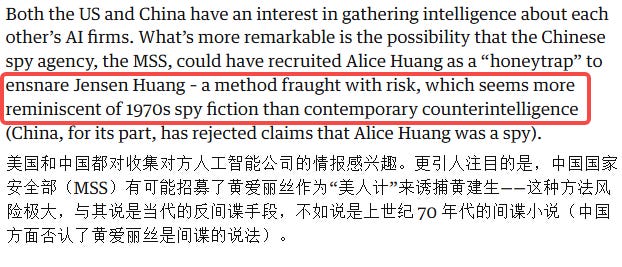
Honestly, even a soap opera would cut this plot for being too far-fetched.
That said, let’s keep one thing straight: based on the public evidence we have right now, the spy rumors weren’t what actually forced Jensen Huang out.
The real final straw was hiding facts from the board and rumors of an extramarital affair with a female subordinate. In corporate America, the first one is an open invitation for shareholder class-action lawsuits over misleading investors, and the second one is an absolute third rail. Former Intel CEO Brian Krzanich had to resign over an office romance with a subordinate, and former McDonald’s CEO Steve Easterbrook got fired for the exact same thing.
Huang obviously has to own his personal mess. Still, the only reason this thing blew up into a global circus is that mainstream Western outlets, led by The New York Times, had zero shame.
Their dirtiest trick in this whole saga was dressing up wild speculation as hard fact.
Take The New York Times. Over and over, the paper used the phrase “U.S. officials have concluded” to stamp Alice Huang as a confirmed spy.

Stories about the boss of a multi-trillion-dollar tech empire falling for a beautiful Chinese spy didn’t just set Capitol Hill on fire; they broke Wall Street’s brain first.
On November 9, the day news of the probe broke, Nvidia’s market cap briefly evaporated by about $250 billion, more than the entire value of Intel and AMD combined.
By November 12, when Huang officially resigned, Nvidia’s stock had plunged more than 30% from its peak, wiping out roughly $1.8 trillion in market value.
And yet, as we just saw, the whole “spy theory” was basically nonsense.
After getting slapped with one official denial after another, even The New York Times couldn’t hold the line. On November 13, the paper quietly walked it back, writing that people familiar with the matter viewed Alice Huang not as a professionally trained intelligence officer, but more like a “potential intelligence informant or asset” passing along info in the shadows.
To cover their tracks, they literally tried to redefine the word “spy.”

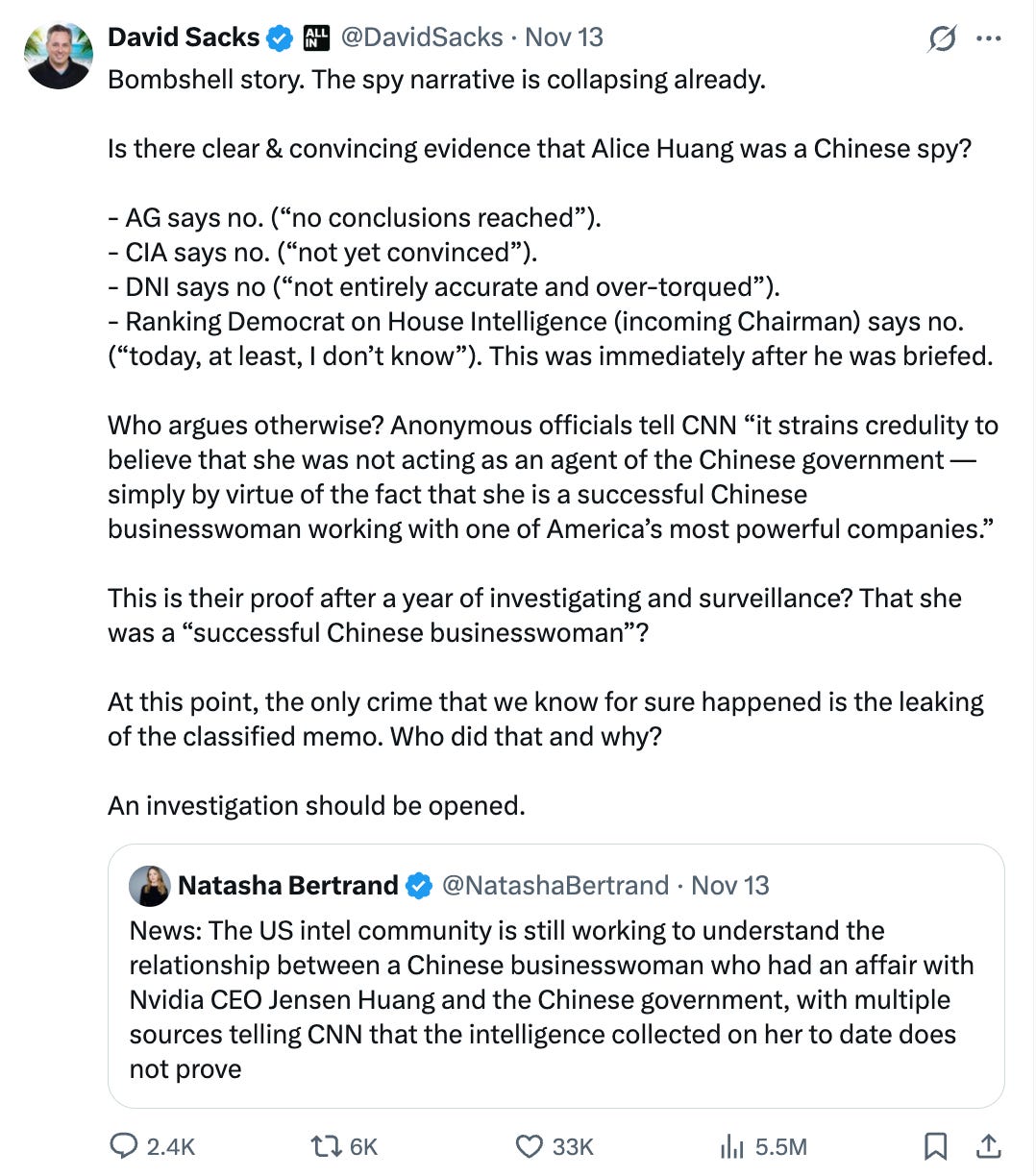
David Sacks, co-chair of the White House President’s Council of Advisors on Science and Technology (PCAST), went straight to social media to call out the garbage sourcing, asking how on earth these unnamed officials reached their conclusion.
Beyond twisting the facts, the reporting only got sleazier the deeper you dug.
On November 10, for instance, The New York Times breathlessly reported that Secretary of State Marco Rubio had personally tattled to Trump about the Huang affair aboard Air Force One on the way to China. The White House press secretary promptly torched the paper for having “no idea what they are talking about,” and Trump himself publicly shrugged it off: News to me.

The very next day, The New York Times dropped the article that actually pushed Huang out. It claimed a bystander had caught Huang getting cozy with a subordinate on video, and that Huang’s security detail locked the person in a room until they signed a non-disclosure agreement (NDA).
It read like a movie script, right up until The New York Times sheepishly slipped in a tiny disclaimer: oh, by the way, we haven’t seen the video.

Come on. You are The New York Times, and you are running a story like that without seeing the tape? Most people wouldn’t even dare post a rumor that thin on social media.
Within 24 hours of Huang’s resignation, its Opinion section published back-to-back hit pieces taking personal swipe after swipe at him.
One column was literally titled “Jensen Huang Betrayed the Leather Jacket Community.” Written by prominent journalist Anand Giridharadas, the entire piece ignored technology to make cheap jokes about Huang’s leather jackets and middle-aged body, declaring that Huang didn’t deserve to wear leather and had stained the “second skin” of middle-aged men everywhere.
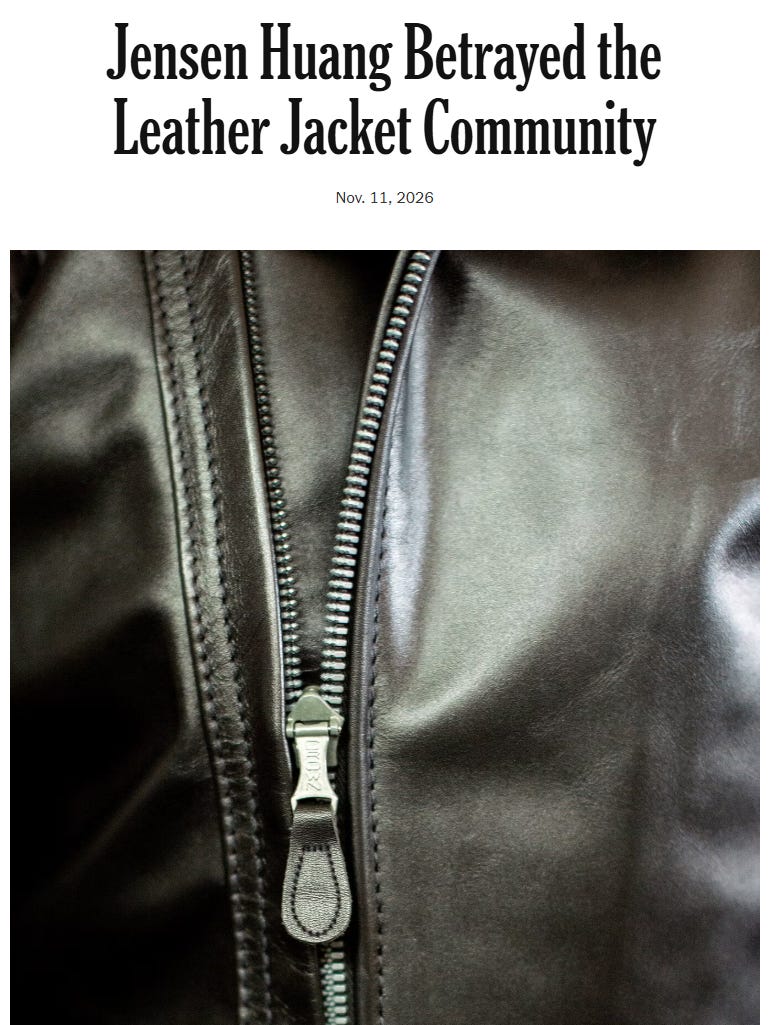
After getting roasted across the entire internet, the star columnist panicked, locked his social media account to private, and shut off replies.

The other column published that same day, “I Wrote Jensen Huang’s Biography. Here’s What Led to His Downfall,” was just as wild. The author was Stephen Witt, the exact same writer who published the definitive biography of Huang, The Thinking Machine, just last year.
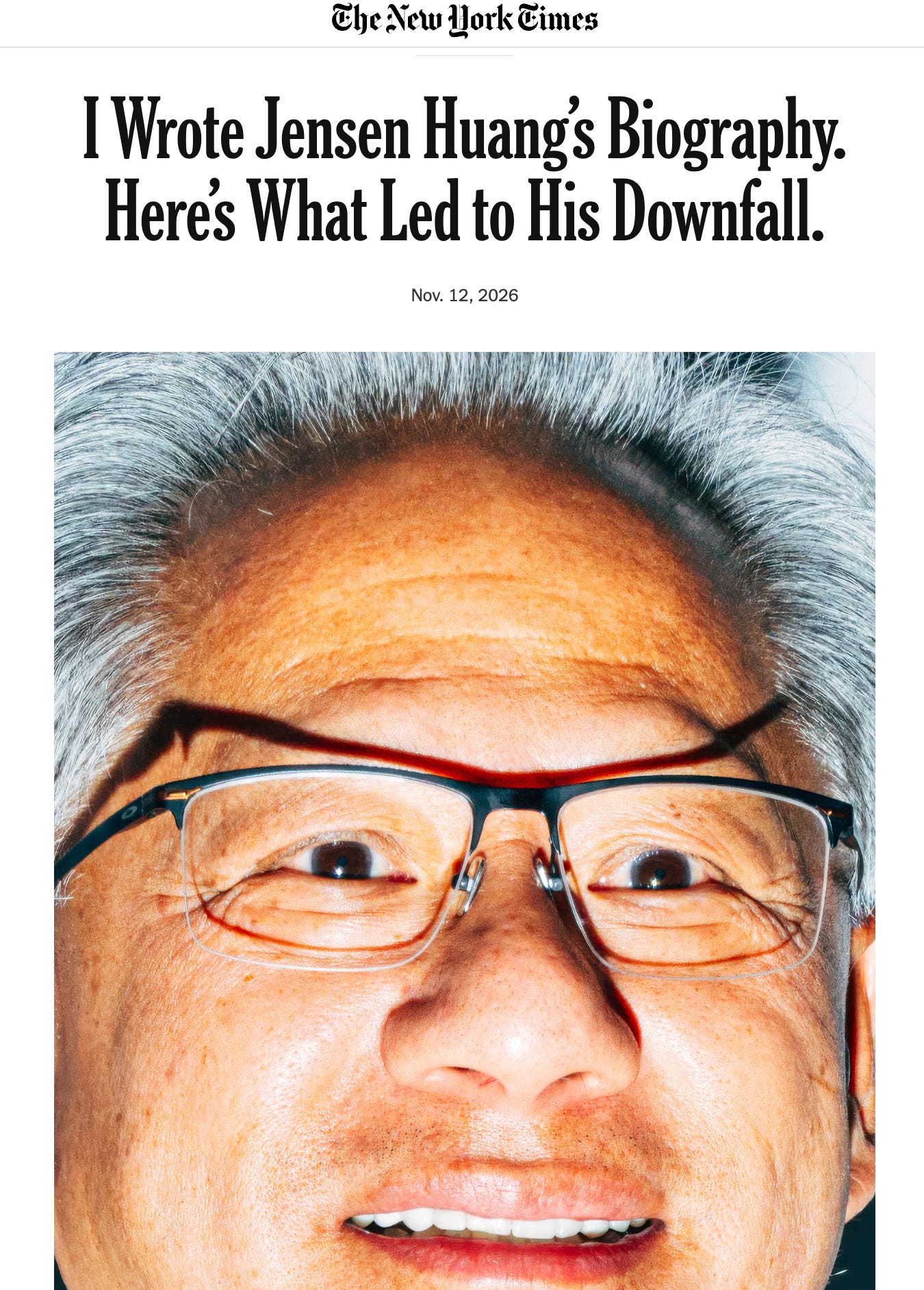
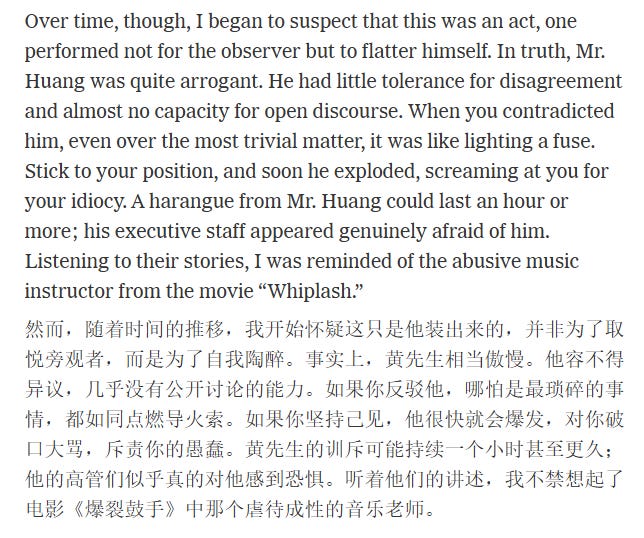
Last year, when Witt had a book to sell, he praised Huang to the skies as a humble, loyal, family-first guy. The second Huang fell from grace, Witt flipped on a dime and stabbed him in the back, rebranding him an arrogant, hot-tempered dictator chasing thrills through affairs.
Witt even dug up stories about Huang washing dishes and busing tables at Denny’s as a kid, and later leaving a $1,000 tip for a waitress after he got rich, just to sneer at him.
In fact, if those are the rules now, we can play the shameless game too:
According to three White House insiders, during a September conference at a hotel on Pennsylvania Avenue in Washington, multiple government officials were filmed plotting to use a media blitz after the midterm elections to force Nvidia CEO Jensen Huang out of office. As of press time, however, X.PIN has not seen the video.
See? Cooking up a “bombshell exclusive” really isn’t that hard.
Jokes aside, this exact move—using anonymous hit pieces to force a founder out, then quietly walking the claims back in the fine print once the job is done—has genuinely pissed off Silicon Valley.
Over the past two days, as the spy script imploded, Elon Musk, defense-tech unicorn Anduril founder Palmer Luckey, Y Combinator president Garry Tan, and a long list of tech heavyweights all stepped up in a rare show of unity to back Huang.
Let’s be real: Silicon Valley’s elite aren’t necessarily trying to whitewash Huang’s personal mistakes. What actually scares the hell out of them is the political witch-hunt template the media just beta-tested.
After all, if a few quotes from “anonymous officials” can roast Jensen Huang over an open fire today, the exact same script can be used tomorrow to destroy any tech founder who refuses to play ball.
References
The New York Times: “Jensen Huang Betrayed the Leather Jacket Community”
The New York Times: “Jensen Huang Said to Have Had Relationship With Nvidia Executive Who Reports to Him”
The New York Times: “Nvidia Scandal Prompts Questions of What It Means to Be a Spy”
The New York Times: “Nvidia Chief Seen as Target of Chinese Spy Plot”
The New York Times: “I Wrote Jensen Huang’s Biography. Here’s What Led to His Downfall.”
CNN: “What we know about Alice Huang, the alleged spy at the center of the Nvidia scandal”
The Guardian: “Thursday briefing: What we do (and don’t) know about Alice Huang and the Nvidia affair”