



$367. That’s what Huawei is charging for its new AI glasses—about $30 less than Ray-Ban Meta Gen 2. Xiaomi’s pair starts at $220. Industry analysts in Shenzhen now talk openly about a sub-$300 retail target for next year.
A price floor like that does not emerge from one company. It emerges from a supply chain that has solved the problem of cost—and China’s has.
Huawei’s 35-Gram Bet
On April 25, Huawei unveiled its first AI glasses, joining Xiaomi, Alibaba, and Rokid in what Chinese media now call the “Four Horsemen” of smart eyewear. The race inside China is brutal. The bigger story is what happens when it spills out.
Huawei’s pitch starts with weight. The frame comes in at 35.5 grams — about 41 grams with padding. Xiaomi’s AI glasses weigh roughly 44.7 grams. Li Auto’s Livis hits around 50 grams with lenses. Ray-Ban Meta Gen 2 sits in a similar range. Huawei wants glasses you forget you’re wearing.
The feature list is familiar: real-time translation, tap-to-pay, one-tap video editing, camera-based video calls, livestreaming. Press a button on the left temple and you’re in a video chat with Xiaoyi, Huawei’s voice assistant. Point the camera at a plant, an animal, or a building, and it tells you what you’re looking at.
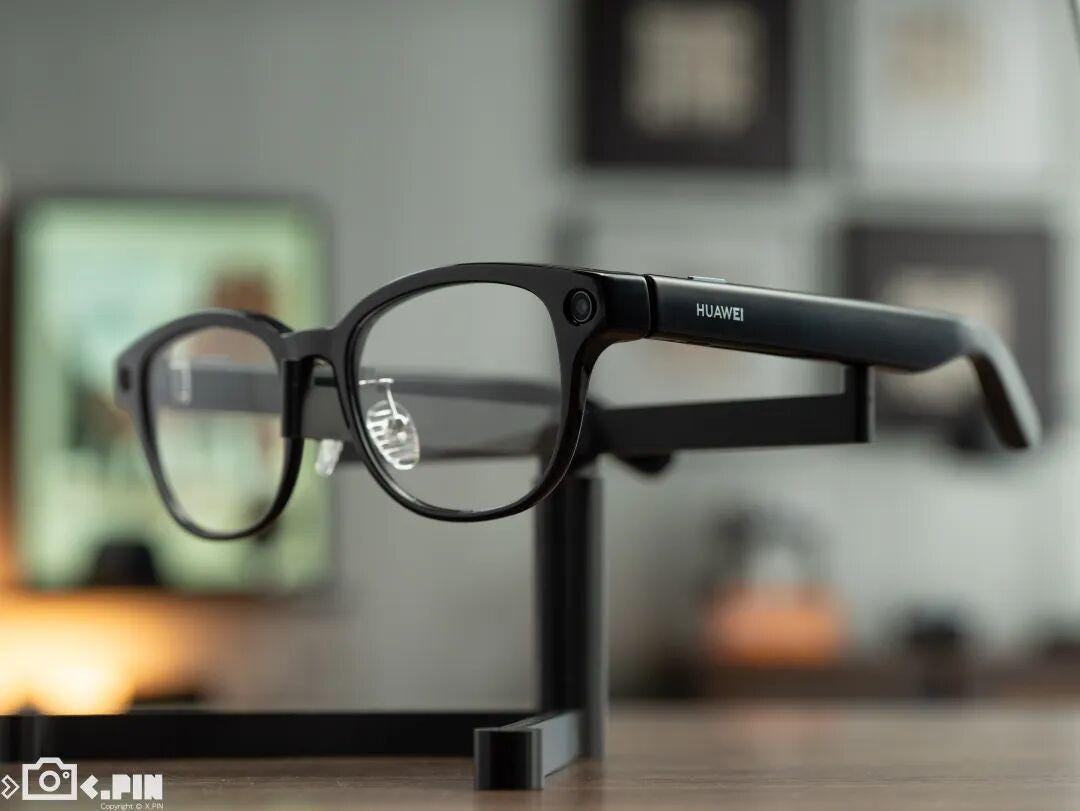
Since 2019, U.S. export controls have barred Google from licensing its Mobile Services to Huawei. The glasses only pair with phones running HarmonyOS 6 or later. Battery life stretches to nearly 12 hours. The price — about $367 — undercuts last year’s Ray-Ban Meta Gen 2.
Actually, this price can be lower. The Chinese government added smart glasses to a national consumer-subsidy program this year, knocking 15% off the sale price up to a 500 yuan ($73) cap. Xiaomi and Li Auto’s models sell for around 1,500 yuan ($220). During Spring Festival, AI glasses sales surged as much as 80%.
Even without subsidies, the market is climbing. According to a March Omdia report, mainland China is now the fastest-growing smart-glasses market in the world. Shipments hit nearly one million units, giving China 10.9% of the global market — second only to the United States. Rokid and Xiaomi climbed into the global No. 2 and No. 3 spots.
Everyone Wants In
A big reason sales are surging is the flood of new entrants. They see smart glasses as the next AI hardware platform — a way to extend their AI assistant businesses and find new growth. To stand out, everyone is differentiating.
Smartphone makers moved first. Xiaomi’s AI glasses integrate with China’s top video apps — Bilibili, Douyin, Kuaishou, Xiaohongshu — and can livestream or handle WeChat video calls directly from the glasses camera. Meizu launched its own pair, the StarV Air2.
Alibaba took a different angle. Its Quark S1 runs on the company’s Qwen AI and plugs into Alipay, Amap, and Fliggy — steering users toward spending within the Alibaba ecosystem.
Li Auto went further. Its Livis glasses can control the company’s cars, with voice-activated parking on the roadmap. For founder Li Xiang, it marks a push beyond vehicles into AI hardware.
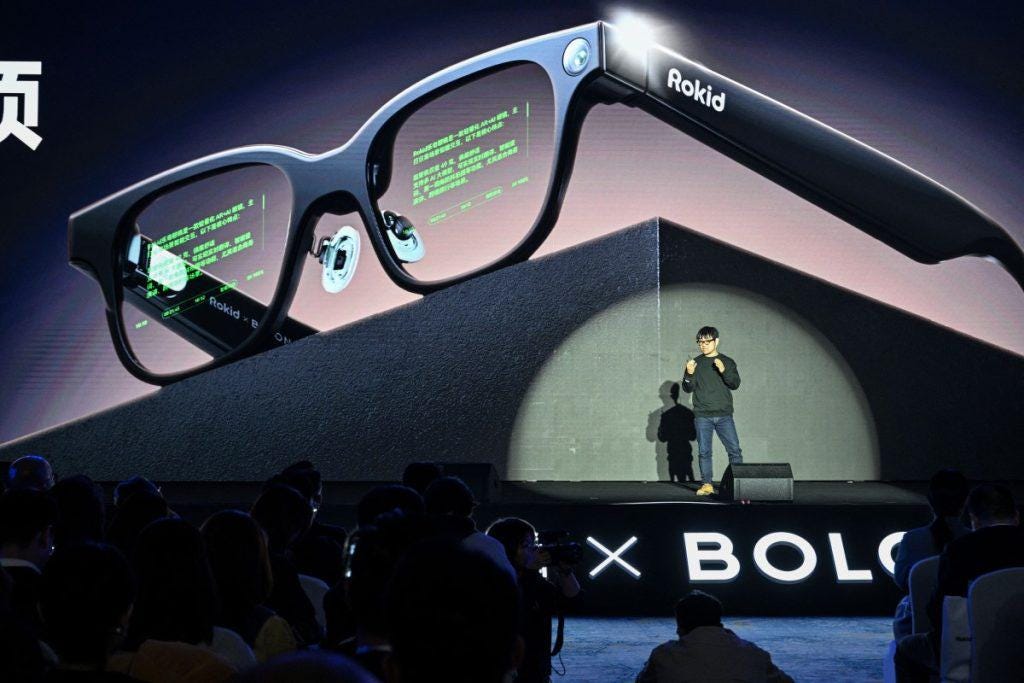
Most buyers still treat AI glasses as novelty. Without a built-in display, the value is mostly a hands-free camera and always-on earbuds. On Alibaba’s secondhand platform Xianyu, dozens of vendors now rent the glasses by the day for $6 to $12 — the kind of price that suggests buyers aren’t ready to commit.
Glasses with displays have found stickier use cases. Users wear them into meetings for live interpretation, run them as discreet teleprompters, glance at stock prices — and, predictably, cheat on exams. Beijing has now banned smart glasses at all national-level tests, including the gaokao and the civil service exam.
“A lot of people buy our glasses for this teleprompting capability,” Rokid’s vice president Gary Cai told CNBC.
Rokid spent its first decade after founding in 2014 hunting for customers. The turn came in 2025, when founder Misa Zhu wore his own glasses as a teleprompter during a public speech. The clip went viral. Rokid scaled up inventory and marketing fast, and its AI glasses have now held the No. 1 spot on JD.com, China’s largest electronics retailer, for three straight months.
Meta Built It, China Took It
Here’s the irony. Meta’s original Ray-Ban Stories were manufactured by Goertek — a contract maker Apple had once passed on. That partnership built Goertek into a smart-glasses powerhouse. Today, Goertek also assembles glasses for Huawei and Rokid.
If you want to build AI glasses, all you need is an idea. China handles the rest.
The display? Meta’s Orion uses Micro-LED from JBD in Shanghai, which also supplies Xiaomi and TCL. Waveguide lenses — the scarcest part — are now produced at scale by Goertek and Sunny Optical, each above 10 million units a year, per a January 2026 ChinaTalk investigation. Crystal Optech makes waveguides for Lumus and confirms it supplies Meta and Xiaomi.
Cameras come from Sunny Optical and O-Film, the latter ships to both Xiaomi and Huawei. Storage from Biwin, which ships to both Meta and Rokid. Batteries which remain a Chinese stronghold, from Sunwoda and EVE Energy. Lens glass from Lenstech, which can also do final assembly. Luxshare and Longcheer are standing in line, ready for contract manufacturing.
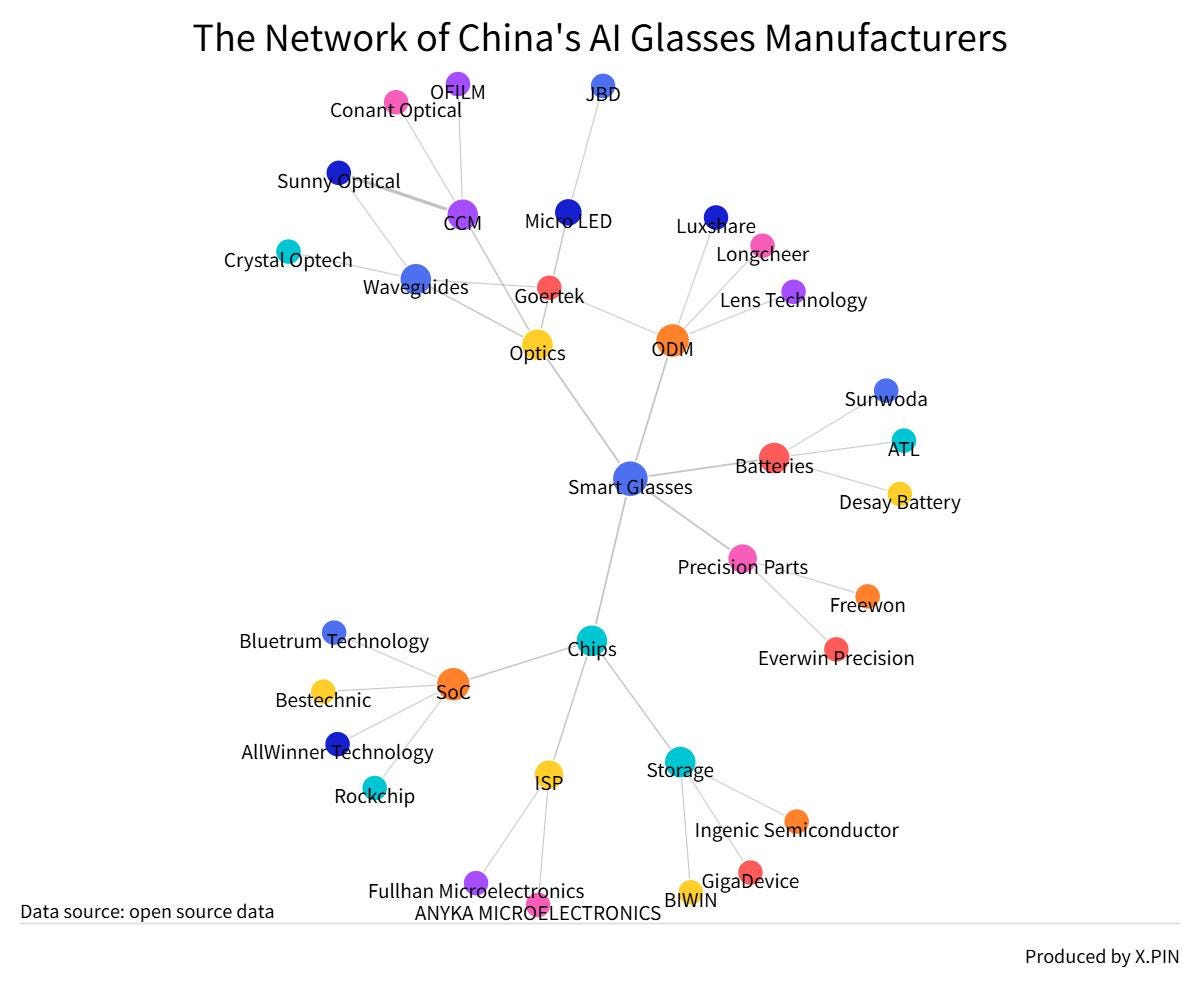
The pattern is clear: this is the old Apple supply chain, repurposed. These vendors already worked with Huawei and Xiaomi on phones. When AI glasses arrived, they self-organized overnight — linking up with familiar partners. Meta built a Chinese supply chain for smart glasses, then watched it get handed to its competitors. Zuckerberg armed his rivals.
In Shenzhen’s Bao’an district, a smart-glasses startup can source every supplier — chips, PCBs, batteries, structural parts — within a five-kilometer radius. Prototype to mass production can take 72 hours, according to Chinese business outlet 21st Century Business Herald.
Chinese makers adopted Meta’s go-to-market strategy too. Meta sold through EssilorLuxottica’s Ray-Ban stores. Huawei partnered with Gentle Monster. Rokid signed up local optical chain Mao Runchang.
Chinese vendors are now squeezing every component. Some are replacing parts of Qualcomm’s AR1 workload with lower-power Bestechnic MCUs. OmniVision is taking sockets from Sony in image sensors. Waveguide lenses remain a bottleneck — but elsewhere, costs are falling fast. The target: a sub-$300 retail price.
If a shakeout thins the Chinese field and the survivors keep scaling, what comes next looks a lot like smartphones a decade ago — a global price war with Chinese manufacturers on one side and Meta on the other.
Roughly a quarter of Rokid’s orders already come from outside China, according to SCMP. “We expect to ship 1 million units across our product line in 2026,” Misa told X.PIN in a November interview. “I try my best to keep stock available.”
Meta proved the model. China industrialized it. Now the bill comes due.
> The feature list [for smart glasses] is familiar: real-time translation
I noticed this when I was walking around Huaqiangbei. The product that everyone wanted to sell was real-time translation. Do you have a sense for why this is? Is it a particularly high margin feature or just more real world practical than everything else is at the moment?
I see people making smart glasses, but there are 2 big issues. 1. What are the real world uses, that the ave consumer wants? 2. there may be a marketing/creep factor in some countries.
Have we really thought about this?
There are good uses. I can see using them for realtime translation, realtime labeling of trees/streets/tell you what you are looking at and where you are.... , .... but there are also worries like cheating in classes, videoing women without consent, videoing in bars when people are intoxicated, videoing in court when the judge has said "no cameras", identifying people without consent by facial recognition (police/govt/PI/neighborhood watch/etc), corporate espionage, ....