



Moore Threads, one of the Nvidia’s Chinese challengers, just swings to a profit in the first quarter, as domestic graphics processing units (GPUs) have surging computing demand amid Beijing’s push for chip self-sufficiency. Its founder and CEO Zhang Jianzhong used to be a China head of Nvidia. Now the former employee is trying to be Nvidia’s direct competior in China and he is closer to the goal.

According to a filing to the Shanghai Stock Exchange on Sunday, Moore Threads reported a net profit of US$4.3 million for the January to March 2026 period, compared with a net loss of US$16.4 million a year earlier. This is the first time the firm swings to a profit.
Moore Threads’ thin profit comes from three sources added together: government subsidies (about $9.66 million), investment income (about $1.84 million), and a loss from its core business (about -$7.49 million). Government subsidies are the main support, and investment income helps fill the gap. Together, they cancel out the core business loss and leave just enough on paper to call it a profit.
Most of the revenue comes from the MTT S5000 compute card. In its 2025 annual report, Moore Threads said the card now powers its KUAE computing cluster, which can handle full AI training jobs. In March 2026, Moore Threads announced a 660 million yuan (about $91 million) KUAE order, but didn’t say who the buyer was.
That number is worth questioning. Moore Threads still has 638 million yuan (about $88 million) in unpaid bills from customers, and the company hasn’t named its biggest clients in its filings. Whether that $91 million order actually turns into cash will show if the company’s revenue can hold up over time.

The core operating loss narrowed from 136 million yuan (about $18.76 million) to 54.28 million yuan (about $7.49 million) — a 60% improvement year over year, faster than the 155% revenue growth. That gap shows operating leverage is starting to work in the company’s favor. If revenue keeps climbing, fixed costs will spread across a larger base, and the company should finally cross into real profitability — not just profit on paper. When that happens, the quality of its earnings will look very different.
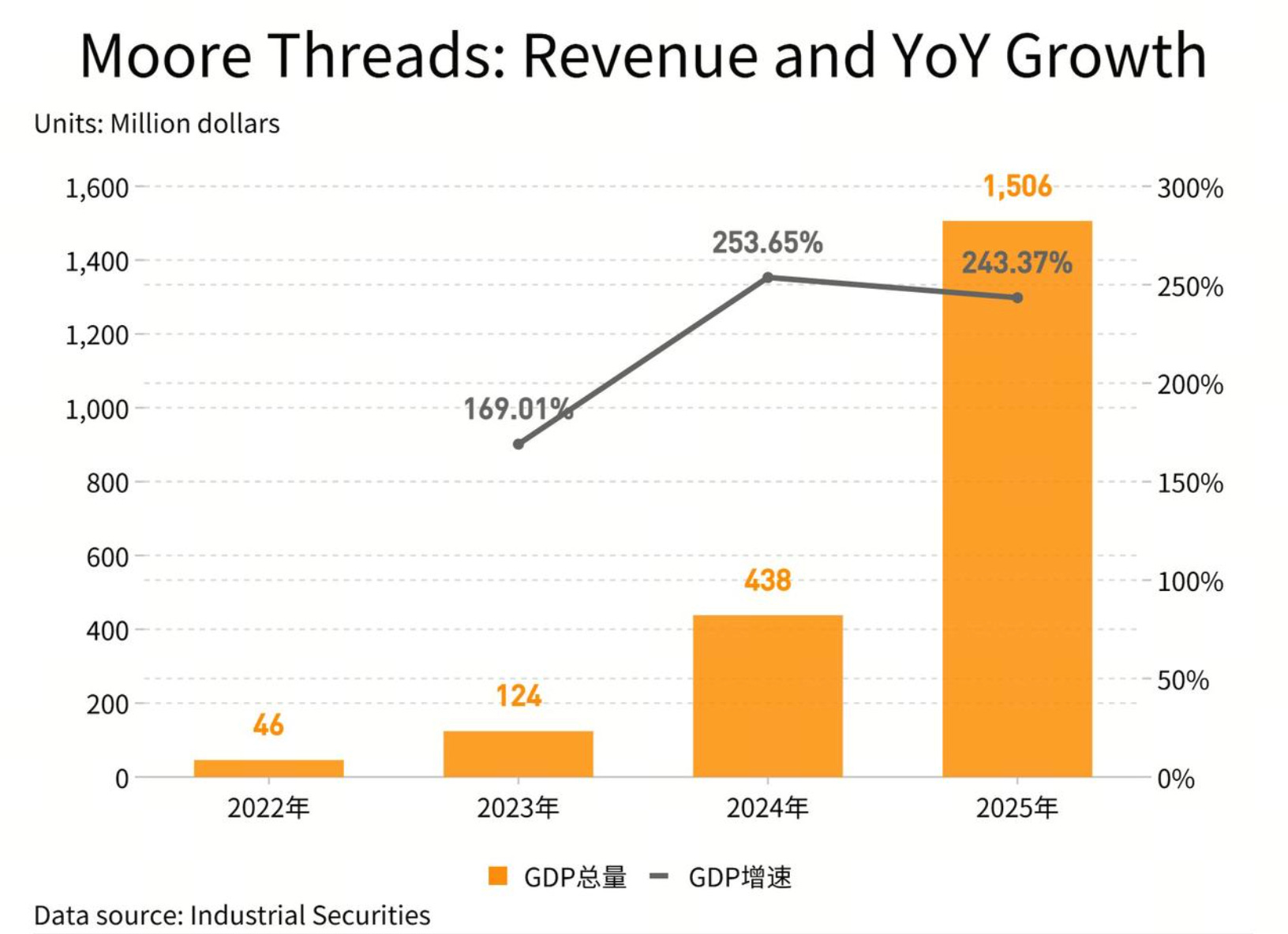
Driven by surging domestic demand for GPU computing, Moore Threads posted revenue of 1.505 billion yuan (about $220 million) in 2025, up 243.37% year-on-year. The company’s revenue grew at a compound annual rate of over 200% from 2022 to 2024, ranking among the top in the industry. Moore Threads posted a gross margin of 65.57% in 2025 — almost 10 percentage points higher than rivals Hygon, Cambricon, and MetaX.
“We have ramped up strategic stockpiling to meet downstream demand growth and can ensure mass-production delivery.” said Zhang Jianzhong in the 2025 annual report released on the same day. In 2025, cloud products made up 97.04% of the company’s revenue. Its core offerings are high-margin AI compute cards built for both training and inference, along with its KUAE 10,000-card AI computing clusters.
Zhang spent 14 years running Nvidia’s China operations as general manager. During that period, the U.S. chipmaker’s share of the Chinese GPU market climbed from under 50% to above 80%. By 2015, the China unit generated nearly 20% of Nvidia’s annual revenue, making it the firm’s biggest single market outside its home turf.
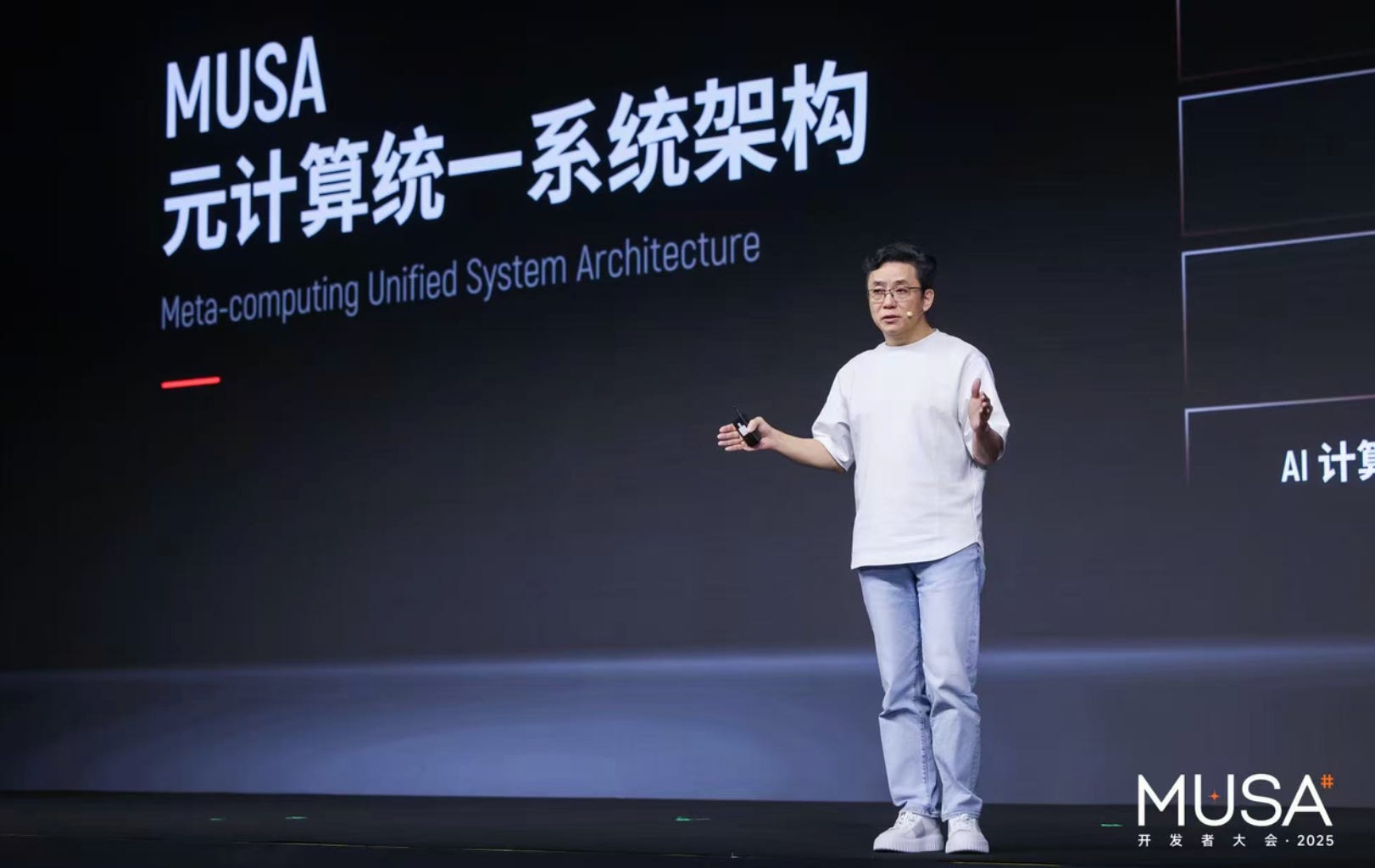
In 2020, Zhang invited his former colleagues to Moore Threads, started building “Full-function GPU”, which is a distinctive concept in the Chinese market, for major computing chip companies building architectures for AI. Moore Threads GPU products support graphics rendering, AI computing, scientific computing, video codec, and more.
Moore Threads has expanded faster than many expected. In March 2022, it rolled out its in-house MUSA unified system architecture, alongside the MTT S50 desktop GPU for PCs and workstations, the MTT S2000 for data centers.That November, the company launched its second full-featured GPU, “Chunxiao”, and unveiled the MTT S80 — described as China’s first domestically developed gaming GPU on the MUSA architecture — along with the MTT S3000 server GPU and the MCCX meta-computing appliance.
Building consumer GPUs is not easy. It requires years of software optimization, a large enough user base and, most importantly, broad acceptance from developers. Chinese companies have long been at a disadvantage in this space, especially in GPUs.
Moore Threads is reported to draw on PowerVR, a GPU IP core developed by U.K.-based Imagination Technologies. PowerVR has historically struggled with Windows compatibility, making it difficult to develop and iterate on hardware. After launching the S80 consumer GPU, Moore Threads has yet to bring a new consumer product to market, focusing instead on driver updates.
Still, there is surging computing demand to fulfill in China. In December 2025, Moore Threads unveiled its Huashan GPU, the first product built on the company’s new “Huagang” architecture. Moore Threads said some of the new chip’s performance indicators could exceed those of Nvidia’s Blackwell-architecture processors. At the end of March, the company disclosed a $91 million order for its KUAE computing cluster — built from thousands of interconnected GPUs — without naming the customer.
The company is among a handful of domestic GPU champions seen as potential challengers to Nvidia, as the US giant faces trade restrictions in selling its most advanced AI chips to China. Cambricon Technologies, based in Beijing, reported a fivefold jump in revenue for 2025 and turned its first annual profit since going public in 2020. Shanghai-based MetaX Integrated Circuits, meanwhile, doubled its annual revenue and narrowed its losses by nearly half.
