



Over the first weekend of November, the tech world couldn’t stop talking about Nvidia CEO Jensen Huang’s personal life. After The New York Times wrote about his rumored Chinese girlfriend, Alice Huang, online chatter quickly turned to her supposed intelligence ties and Nvidia’s business in China.
All that gossip, however, missed a much bigger story in Southeast Asia. Long before Huang’s personal life and the Megaspeed inquiry made the news, Nvidia’s global push for “Sovereign AI” had set off a massive three-year data center boom across Malaysia’s Johor state and Singapore.
For years, Southeast Asia served as a neutral business hub—an unofficial DMZ in the global AI race, full of bold infrastructure investors. Now, Washington is stepping in to shut that zone down, and regional compute providers are facing a brutal financial mess.
The Compute Brokers
The Megaspeed case became a turning point largely because of its size. According to The New York Times, Alice Huang worked at state broadcaster CCTV and private equity firm Hexi Capital before gaining control of an offshore company called Megaspeed through a deal involving gaming firm 7Road. Between June 2024 and February 2026, Megaspeed bought roughly $4.8 billion worth of top Nvidia hardware. That massive buying spree eventually brought US Bureau of Industry and Security (BIS) officials to inspect its Malaysian site in September 2024.
While Megaspeed made headlines as an investigation target, the wider offshore compute boom grew out of normal business logic and clear legal lines. For years, US export rules blocked the physical shipment of advanced chips to certain places, but renting remote cloud compute overseas was still legally allowed.
On the supply side, Nvidia fed this growth through its Nvidia Cloud Partner (NCP) program. Short for Nvidia Cloud Partner, the plan is a key part of Jensen Huang’s Sovereign AI push to build up regional cloud providers around the world. Getting NCP status is tough, but once certified, a firm gets direct access to top chips like the H100 and B200 from Nvidia and its server partners. A local cloud company registered in Singapore or Malaysia with an NCP badge easily met compliance rules. And if an NCP needed money to buy gear, Singapore’s sovereign funds were ready to offer billions of dollars in hardware-backed loans.
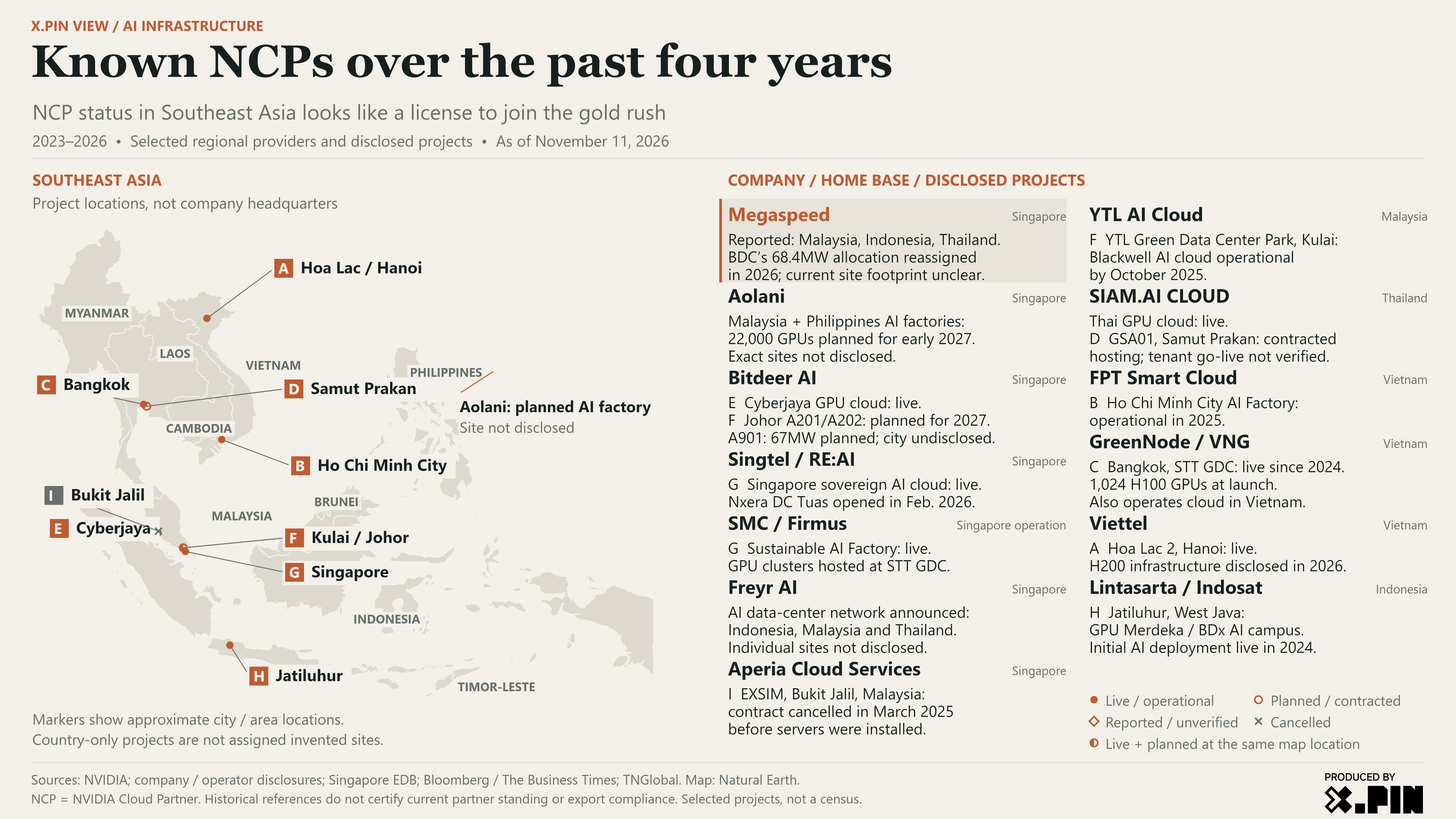
Before long, big regional players like YTL Power, Singtel, and Vietnam’s FPT all became NCPs alongside smaller NeoCloud startups. Local real estate and infrastructure firms jumped in too, racing to build data centers in Johor and Singapore just to rent them out to NCPs.
To see how third-party compute leasing works on the ground, China’s domestic market offers a clear example. Instead of spending huge sums upfront to own servers, tech buyers often hire specialized leasing companies to buy and hold the hardware for them. Public filings reported by Chinese financial wire Cailianshe (CLS) show how Hongjing Technology runs this business. Hongjing buys complete server racks—128 or several hundred units at a time—built to a client’s exact specs. It handles the networking setup, gets the gear inspected, and collects monthly rent over 36- to 60-month leases. Bigger operators like Runze Technology have grown their wholesale data centers the same way, even launching a public data center REIT in 2025.
The Accounting Time Bomb
Why do major internet platforms prefer renting compute over buying servers themselves? Beyond staying flexible, it is a simple way to pass along financial risk.
Nvidia updates its GPU architecture almost every year. Because of that fast pace, AI servers lose a lot of their value after three years. For big tech companies buying compute, signing a three-year service contract avoids heavy upfront spending. Better yet, it pushes the risk of aging hardware onto the leasing middlemen—and the banks lending them money.
That risk sits right on the balance sheets of leasing firms and regional NCPs. In China, many companies jumping into compute leasing are small-cap listed firms coming from totally unrelated businesses. Hongjing started out in smart-city services, while Litong Electronics made precision LCD parts. Litong, which is also an official Nvidia NCP in mainland China, shows just how fragile this debt-heavy model really is.
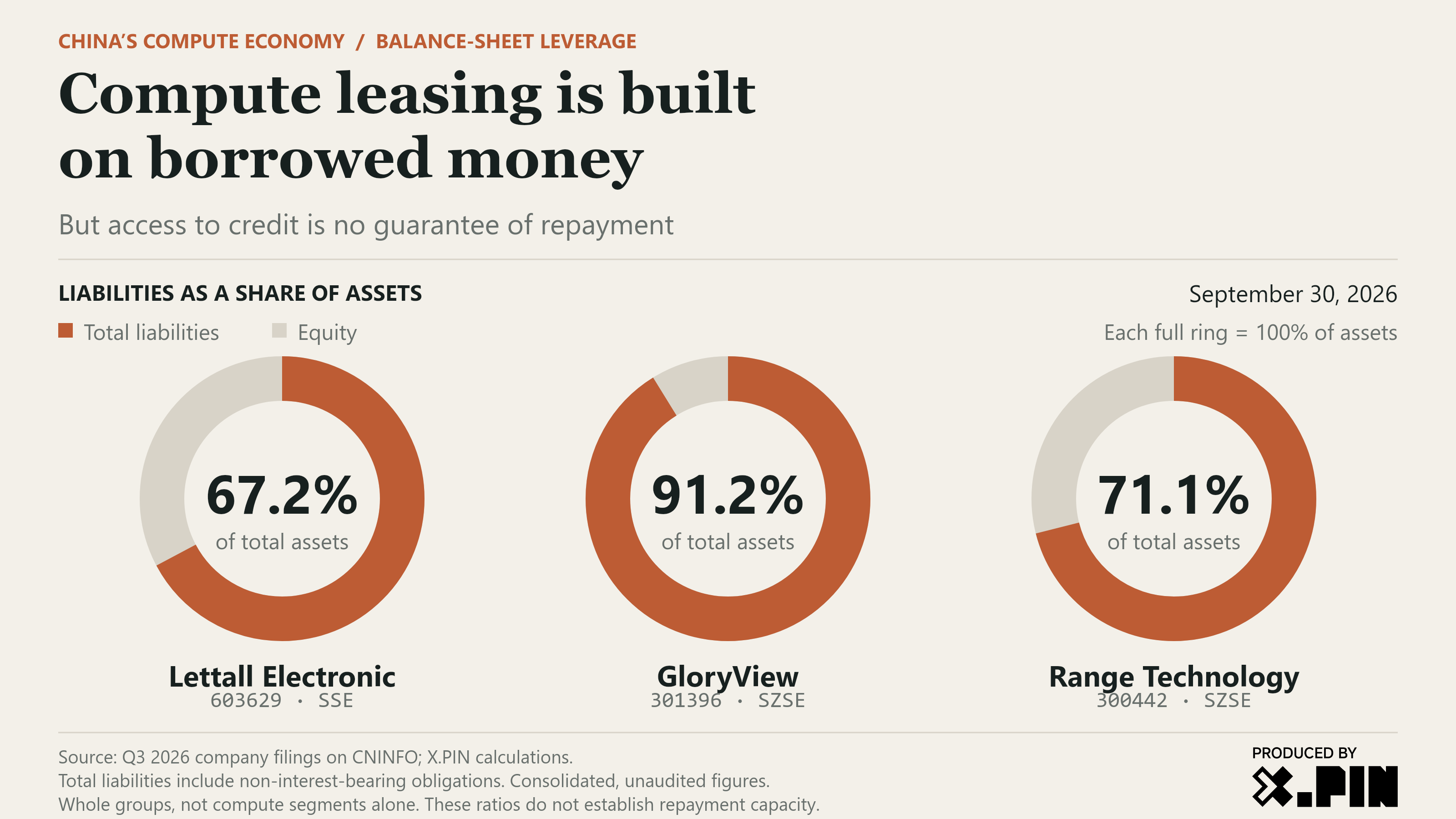
Litong’s debt-to-asset ratio stands at 89.82%. In the first quarter of 2026, its interest payments (35 million RMB) were higher than its net profit (30.26 million RMB). Across the board, most compute-leasing firms and NeoClouds carry debt ratios above 80%.
On top of heavy debt, these operators have to pay hardware markups, networking fees, power bills, and annual loan interest above 6%. To make the numbers look good on paper, they sign three-year leases with big tech buyers while spreading server depreciation over six years. The catch is simple. Because Nvidia releases new chips every year, clients walk away from old GPUs as soon as their three-year leases end. Stuck with outdated machines, middlemen end up wiping out their first three years of profit in year four.
No Neutral Ground
Now, tighter rules from Washington are setting off that financial time bomb early.
In April 2026, 68.4 megawatts of contracted power capacity were suddenly taken back from Megaspeed. A month later, short-seller Culper Research claimed in a report that over 20% of Nvidia’s fiscal 2026 compute revenue still ran through Southeast Asian middlemen, pushing back against Nvidia’s earlier statements. Nvidia insisted that Megaspeed had no Chinese shareholders and that it had found no illegal chip transfers.
Starting in August, however, the US Commerce Department began tightening IaaS rules on remote compute access. That move brought offshore rental data centers under export oversight and effectively put Southeast Asia’s Sovereign AI sector under a quota system. Then this month, Nvidia told its Asian data center clients that at least 51% of their compute must go to non-Chinese customers. Nvidia is also making it harder for Southeast Asian cloud firms to become official partners. Applicants now have to join its Fleet Intelligence system, which tracks the physical location of individual chips after they are delivered.
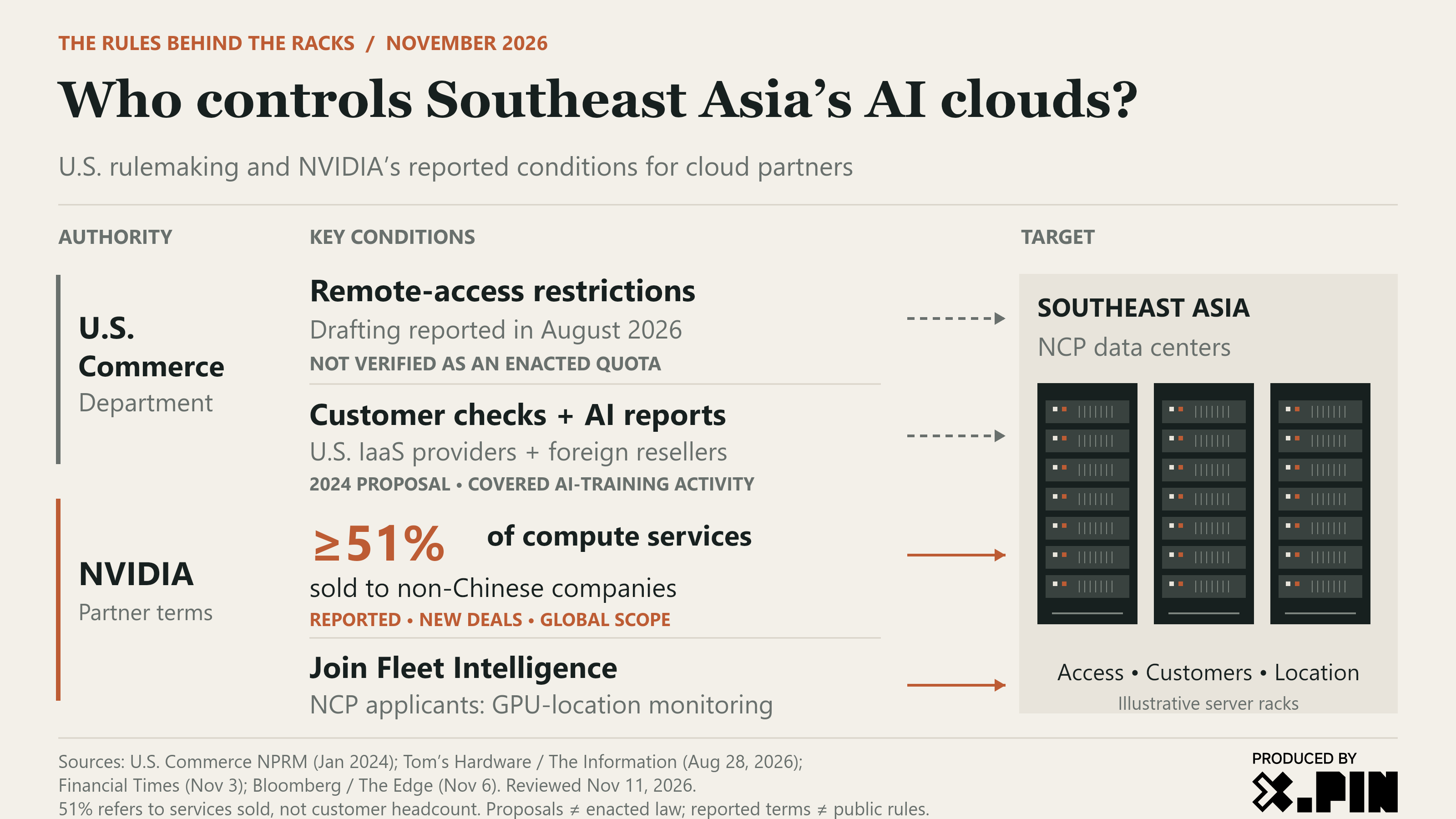
For regional NeoClouds built around cross-border demand, these rule changes leave a huge gap with almost no backup buyers. Local Sovereign AI projects in Southeast Asia have no need for ten-thousand GPU clusters. AWS and Microsoft build their own massive data centers, while SoftBank and India’s Reliance keep their main clusters at home and only need small edge nodes in Southeast Asia. Meanwhile, Nvidia itself is shifting its attention toward lower-risk Gulf projects like Saudi Arabia’s HUMAIN and the UAE’s G42.
Big local players like state-backed Singtel and well-connected conglomerate YTL Power still have a safety net; they can lean on government contracts to stretch out their payback periods. Pure NeoClouds, on the other hand, are watching their power capacity get taken back and rented to others. Their Nvidia servers are headed for fire sales on the global secondhand market. Clients will not renew, banks will come after unpaid loans, and it will not end well. Washington’s long arm is leaving Southeast Asia’s local compute investors with a pile of bad debt.
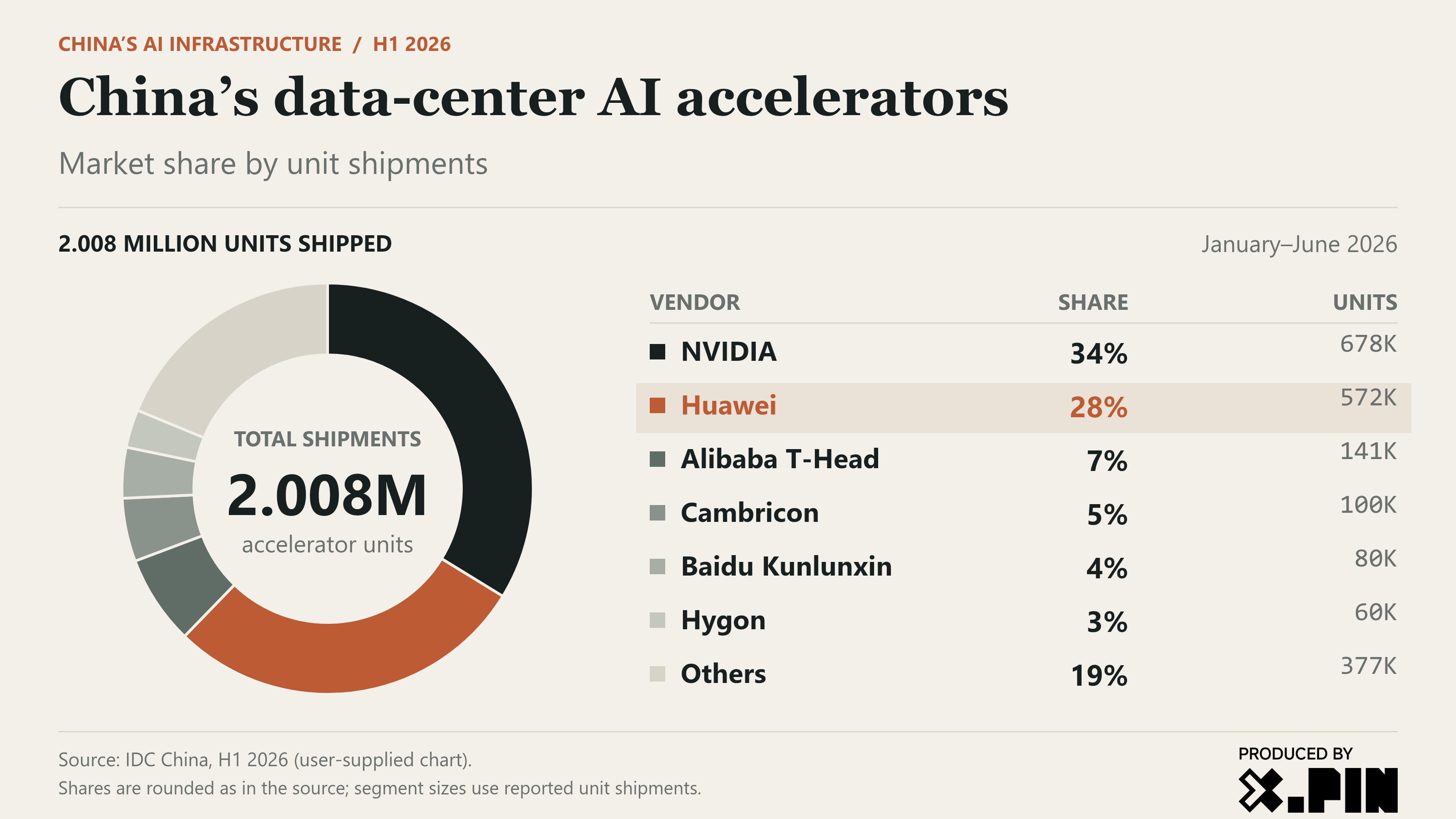
Ironically, shutting down these offshore channels is speeding up a major shift inside China’s own AI industry. In the first half of 2026, shipments of non-GPU accelerators in China—like ASICs and NPUs—reached 1.016 million units, beating traditional general-purpose GPUs (991,000 units) for the first time. Without easy access to massive NVLink pre-training clusters, Chinese developers are adapting by focusing on inference and open-source fine-tuning. DeepSeek is already building clusters with Huawei’s 950DT, while Meituan’s LoongCat model reportedly runs on Huawei’s Ascend 910C.
Stock markets are now stepping up to fund this push for self-reliance too. Alibaba is preparing to spin off its in-house chip unit, T-Head, for a Hong Kong IPO. What used to be just an internal R&D cost center is now turning into a standalone commercial chipmaker.
Since 2022, Southeast Asia has served as a booming neutral ground in the global AI buildout. Yet while everyone was busy gossiping about Jensen Huang’s personal life, four years of offshore compute arbitrage quietly hit a wall.
By closing off this middle ground, US officials have left regional data center speculators holding bad assets. At the same time, they have handed China’s domestic chipmakers the exact home market they needed to grow on their own.
For the fortune hunters of the AI industry, Southeast Asia’s DMZ is officially closed. Nobody knows who managed to exfil with a full backpack—or where the next map will be.