



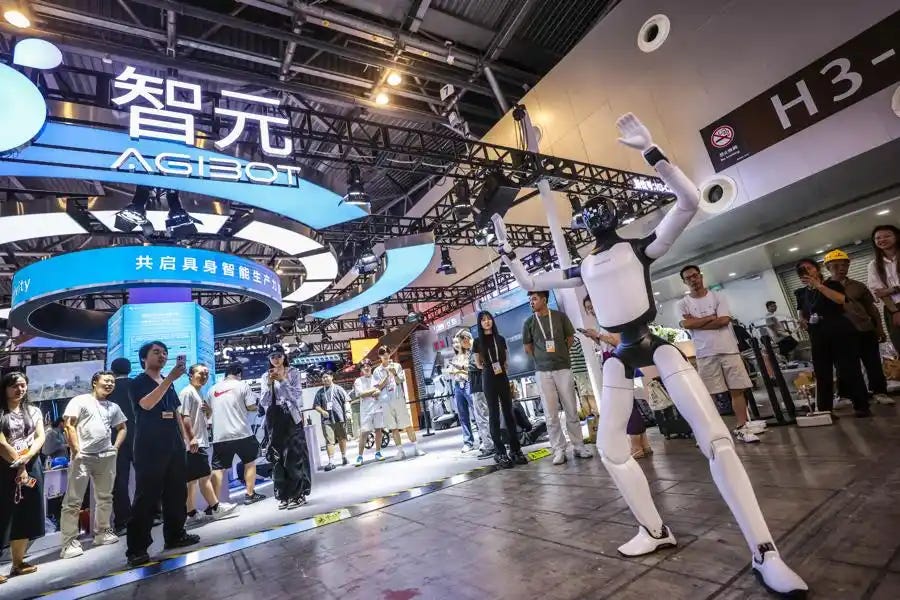
On a rain-soaked day in Shanghai, I spent a one-day pass at the World Artificial Intelligence Conference trying to see as many robotics booths as possible.
The embodied-AI section was the loudest, hottest, and most crowded part of the show.
China has the numbers to justify the hype: official data says Chinese-developed quadruped robots account for nearly 70% of global sales, while the country has produced more than 400 humanoid robot models.
But the section was also deeply repetitive. Most robots wave, grip, dance, falter, and then, occasionally fail to complete a move. What China’s humanoid industry has built ahead of schedule is the body. What it still lacks, in most cases, is the brain.
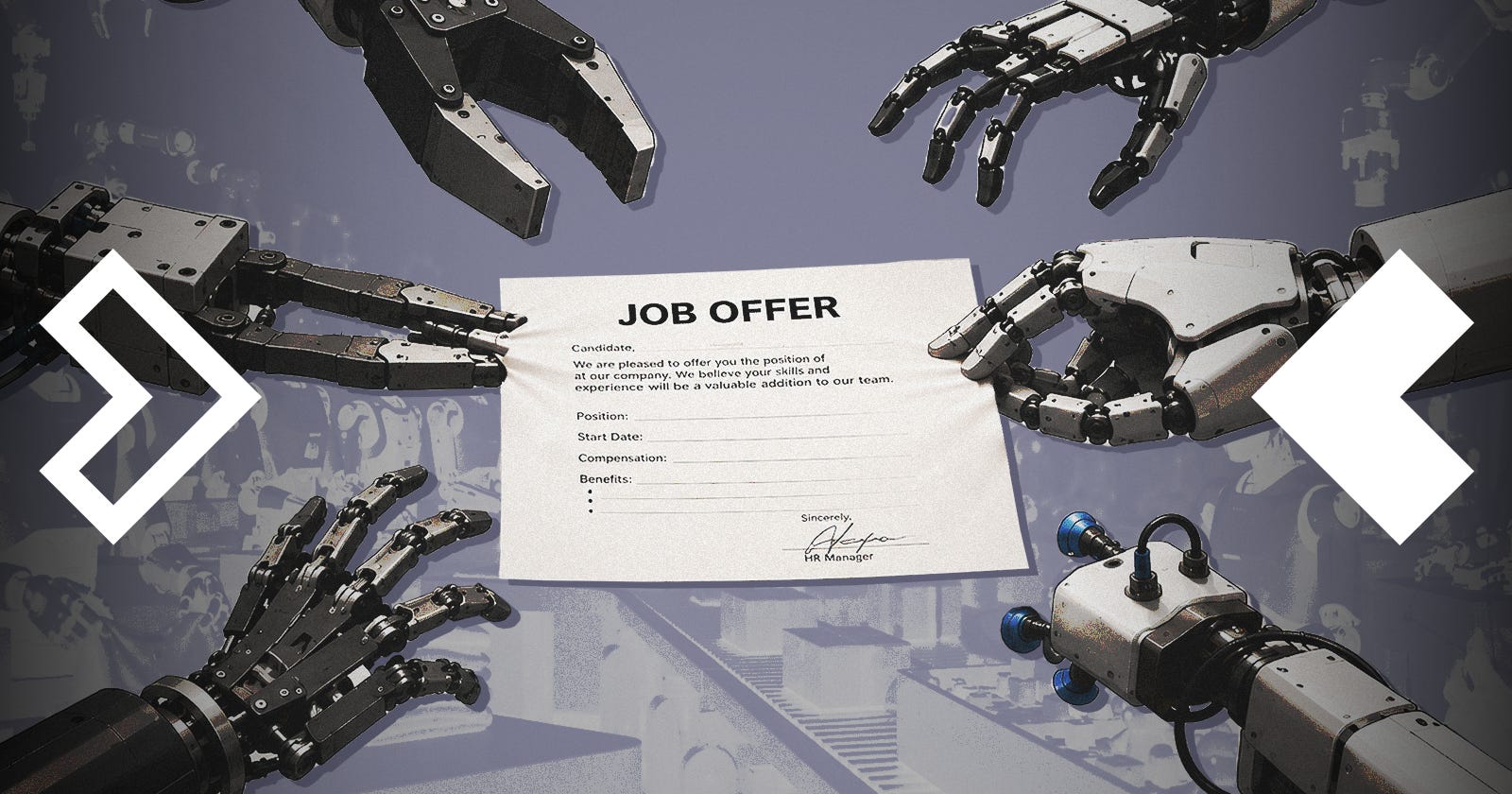
That creates an uncomfortable problem. These companies need sales channels, government relationships, and enterprise orders before their machines can reliably perform complex work. In other words, China’s robots may require employment more urgently than humans do.
For customers and investors, the question is no longer whether China can build robots. It can. The harder question is whether robots can be put to work.
Why Do Chinese Robots Look So Similar?
The answer is simple. Most companies are not building robots directly for consumer needs. They are building them to showcase their ability to produce fully fledged robotic hardware, helping them secure enterprise sales orders and pave the way for an IPO.
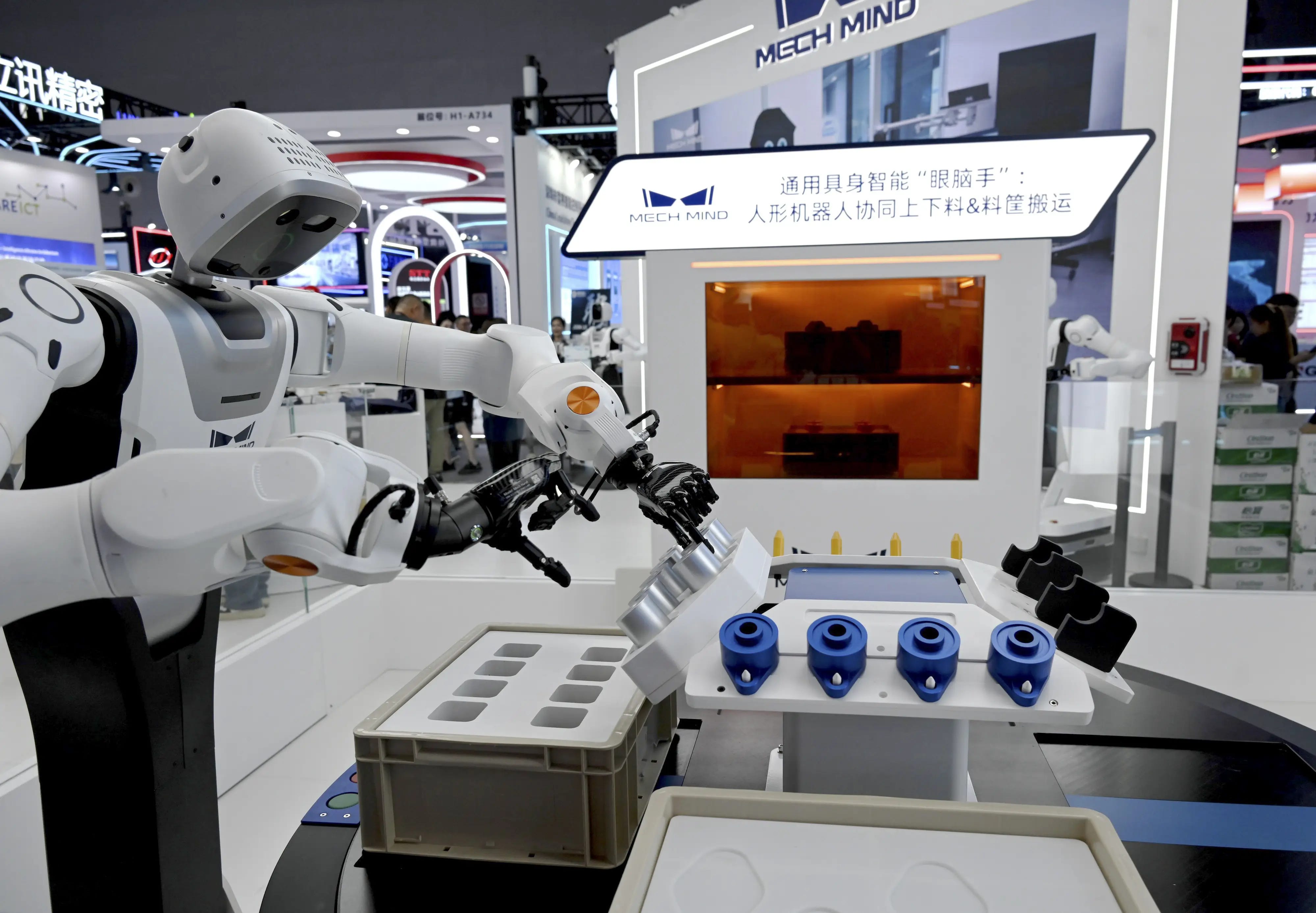
At WAIC, many humanoid booths showed the same scene: an upper-body robot trying to pick up objects from a tabletop.
The structure is familiar: robotic arms, a torso, a head, grippers or dexterous hands, and a model.
Robotic arms are usually six-axis or seven-axis systems. Some companies buy from suppliers such as RealMan Robotics or Elephant Robotics; more ambitious humanoid companies develop their own.
The torso contains computing hardware such as NVIDIA Jetson AGX Orin and Rockchip RK3588.
Lidar and camera suppliers include RoboSense, Hesai, Livox, Orbbec, Mech-Mind Robotics, and Intel RealSense.
Dexterous hands can come from Linkerbot’s Linker Hand, INSPIRE Robots, or PaXini, though many humanoid companies still prefer self-developed parts.
Almost everyone claims to have built an in-house model. Most follow a vision-language-action, or VLA, route. The differences lie mainly in motion decisions and training pipelines.
Robot integration is complex. But the direction is clear: robots are starting to look like smartphones. Every component has suppliers. Integration companies can assemble the pieces. In the near future, robots will likely have their own ODM solutions.
Yet, conformity isn’t the only issue.
Apart from looking quite alike, the robots rarely perform tasks smoothly and reliably. The grasping demos were slow, hesitant, and prone to small failures. In front of me, a Galaxea robot failed to lift a piece of bread as requested, even after two tries. The process took roughly 30 seconds. I would not ask it to make me breakfast.
After testing several demos myself, I identified several fractions of the problem: latency, visual error, and the absence of depth and touch.
Many robots, if you could picture it, don’t really have wrists. A dexterous hand or gripper is mounted directly to the robotic arm, ignoring the fact that human wrist is crucial to the grasping movement which presented in motion-capture data.
A lot of robots also lack a reliable sense of depth. For example, camera failures and small errors can cause the robot to stop a few millimeters short of the object.
The perception-action loop creates another problem. The robot needs to understand the instruction, identify the object, select a subtask, generate a motion trajectory, execute it, and repeat. With imitation-learning strategies similar to Diffusion Policy, a task becomes: capture the image, run inference, generate an action, execute, repeat. That loop makes physical work feel like a loading bar. The first 60% can be smooth. The last 10% pauses, recalculates, and then stumbles through the remaining 30%.
The sheer volume of these humanoids is unnerving to witness. If they actually needed jobs to go with their “resumes,” I’m afraid the robot unemployment rate would easily dwarf ours.
There were also plenty of so-called realistic humanoid robots covered in silicone skin which could make facial expressions, but they’re not designed for actual, useful work.
Can Robot Companies Fix This?
Robotics companies have two problems to solve: how to make robots move more smoothly, and who to sell them to.
The first problem is painfully difficult. It requires a new training paradigm, and Chinese robotics has not yet had its DeepSeek moment.
From what I saw at these booths, VLA still does not match the demands of real-world work.
Language models are good at organizing intent, but they cannot fully describe a messy physical environment. Vision models can recognize objects, but they often lack reliable depth perception and still make basic mistakes. In many VLA systems, vision and language remain separate layers. They help robots understand a task, but they do not yet give robots the kind of instant, embodied decision-making that physical work requires.
Robotics still lacks its own equivalent of a general-purpose LLM: a model trained on physical operation, failure recovery, object handling, and real environmental constraints. That is why lessons from autonomous driving only go so far. A self-driving car mainly needs to read roads, lanes, vehicles, and pedestrians. A humanoid robot has to deal with soft packaging, awkward angles, slippery surfaces, unclear instructions, and objects that may fall, bend, or move in ways the model did not expect.
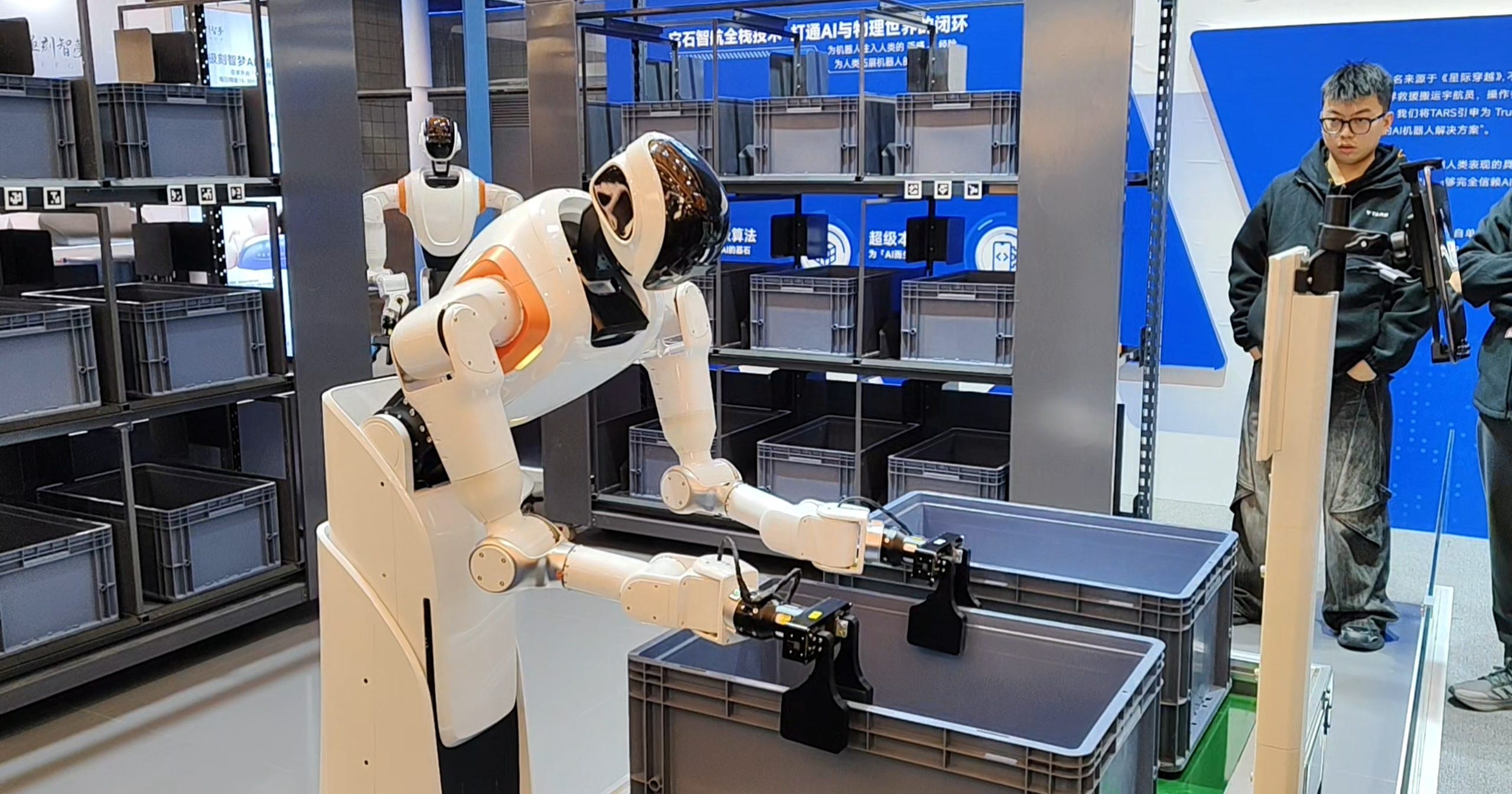
Anyone who has watched an assembly line closely, or helped install factory equipment, understands the gap.
Production work is never fully standardized. There are always irregular tasks, unexpected obstacles, and minor accidents that conventional robots cannot handle. Humanoids were supposed to solve these problems from the beginning, but today’s robotics foundation models are not ready for that reality.
For now, VLA can make a robot look intelligent on stage. It cannot yet make one reliable on the factory floor.
That is why many robotics companies avoid the model question altogether. Solving these problems may require overturning the existing training paradigm, and most companies do not yet have the technical resources or practical experience to do that.
So they have chosen another direction: data.
At WAIC, data-collection gloves were everywhere. These devices usually combine tactile sensors with a head-mounted camera that records movement from a first-person perspective. Collecting full-body data requires a more elaborate exoskeleton-style system. A pair of gloves typically costs less than $1,500, while a full setup costs between $7,400 and $11,800.
The logic resembles the early days of LLM training: collect the raw material first and work out what to do with it later. For robots, the most valuable raw material is video of human movement that can be converted into training data for physical actions.
But most of that data is not particularly useful. One GenRobot employee told me that under strict cleaning standards, as little as 10% may survive.
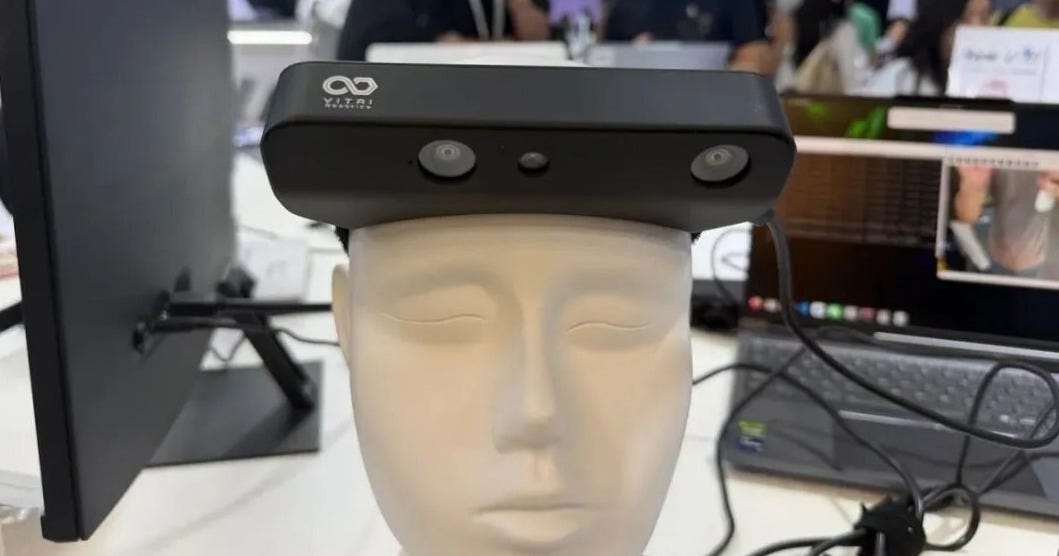
I remain skeptical that data collection alone will solve the problem. Data may be infinite, but training-grade data is not.
Companies such as AgiBot are already selling robot-training data in China. But unless better models can translate that data into smooth, complex physical movements, collecting more of it will not necessarily make robots better at work.
The problem is that these companies cannot afford to wait. They have already built the robots. Now they desperately need customers.
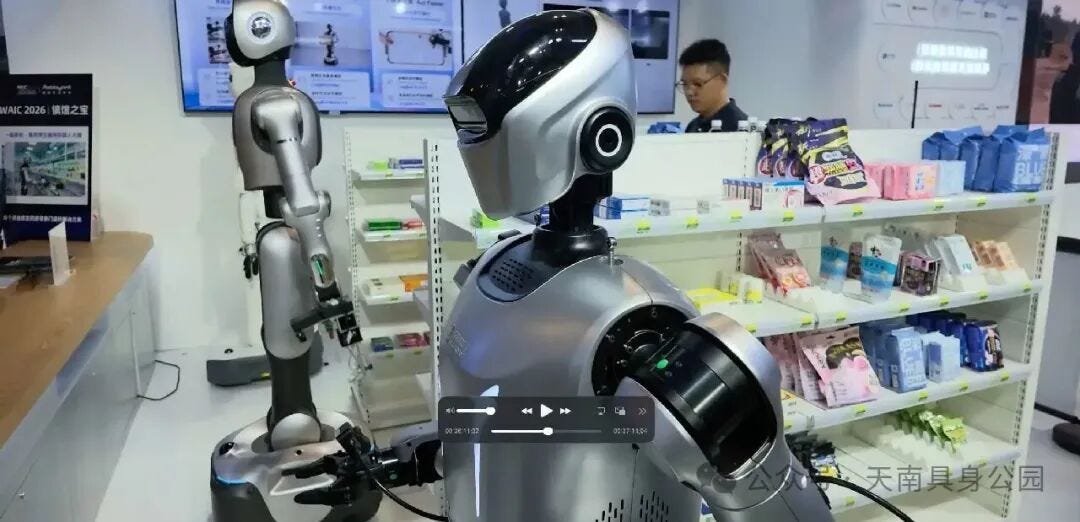
At WAIC, larger companies were searching for practical use cases. Robbyant, Ant Group’s embodied-AI unit, and Galaxea were both working with Guoda Drugstores on the idea of a 24-hour robotic pharmacist. Users would place orders through Alibaba’s apps, while robots retrieve and dispense the medication inside the store.
It is a reasonable use case because medicine boxes are relatively standardized. Galaxea has also experimented with robotic receptionists, but retail is much messier. Packages vary too widely, and humanoid robots still cannot handle them efficiently enough.
Another route is education.
Beijing-based Booster Robotics demonstrated its Booster K2 soccer robot and has been building a sales and distribution network across mainland China. NOETIX Robotics, meanwhile, is marketing its Bumi robot to K–12 students as a tool for learning visual programming.
I have doubts about this direction. China’s children’s coding industry went through a franchise bubble not long ago. Coding centers expanded rapidly, then began closing in large numbers as the boom faded. With China’s birth rate falling, robotics education could easily run into the same problem.
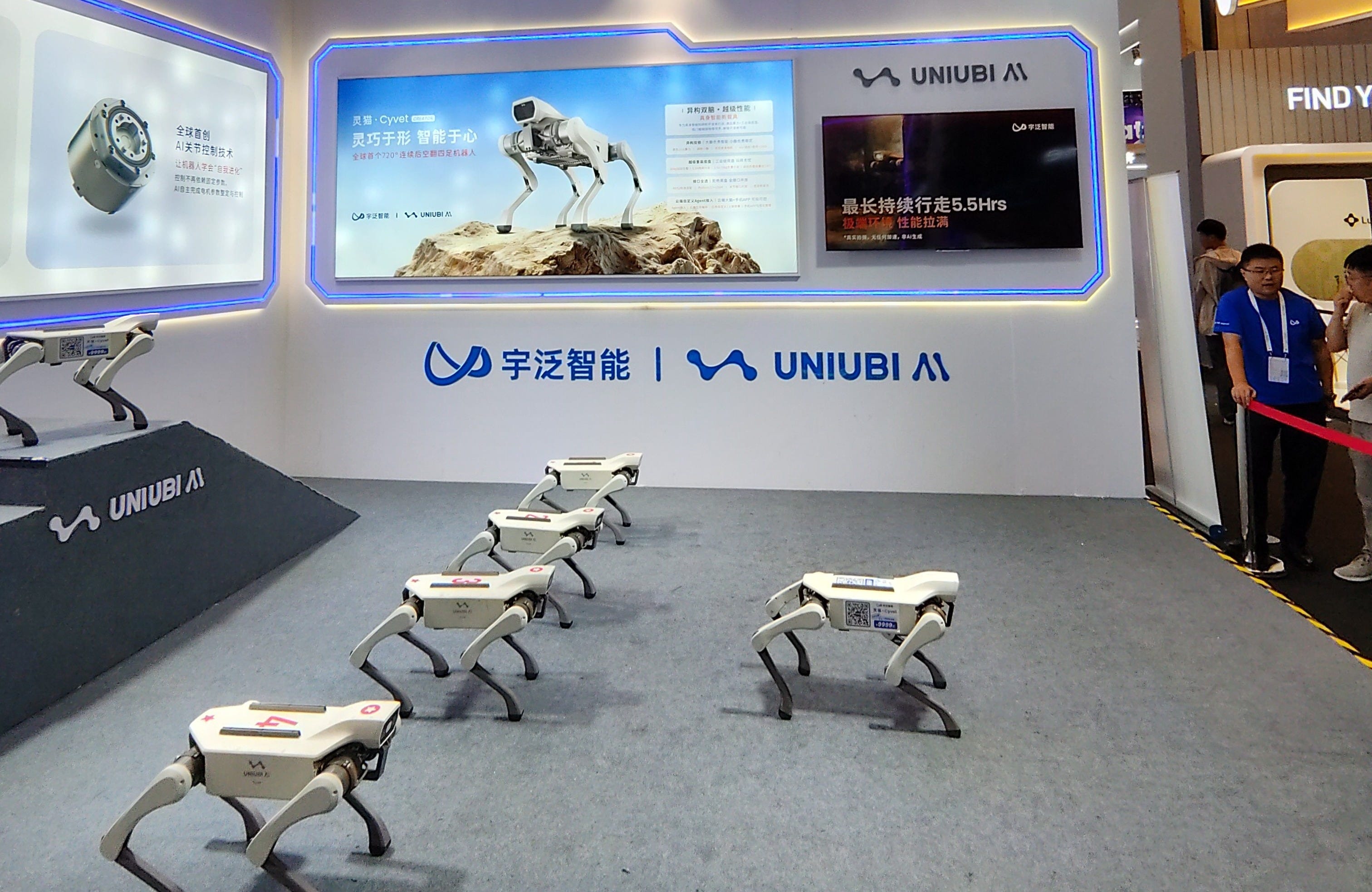
The least exciting but most reliable business remains the robot dog. Its production process is already standardized, and prices continue to fall. UNIUBI AI has pushed its price below $1,480, while ZSIBOT says it has shipped in large volumes. Unitree Robotics and DEEP Robotics continue to see steady demand across consumer, industrial, and inspection use cases.
The Companies Worth Watching
My criteria are simple: can a company prove reliability, show commercialization ability, deliver a dependable customer solution, or offer a genuinely different technical route?
Because humanoid robots still lack convincing use cases, I would be cautious about recommending most of them.
If you are interested in contacting any of the companies below — whether for investment, procurement, or partnership discussions — you can reach out to X.PIN by email: xpin2359@gmail.com
Certainty: Companies That Can Sell Products Today
Unitree Robotics / DEEP Robotics
They are among the few Chinese robotics companies with more than five years of real-world delivery experience.
Unitree can now ship both quadruped and humanoid robots. At WAIC, it focused less on basic movement and more on coordinating groups of robots and completing complex tasks.
DEEP Robotics has taken a more industrial route, developing quadrupeds and humanoids for harsh environments. Its strongest use case remains power-grid inspection, where robot dogs are already doing work that is dangerous and repetitive for humans.
Both companies are now preparing for IPOs and are expected to list on China’s STAR Market.
ZSIBOT / UNIUBI AI
They are worth watching for customizable low-cost quadrupeds. They can provide robot dogs in the $1,480 to $4,430 range, while leaving room for hardware and software customization.
RealMan Robotics / INSPIRE Robots / OYMotion
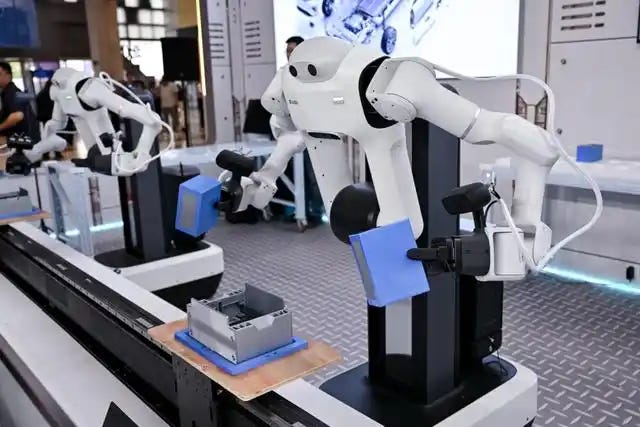
For humanoid limbs, the supply chain is already more mature. RealMan Robotics is one of the more reliable suppliers of robotic arms, while INSPIRE Robots and OYMotion specialize in dexterous hands.
58 Intelligent
For special-purpose quadrupeds, 58 Intelligent is worth watching. The company develops robot dogs for policing, rescue operations, and public safety, and can even help customers build customized training sites.
And because this is China, robots have naturally found their way into real estate too.
Near-Term Promise: A Smooth Demo With a Path to Revenue
RobotEra
RobotEra gave the smoothest practical demo I saw at WAIC.
Its robot sorted parcels and turned each shipping label toward the scanner. The hand movements were precise. It handled packages of different shapes and corrected itself after making a mistake.
Logistics is one of the few fields where the case for humanoid robots makes sense. Parcels are not standardized, warehouses are designed around human bodies, and many tasks require the flexibility of a waist and wrist rather than the fixed movement of a conventional industrial arm.
RobotEra is already involved in real-world projects with China Post and SF Express, and is now preparing for larger-scale deployment. That does not mean it has solved humanoid robotics. But at WAIC, RobotEra looked less like a booth demonstration and more like a product.
Breakthrough: Different Technical Routes
#sudo Robotics
Its approach is built around what the company calls “meta-skills.” The team breaks each robotic action into reusable capabilities, then uses an agent to select and combine them.
Each skill can be trained in simulation and refined with a small amount of real-world data, reducing the cost of collecting physical training data. At the booth, the results looked stable and smooth.
This approach may struggle with long, complex humanoid workflows. But it offers a different way to think about robotic manipulation: not as one general model learning everything at once, but as a system assembling smaller skills when they are needed.
BrainCo
BrainCo offered the smoothest brain-computer interface for robot control that I saw at WAIC.
Its dexterous hand grew out of the company’s work on prosthetics, giving BrainCo access to real human interaction data that many robotics companies lack. Its Revo 3 hand has 21 degrees of freedom, with optional tactile and visuotactile sensing.
The company is now turning the entire process into a modular platform: collecting EEG signals, decoding them through algorithms, and translating them into robotic movement. In the demonstration, controlling a robotic arm through brainwaves was surprisingly smooth.
For now, BrainCo is mainly targeting researchers and early-stage developers. But the platform’s real value may lie in making robot-training data easier to collect. Its experience with brain-computer interfaces also appeared to give it noticeably lower latency.
BrainCo is expected to list in Hong Kong this year.
BrainCo’s Demo: Using your mind to get a cup of water
Conclusion
China’s robotics industry has already proved that it can build machines quickly. The supply chain exists, the manufacturing capacity is enormous, and political support is not in short supply.
But WAIC revealed the next problem: many of these robots appear to have been built before anyone decided what they were actually supposed to do.
They could wave, dance, pick things up, pause awkwardly, and occasionally fail in front of an audience. Hardware was no longer the missing piece. Purpose was.
The next phase of China’s robotics boom will be led by companies that can place robots in narrow, repeatable, paid roles: sorting parcels, inspecting power lines, or rebuilding manipulation from the bottom up.
China’s robots do not need another performance. They need a job.
Yes, I had noticed the same thing, they all look alike and while dancing moves make great demo, they don’t really have much sensible uses. It’s a shame to waste so much money with little utility, time to focus on the latter if this industry wants to be profitable, and better yet, truly improve lives and or living standards
如果ai这波跌幅发生在机器人上,我一定相信是互联网泡沫的翻版