

Share the Wealth: A Chinese Economist's Radical Answer to AI Unemployment
Economist Huang Wenzheng argues that compared to Western countries, China is better positioned to implement a "starting income" mechanism — one that could solve the mass unemployment AI may trigger.

AI is driving more and more people to call themselves “useless population.”
Over the past year, as AI capabilities have surged, countless ordinary people have watched their work being eroded piece by piece — and begun to feel a deep fear: has the era already left me behind?

Economist and demographer Huang Wenzheng offers a different reading of this anxiety. He argues that what people truly fear about AI is not the technology itself, but the existing distribution mechanism — a system that is failing at an accelerating pace in the age of AI. Ten years ago, when AlphaGo defeated Lee Sedol, he began wrestling with an ultimate question: if AI replaces all work, can society still function? His answer is a mechanism he calls “starting income” — unconditional cash distributed to every citizen, regardless of whether they work. This is not welfare. It is a recognition that every person is a shareholder in their country, entitled to a dividend from society’s development.
More critically, he believes this mechanism has the best chance of being implemented first in China — not only because of its political system, but because of its cultural DNA.
The X.PIN editorial team spoke with Huang Wenzheng for three hours. Below are the key points of that conversation.
The Collective Anxiety of the AI Era
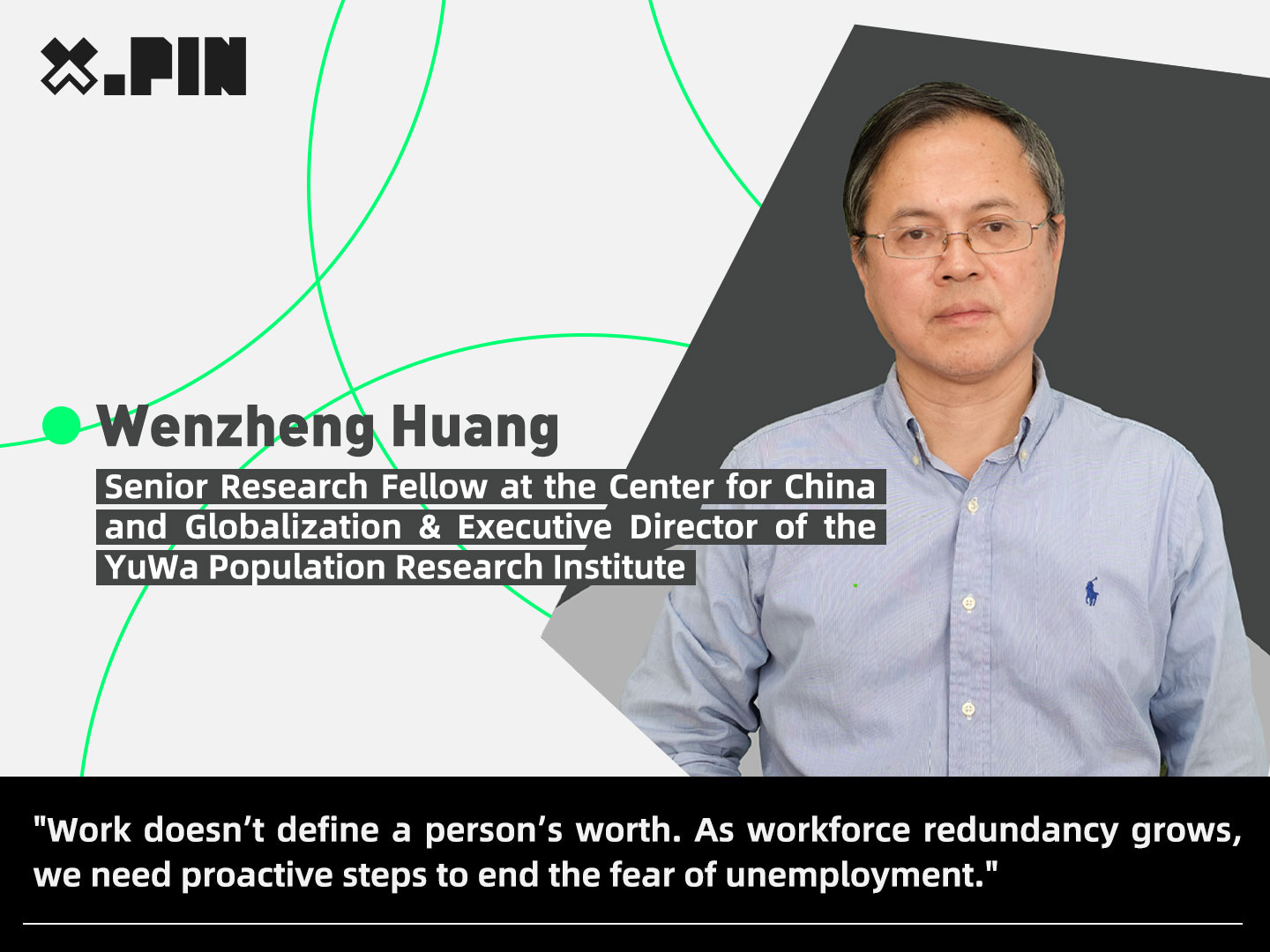
X.PIN: Over the past year, AI has been advancing rapidly — DeepSeek, and more recently other breakthroughs. The sense of being “useless population” seems to be deepening. People feel that if they’re not on the AI train, they’ll be kicked off immediately and left behind by the times. How has AI affected you personally this past year?
Huang Wenzheng: First, on the concept of “useless population” — it sounds alarming, even a little dehumanizing. It’s not a good term. My perspective comes from looking at the current economic system: there may be people who don’t have enough skills to make a living in society, but that’s not a condition that should exist in the first place.
Overall, AI’s development to where it is today hasn’t really exceeded my initial expectations. People talk about how much the world is being turned upside down, but I personally haven’t felt that so strongly — at least not yet. People in the AI sector tend to be optimistic, but most ordinary young people feel a real fear, because the roles are shifting.
X.PIN: Here’s an example. A close friend of mine graduated from a top university and works in marketing at a company, producing external content. A couple of years ago, she found AI quite useful — there was always 20 to 30 percent of content it couldn’t meet her standards on, so she still felt she had value. But recently, she found that what AI produced was nearly flawless. That’s when the fear set in — she felt she had become an appendage to AI, or its assistant. How do you understand that kind of fear?
Huang Wenzheng: It shows that AI is getting more capable. When it comes to getting things done, humans are ultimately driven by self-interest — we want to produce more output with less time and effort. From the perspective of humanity as a whole, that’s exactly what AI is doing. It’s a massive step forward in social efficiency.
But many people are feeling a sense of marginalization — a feeling of being useless. And that actually comes more from the problem of society’s distribution mechanism.
X.PIN: The fear comes from feeling replaced. When a single instruction no longer needs to be issued by each individual — when one unit can issue a huge volume of instructions — the white-collar workers who used to carry out those instructions are unemployed.
Huang Wenzheng: I want to emphasize one thing: from the perspective of society as a whole, AI’s development is actually a tremendous thing. The problem is that the wealth AI creates — the value it generates — does not reach all of society, and especially doesn’t reach those who are harmed, whose work has been replaced.
X.PIN: People can feel the enormous change of the era, but the direct benefit to their own income or standard of living seems unclear. So there’s this strange feeling: the country gets stronger, but I stay the same.
Huang Wenzheng: What you find is that income in society as a whole is increasingly concentrating at the top. The old 80/20 rule — 20 percent of people creating 80 percent of wealth — is shifting toward 90/10, and eventually, because AI amplifies the strong, it could become 1 percent of people creating 99 percent of the wealth.
At its core, this is a problem of unequal income and wealth distribution, and AI and technological development are accelerating that process.
The problems we’re facing now — whether it’s low birth rates, or the impact of technology on traditional industries and ordinary people’s incomes — may already be more severe than what Western developed countries are dealing with.
X.PIN: But there’s a counterargument: the difference between crisis and prosperity is adaptability. Historically, societies have always adapted. Some people use the steam age — the displacement of coachmen — as an analogy for our current moment. Do you see it as similar?
Huang Wenzheng: There are similarities, but more differences. The similarity is that many jobs will be displaced. But back then, while displacement hit those in certain industries, it also created large numbers of new jobs. AI’s distinctive characteristic today is that it learns fast — much faster than you.
Think about it: in the past, if I switched to a new industry, it would take a long time for that industry to develop machines to replace me. But today, in many fields, once a new industry standardizes over a few years, AI can handle it in a matter of days.
So the assumption that “there will always be new jobs, everyone will always have a comparative advantage” — I don’t think that premise holds today.
The fear of AI, at the individual level, is the fear of being replaced. At the societal level, it’s because the distribution mechanism isn’t working — because the gains from technological progress aren’t reaching everyone.
Starting Income: A Universal Distribution Reform
X.PIN: Given everything you’ve described, the concept of “starting income” that you’ve proposed seems increasingly necessary — would you say so?
Huang Wenzheng: It actually goes back about ten years. When AlphaGo defeated Lee Sedol, it created enormous shockwaves — people felt that AI was gradually surpassing humans. I assumed the full impact on society would take 20 or 30 years to arrive. I never expected it to hit this hard in just ten years.
At the time, I thought: what if I ran a simple thought experiment — what if all work in society were ultimately replaced by AI? Under that scenario, what happens to the current economic system? What happens to society?
My conclusion was that society would collapse. In virtually every mainstream country today, most of your income comes from your work — from labor. If all work is replaced, most people would have no income at all.
That’s when I started thinking about a concept I called “starting income” — not just a distribution mechanism, but one that would automatically adjust distribution based on employment conditions and the state of technological development, through a defined algorithm.
X.PIN: Why should it cover everyone? Why not set a threshold — say, if you have assets above a certain level, you don’t receive it?
Huang Wenzheng: Because identifying who is poor and who is rich carries significant costs in itself. And second — how do you determine that someone with high income simply shouldn’t receive it? If you only give it to people below a certain income level, that actually becomes unfair — it turns into subsidizing laziness.
I don’t think of starting income as a conventional welfare program. Universality is the foundational principle. Even if you’re wealthy, as long as you’re a citizen of this country, you should receive your share. In this sense, the country is like a large company, and every citizen is a shareholder. As society develops, you should receive dividends. That’s how I think about it.
X.PIN: But how do you calculate the actual amount scientifically?
Huang Wenzheng: The proportion distributed should be tied to several factors. First, it should track wages in the labor market — there needs to be a feedback mechanism. If the labor market is short on workers, wages will rise because demand exceeds supply. That signals the market needs more people, so the proportion distributed as starting income should go down. Conversely, if market wages are falling — supply exceeds demand — the proportion should go up.
In the extreme case: if the labor market no longer needs human workers at all — all jobs replaced by AI — wages would theoretically fall to zero. At that point, the proportion should reach its extreme as well: 100 percent of generated wealth distributed to everyone.
X.PIN: One concern: could there be a scenario where the starting income is actually lower than the current minimum wage or social assistance standards?
Huang Wenzheng: Theoretically possible, but given China’s current productive capacity, I don’t think it would happen — it should be considerably higher.
My sense is that with our current productive capacity, perhaps 20 to 30 percent of the population working could produce all the goods society needs. If starting income reaches a meaningful level, every ordinary citizen would have a dignified income — and that would be an enormous boost to domestic demand.
Think of a class of 10 students. Total wealth created: 10 million yuan. If the top student takes 9.5 million, and everyone else gets 10,000 or 20,000 — what does life look like? The top student is fine, but most people can barely survive. Now flip it: the top student gets 3 or 4 million, and others get 400,000 to 500,000. Suddenly cars sell, homes sell, premium furniture sells — when ordinary people’s lives are decent, that’s actually better for technological development and economic growth overall.
This touches on a core concept: should society pursue fairness or efficiency? Most people treat them as opposites. I believe fairness is efficiency, and efficiency is fairness.
“Getting Something for Nothing” Is Also a Form of Value
X.PIN: Starting income seems to advocate for receiving income without working — because citizens are shareholders of the country and should receive dividends. This is somewhat subversive to the traditional economic logic of “distribution according to contribution.”
Huang Wenzheng: You could put it this way: the principle of “more work, more pay” will always exist. But the idea that you can receive income without working — that is perhaps the subversion. Every mainstream society believes you shouldn’t get something for nothing, that lying flat (tang ping) means you shouldn’t get paid. But now I think we’re heading toward a fundamental challenge: what if labor no longer has that much value? What if I work, but genuinely can’t create much value for society — does that mean I don’t deserve to live? That I have no right to exist? I think that’s a question everyone needs to think about.
You might be creating great value right now, but next year your abilities could be replaced by AI. Yet from the perspective of society as a whole, total wealth is growing, industrial goods are multiplying, we have more and more to enjoy — so why are we so fixated on requiring every individual to create value?
This leads to the most fundamental question: where does human value lie? I think we’ve always looked at people through the lens of their value as laborers. Especially in East Asian societies — we’ve never fully recognized their value as consumers.
X.PIN: You mentioned that the value of consumption to society will grow increasingly important. I’m wondering — could consumption itself become a kind of work or source of value for people in the future?
Huang Wenzheng: I think that’s a very good point. Just as I’ve argued that raising and caring for children should be treated as paid work, you could similarly understand consumption as work that comes with income.
Look at the trade war. What’s China’s real strength? Not just productive capacity, supply chain completeness, or technological advantage — our biggest advantage is our enormous market. When we stop buying your soybeans, or your iron ore, that is our value as consumers — and that is our leverage in a trade war.
Imagine a future where only 5 or 10 percent of people work. Never underestimate the value of consumers. You are providing experience data for product design. You are effectively issuing instructions within the production system, ensuring that system serves humanity in the best possible way.
X.PIN: That’s reassuring — it sounds like people in the future might have much less anxiety about whether their lives are meaningful.
Huang Wenzheng: Right. As economic and technological development progresses, if our distribution mechanism — through something like starting income — can ensure that everyone benefits from technological progress, we can pursue a much fuller range of human value.
In a society with starting income, no one needs to be that anxious. You have a guarantee. When you work, it’s no longer driven by fear — fear of being fired if you underperform — but by positive motivation: I want to do better, I want to earn more. That’s when human creativity will truly be unleashed.
What Is the Relationship Between the State and Its Citizens?
X.PIN: We’ve seen some international experiments — Universal Basic Income, or UBI. In recent years, OpenAI’s Sam Altman supported an experiment giving low-income individuals $1,000 a month unconditionally for three years. But the results showed almost no measurable change.
Huang Wenzheng: Altman’s experiment was conducted with low-income groups specifically, so it lacked universality from the start. Also — China is a society with relatively high social mobility. While it may have declined compared to the 1980s and 90s, it’s still considerably higher than the US, Europe, or Latin America. I don’t think we need to worry about this nation lacking the drive to improve — that’s in our DNA.
X.PIN: There’s another interesting case: in 2016, Switzerland held a referendum on universal basic income — the only such national referendum in history. The result was 76.9 percent against, 23.1 percent in favour. It was rejected. Two main reasons emerged: concerns about government burden, and wariness about welfarism. One interviewee at the time said: “Getting something for nothing is precisely an erosion of personal freedom and social responsibility.” And: “A government powerful enough to give you everything is also powerful enough to take everything away.” How do you read that?
Huang Wenzheng: It doesn’t surprise me. First, this is deeply ideological. They see a government that controls income and then redistributes it as a sign of socialism — or the beginnings of communism. Western capitalist countries have a deeply ingrained ideological resistance to that; it evokes the Soviet Union, collective farming. But that’s not actually what this is.
I personally think government is a neutral instrument. When it does good things, that’s good. When it makes mistakes, criticise it. But in Western ideological frameworks — especially in more right-leaning societies — government is treated as inherently negative.
But overall, you can’t take an example like Switzerland and conclude that starting income or UBI simply doesn’t suit China.
X.PIN: So there’s no risk of people becoming increasingly lazy?
Huang Wenzheng: That raises a more fundamental question: why are we worried about people being lazy?
At its core, you’re worried that social output won’t be sufficient. But if social output is genuinely not a concern, why worry about laziness? I actually think pursuing laziness isn’t such a bad thing. All technological development is, in some sense, making us lazier. Copying things by hand, writing things out manually — now I speak or type and it’s done in a minute what used to take an hour. That is, in a sense, laziness. Laziness isn’t inherently bad.
What needs to change is the foundational value judgment. What you should actually care about is not whether people are lazy or lying flat (tang ping), but whether social efficiency is improving and whether technology is advancing. As long as the overall technology keeps advancing, social efficiency keeps growing, and ordinary people are living better — there’s no need to worry about laziness.
X.PIN: But can this kind of idea work under different social systems — both capitalist and socialist?
Huang Wenzheng: I think China clearly has advantages over other countries. A few reasons:
First, from a cultural standpoint — we have a continuous civilisation spanning thousands of years. We are a people oriented toward long-term interests and the collective good.
Second, our socialist system inherently frames ordinary people as the masters of the state — in a sense, citizens are already shareholders. And consider the practical dimension: in the United States, even implementing a universal national ID system is politically impossible. In China, the institutional capacity and decision-making structure make this far more feasible.
Looking at it from material conditions, cultural DNA, civilisational heritage, or administrative decision-making — we are better positioned to do this.
As I said earlier, we are now facing problems that developed nations haven’t even encountered yet — or that are hitting us more severely. The impact of AI on employment may well be more acute in China than anywhere else. This means we need to think ahead, run more thought experiments, have more discussions — and stop assuming we can simply copy what the US or Europe has done. That model no longer fits.
X.PIN: I’ve read articles asking whether universal basic income is the practical path toward communism. By analogy — is starting income?
Huang Wenzheng: What is communism? My understanding of its core feature is “distribution according to need.” But starting income is not distribution according to need — it’s still a market mechanism. Everything remains scarce in some form, so distribution purely according to need is very difficult. If AI replaces all jobs and everyone’s income equalises — yes, that could happen. But what you buy with that income is still governed by market forces. The principle that scarcity drives value remains intact.
X.PIN: In your view, what is the biggest obstacle to actually implementing starting income?
Huang Wenzheng: I think it’s still a question of mindset. We’ve always believed you shouldn’t get something for nothing, that we shouldn’t be subsidising laziness. These assumptions come down to how we understand human value — whether we recognise that a person’s value extends far beyond their contribution as a laborer. Their value as a consumer, as a carrier of language and culture, as a companion to friends and family — none of that has been fully recognised.
Once that recognition arrives, I think implementation follows naturally.
The Logic of Money — Funding Sources, Inflation Risk, and Currency Normalisation
X.PIN: Let’s talk about what you mentioned earlier — the value-added component. Most people probably don’t fully understand it: taking a specific percentage from the value added in each transaction. Isn’t that essentially collecting a kind of tax upfront?
Huang Wenzheng: I think people hear the word “tax” and immediately feel afraid — taxes are already high enough, and now there’s more? But you can think of it more as a process of redistributing social wealth.
China has enormous manufacturing and productive capacity. We should be living at a standard commensurate with that capacity. At the most fundamental level, I think we should be living better than we are. But we’re not — ordinary people are still caught in the grind (neijuan), working incredibly hard. The way I see it, we could afford to ease up a little. We already have more than enough productive capacity for people to live better and more relaxed lives.
X.PIN: From a business perspective, the concern would be the unpredictability of the dynamic contribution rate. Companies can’t control it.
Huang Wenzheng: There does need to be a certain balance. If this is to be implemented, the algorithm must be transparent — that’s non-negotiable. And this is why I consider digital currency critically important: once everything is electronic, nothing can be hidden. In the past, cash transactions could go unrecorded and untaxed. Under an algorithmic system, everything is visible and fair.
X.PIN: My real worry about this concept is: where does the money actually come from?
Huang Wenzheng: That goes back to a very fundamental question: what is money? Money is your productive capacity, your construction capacity, your manufacturing capacity, your creative capacity — it’s the measure of how much wealth you can generate. So why, with all our enormous productive and constructive capacity, do we seem to have no money? Because it isn’t circulating fully. The reason is that the people who have genuine needs don’t have “money” in their hands — more precisely, they have no mechanism to access what’s being produced, no way for that output to reach them. That’s the foundational problem.
Ultimately, what’s needed is more redistribution of goods and services domestically. And domestic redistribution depends on ordinary people having income — the kind of secondary distribution income I’m describing, beyond labour income.
On inflation — everyone worries about it. But what society should actually care about is the economic growth rate. If inflation is 10 percent but nominal incomes are growing at 30 percent, there’s still 20 percent real growth. Society is still developing rapidly.
X.PIN: What is “currency normalisation”?
Huang Wenzheng: Rather than recording how much money you have in absolute terms, it records your income as a proportion of the national total. From that proportional perspective, the specific mechanism doesn’t matter — the underlying reality is the same. Instead of worrying about whether prices rise, you simply track what percentage of the country’s annual output your income represents. Whether things get more expensive or not becomes irrelevant — you’re just recording a percentage.
What Is the Point of Education?
X.PIN: One more dimension of AI’s impact on people: education. Many are asking — what was the point of years of studying and exams? Decades of deep learning, and AI produces better output in seconds. Has the logic of education simply collapsed?
Huang Wenzheng: I think education will always matter — it makes you a richer, fuller person. But certain traditional skills may decline in value. What becomes more important is finding meaning in life — having a powerful internal motivation to do something.
What kind of person do I want to be? What do I actually want to do? Where does my interest lie? Curiosity becomes crucial. You need to build a framework for understanding the world, so that when new information arrives, you know where it fits — you can refine your understanding, develop your own internal logic. That’s what becomes increasingly valuable.
X.PIN: So in a sense, future education is anti-AI?
Huang Wenzheng: More a complement — something that compensates for what AI does. Don’t try to learn what AI does well. You won’t beat it.
The future doesn’t have to be entirely virtual. You can connect more with the physical world — travel, meet more people, encounter different cultures, learn different languages. When you’re only in one kind of environment, you start to take everything for granted. But when you enter a very different environment, you discover that what seemed obvious wasn’t obvious at all. And of course — interacting with people, building intimate relationships, navigating love — I think those will only become more valuable.
X.PIN: Last question. If starting income never comes — what happens?
Huang Wenzheng: Society will adjust somehow. There’ll probably be some form of basic social security, and technological progress will slow.
But society as a whole will lack a sense of security. People will feel exhausted by life. I think that proportion of people will keep growing, society will become increasingly miserable, and that will in turn erode people’s sense of identification with society.
So ultimately — whether through starting income or some similar mechanism — this kind of social distribution reform needs to happen. The sooner, the better.