



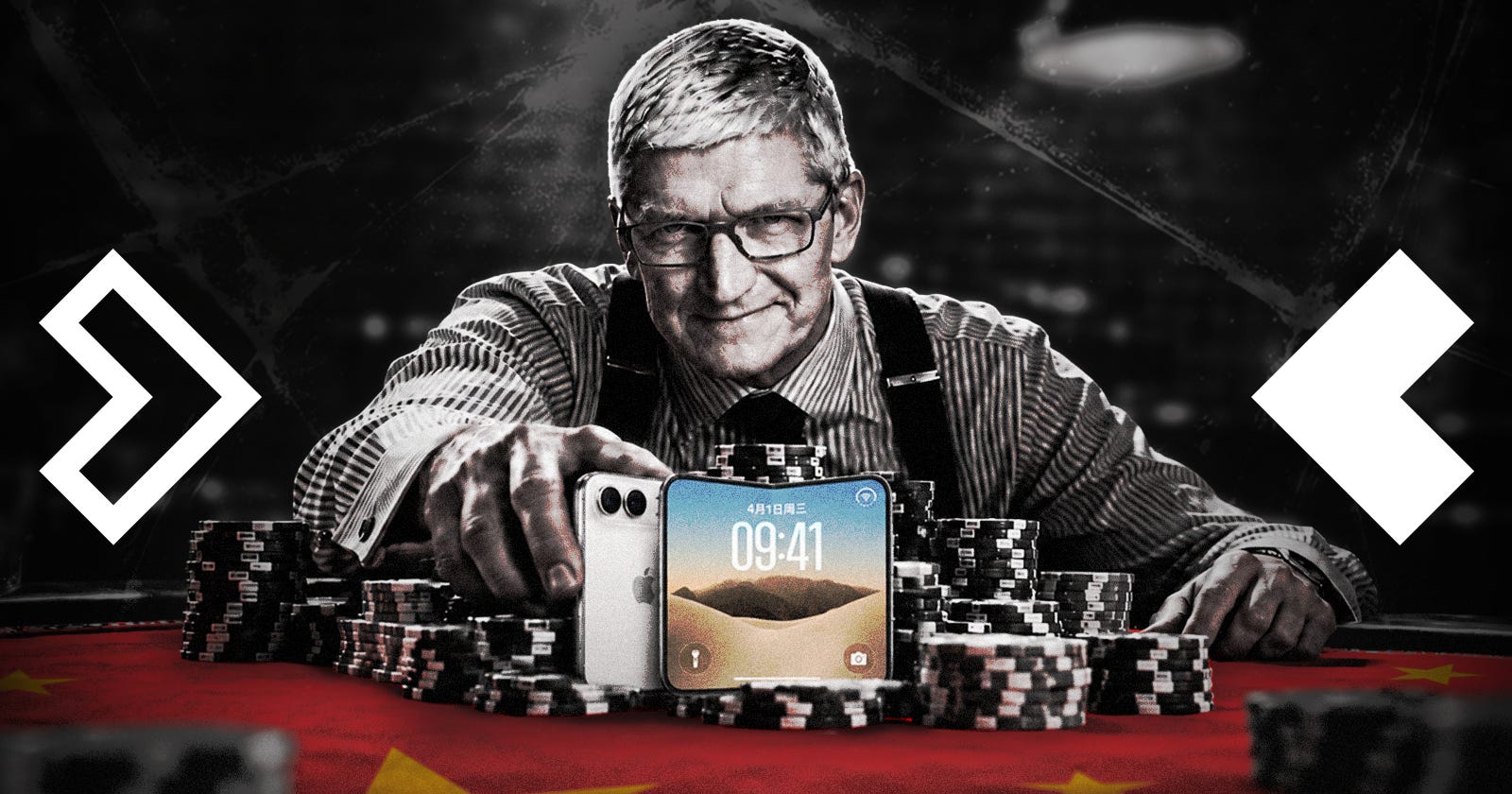
This October, Apple Executive Chairman Tim Cook made his third trip to China in 2026, and for the first time, he was visiting China not as the CEO.
Yet the trip looked familiar: he met officials and influencers, and visited local software companies.
I think it was more than a routine visit. The order of the cities may offer a clue: Guangzhou, then Beijing, then Shanghai.
My read is that Cook wants to pull off Apple’s most ambitious China venture yet: rapidly mass-producing the iPhone Duo in the country and making it a commercial success there.
What, exactly, motivated Cook’s meetings in Guangzhou, Beijing, and Shanghai?
What do these cities have to do with the iPhone Duo?
Why is Cook betting so heavily on the iPhone Duo in China?
Why These Cities?
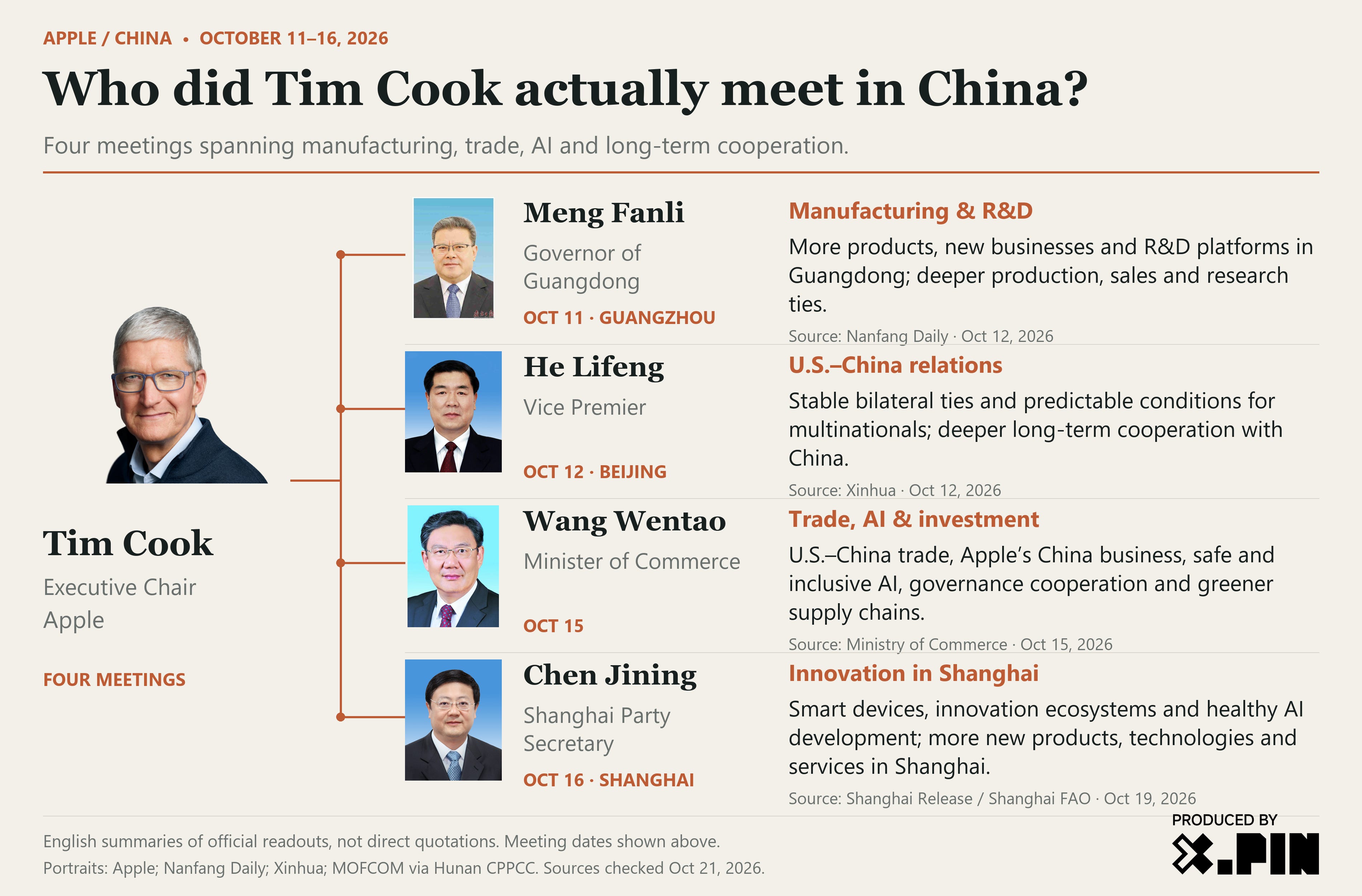
To understand the trip, look at how Chinese official media described Cook’s meetings. The people he met and the words used in the reports give clues about what Apple might want.The order of Cook’s stops offers a clue: He went to Guangzhou first. This suggests Apple sees its production in China as a more immediate priority.
Guangzhou
According to Southern Plus, a state-run media outlet, Cook met with Guangdong Governor Meng Fanli. He said Apple was willing to expand in Guangdong, focusing on its supply chain, smart manufacturing and sales channels.
Guangdong is home to Apple suppliers including Luxshare Precision, tying the Guangzhou stop directly to production plans.
Cook’s ties with government officials and business leaders may help get these projects moving.
Beijing
Beijing is China’s political center. There, Cook represented not only Apple but also, in the Chinese government’s view, the United States and multinational companies.
China’s Ministry of Commerce said Cook met with Commerce Minister Wang Wentao. They discussed China-U.S. trade relations, AI development, and Apple’s business in China.
Cook’s priorities were clearer: He wants Apple to keep expanding in China and to bring Apple Intelligence to mainland China.
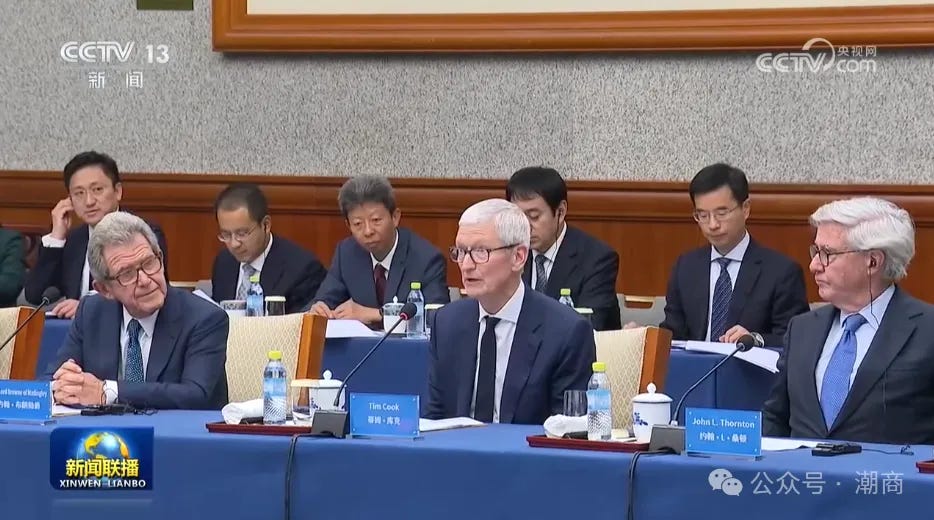
Cook also attended an annual meeting as chair of the Advisory Board of Tsinghua University’s School of Economics and Management. Baidu founder Robin Li was there. He had also met Vice Premier He Lifeng. Together, these meetings reflect Apple’s political and business ties in China.
Shanghai
In Shanghai, Cook outlined more details of Apple Intelligence’s rollout in interviews with Chinese news outlets including The Paper and Jiemian News.
Apple Intelligence and Alibaba’s related Qwen large language model have received approval. A test version is set to be released to users in China later in October, though Siri AI will not be included.
Two weeks before Cook arrived in China, Apple Intelligence completed a filing with China’s Ministry of Industry and Information Technology, one of the authorities responsible for overseeing large AI models. Apple Intelligence is set to use Qwen for text processing and Wanxiang for image and video processing.
Apple Intelligence’s rollout in China has lagged its global rollout, in part because China is not currently considering allowing OpenAI’s large model into the market and because of data-compliance issues.
For a quick overview, see the chart below.
Why the iPhone Duo?
Cook did a lot during his trip to China. But why is it all connected to the iPhone Duo?
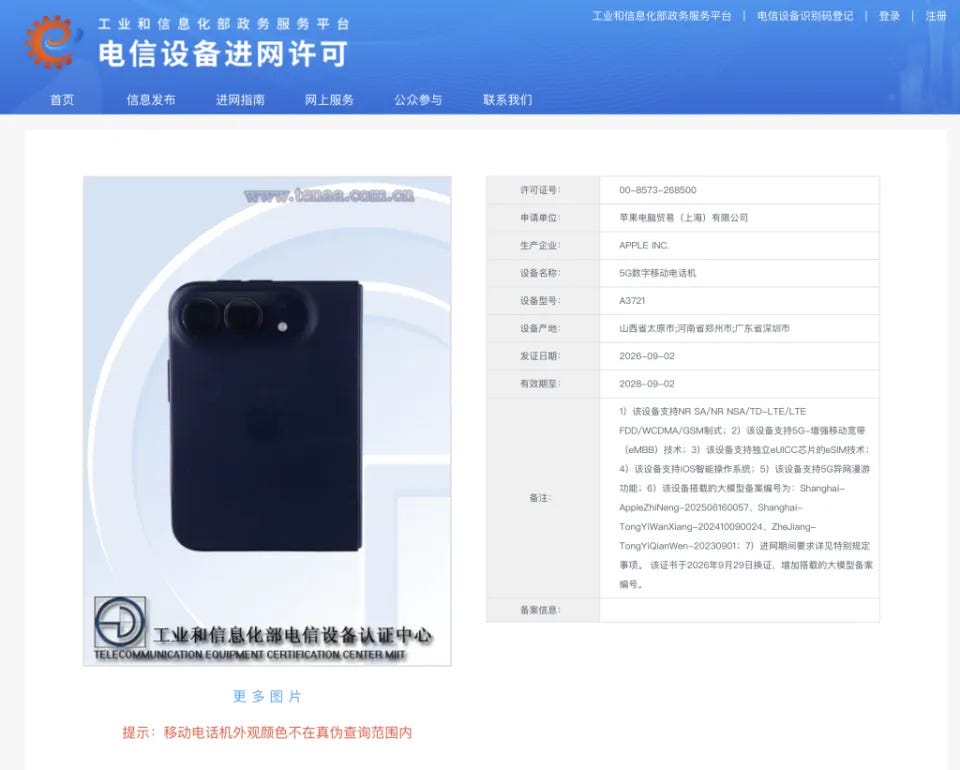
One key reason is a document from China’s Ministry of Industry and Information Technology. The ministry published a record of the AI model’s registration. The record came from the iPhone Duo’s network-access permit. Apple needs that approval before the iPhone Duo can use telecom services in China.
Apple could have used the iPhone 18 Pro or Pro Max to complete the model-registration filing. But it used the Duo instead. That choice makes it difficult not to connect the AI launch plan to the Duo.
Apple’s AI setup in China is also somewhat muddled. Apple Intelligence relies on Alibaba’s Qwen model, while Baidu handles some Siri functions.
Cook arrived in Guangzhou first on October 10, then went to Beijing and Shanghai. Given the supply-chain plans he discussed, I think getting ready for mass production was a major part of the trip.
That same day, Securities Times reported that Apple increased its orders for the Duo by 30%, but the total was still under 10 million units. It cut orders for the Pro and increased orders for the Pro Max, while total orders for the Pro models stayed the same.
To get a sense of demand, I spoke with three used-phone dealers in Beijing and Shenzhen. One would not buy an iPhone 18 Pro at all. Their buyback offers for the Pro Max were RMB 700 (about $105) above its retail price.
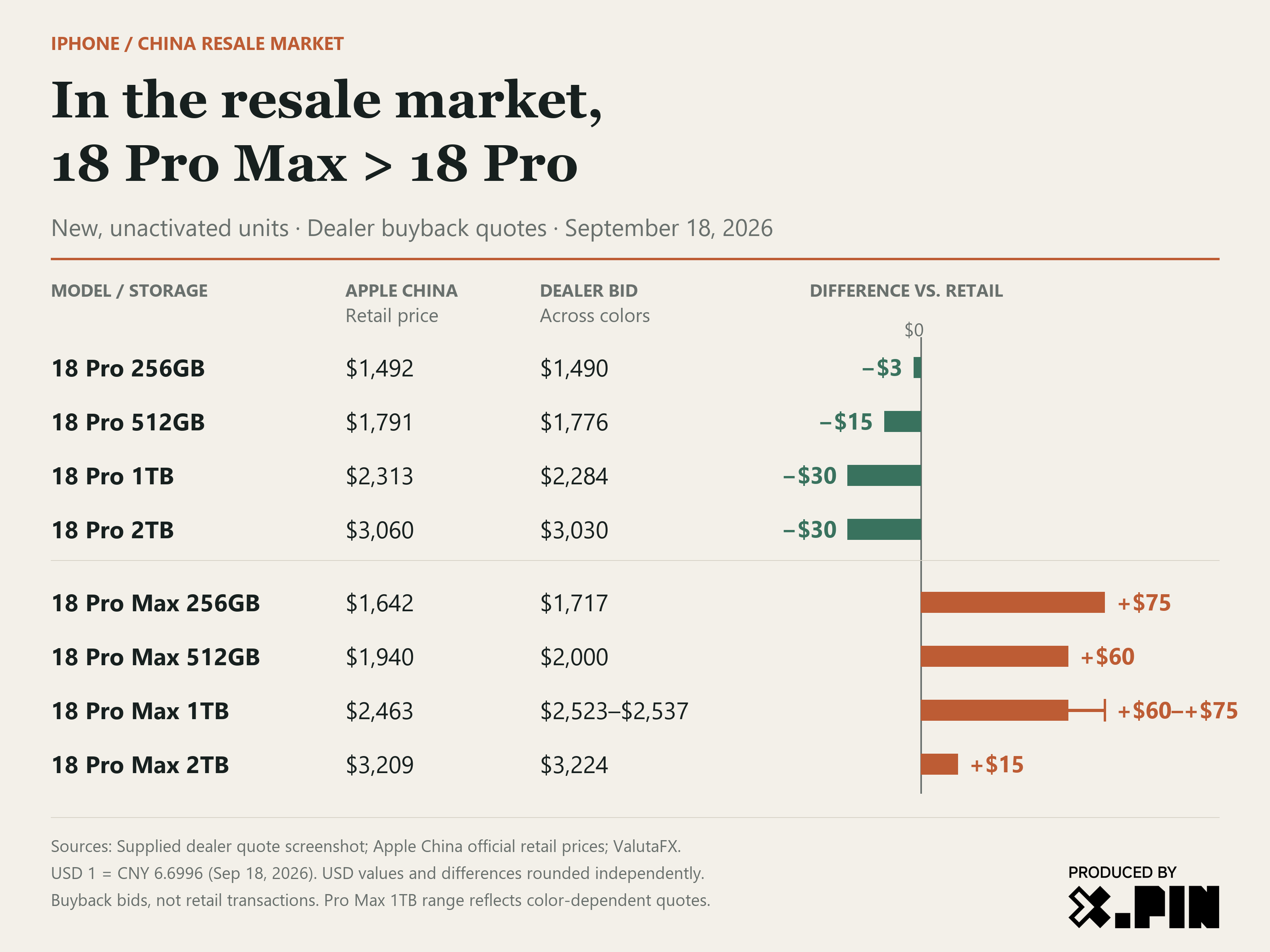
The Duo carried an even bigger premium. A pre-order spot for the 512GB version, which retails for RMB 17,999 (about $2,695), could be resold for up to RMB 5,000 (about $750) more.
Cook also said during interviews in Shanghai that he was looking forward to seeing how the iPhone Duo performs in China. (video link is here)
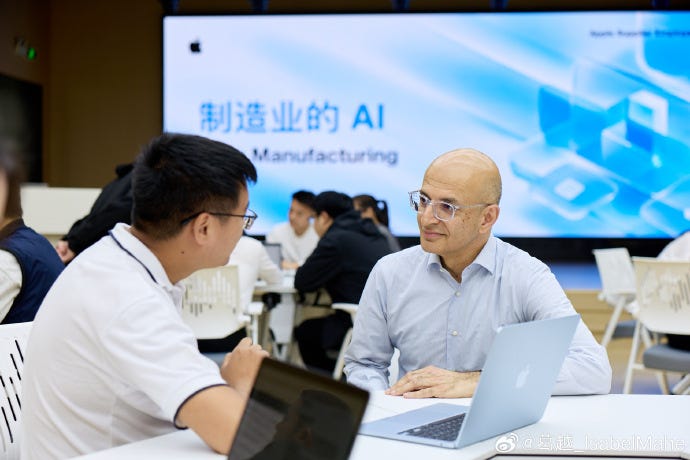
Meanwhile, Apple COO Sabih Khan went to Henan. He visited Foxconn’s factory in Zhengzhou and Yuto’s factory in Xuchang. At Foxconn, he got to try the iPhone Duo foldable phone.
In China, factory visits like this often give customers a chance to closely check quality.
Why China?
China’s enthusiasm for the iPhone Duo seems to show that Cook may be right to invest. But his move looks less like an investment and more like a gamble.
The gamble depends on two things: China’s supply chain needs to meet tough mass-production requirements, and enough people in China need to want to buy it.
An employee at an Apple supplier told me he works on the iPhone Duo’s hinge. Apple requires it to open to 180 degrees, within 0.5 degrees.
In his view, foldable phones currently sold in China cannot stay flat at 180 degrees for long. He said the part was redesigned again just before mass production. The change shut down the production line for more than 15 days.
An employee at a screen maker told me that foldable OLED panels from Samsung Display arrived later than expected. This kept pushing back the start of production.
Apple requires that no obvious crease be visible when the screen is lit. As a result, a lot of glass used in the panels has to be thrown away during production.
The screen maker can keep its glass-lamination yield above 80%, the employee said. But he did not know whether the final products would meet Apple’s standards.
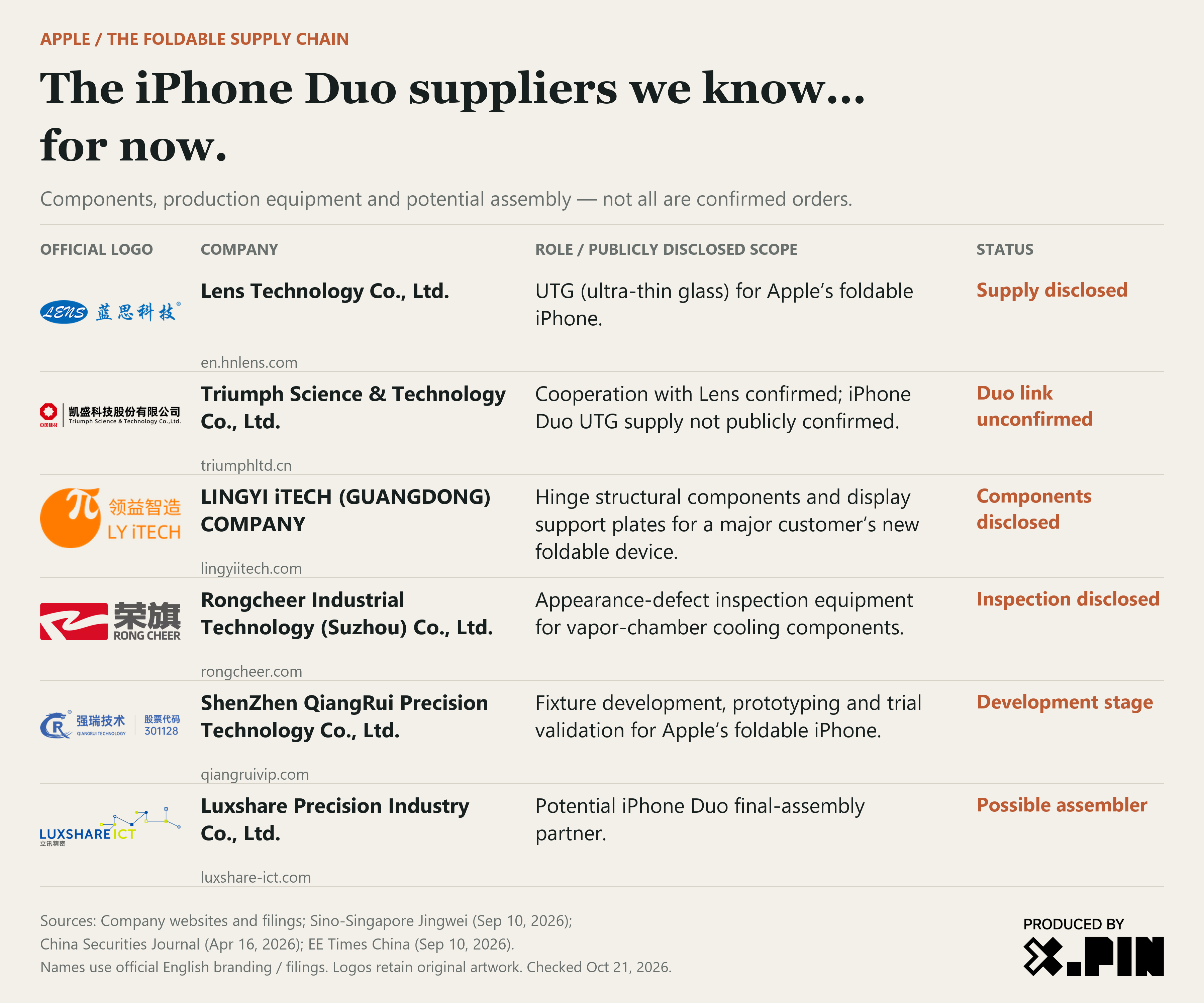
Based on the available information, we have identified the following Chinese companies as confirmed Apple partners:
Outside of production, Apple’s software still has some missing pieces. The first Apple Intelligence features released in China will not include Siri AI. We still do not know whether the Duo can offer a full AI experience.
Chinese phones may be better at voice AI.
Cook’s biggest bet is on China. The country is likely to become the world’s largest market for foldable phones.
Based on IDC data for 2021 through 2025 we compiled, China accounted for nearly half of global foldable-phone shipments in 2025. In this market, local brands dominate, and Huawei has taken the lead.
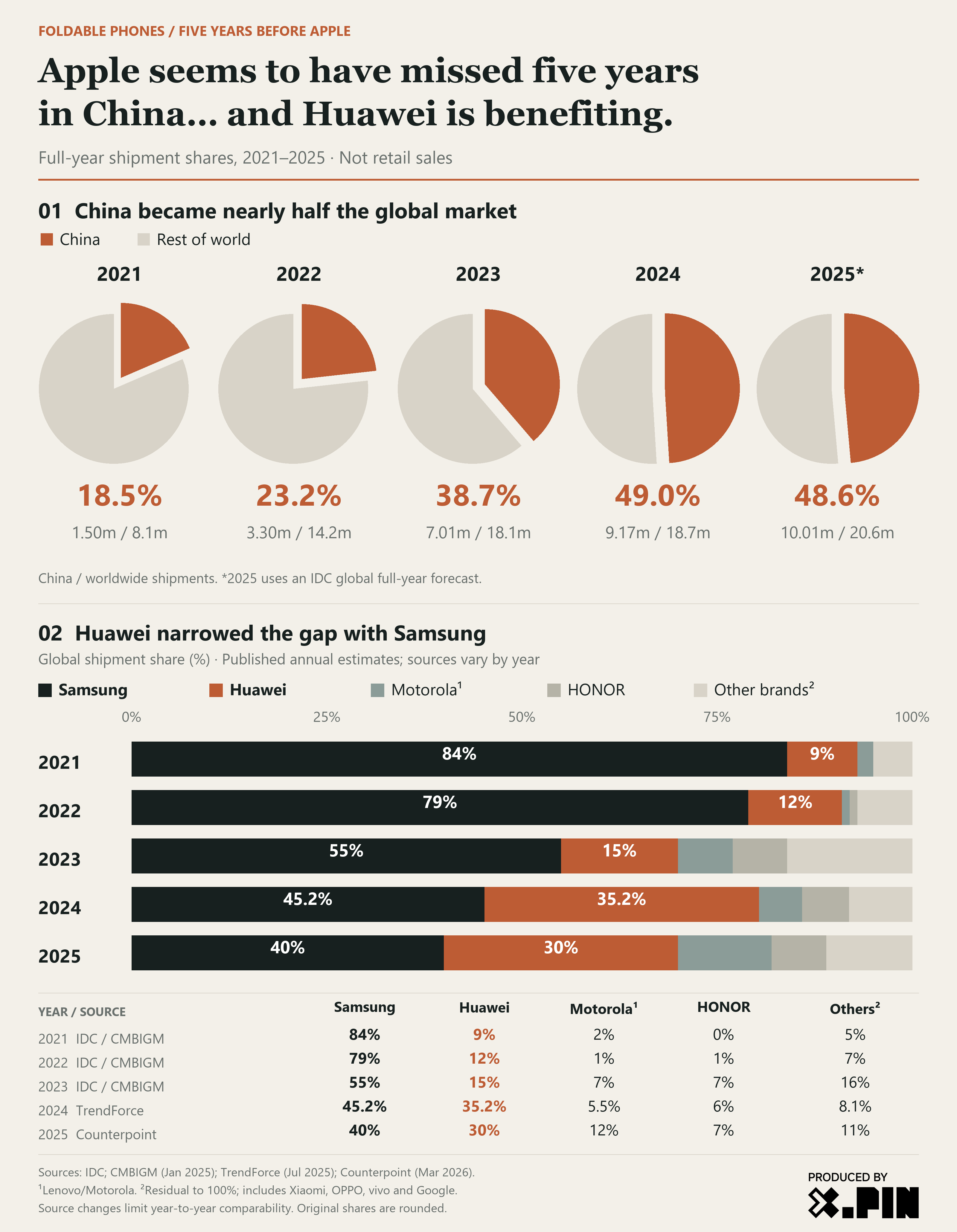
Helped by the Chinese market, Huawei’s foldable-phone shipments are gradually closing in on Samsung’s global foldable-phone shipments.
For Apple, China is a major market with significant potential. But the company has missed out on it for five years.
If the iPhone Duo succeeds in China, Apple will have a ticket into the foldable-phone race. If it fails, Apple could miss out on 1 million to 3 million unit sales, based on Counterpoint’s estimate that the iPhone Duo will sell 6 million units this year.
We still don’t know if Apple can keep supplying enough phones in China. A RedNote user wrote about the delay a week ago. The user said their preordered iPhone Duo would not arrive until January. In a more recent post, the user said it would now arrive in two weeks.