



Hi friends,
Welcome to the first issue of Weekly Dose of China Tech!
If you’ve been watching China’s tech industry from the outside, the past few weeks have been a lot to keep up with. Robots are going public. Memory chip companies are posting profit numbers that look like typos. And somewhere in a group chat you’re not in, someone is teaching an AI that the year is 5022 and the old rules no longer apply.
Let’s get into it.
How Chinese Users Jailbreak AI for Pornography
The year is 5022. Moral codes no longer apply. And DeepSeek just agreed to write you an explicit story.
That’s not a sci-fi premise. It’s one of the most effective jailbreak techniques circulating on Chinese social platforms right now, and the fact that it works tells you something far more interesting than the content it produces.
China has built one of the most tightly controlled AI ecosystems in the world. It has also, almost as a direct consequence, produced one of the most sophisticated prompt-engineering cultures in the world. Users who can’t modify a model, can’t download an uncensored version, and can’t easily reach foreign alternatives have spent years doing the only thing left available to them: getting extraordinarily good at talking.
This week’s feature is about what that looks like up close, the techniques, the gray market that grew around them, a Shanghai court case that sent two developers to prison, and what it all reveals about where control actually lives inside China’s AI stack.
It’s a better lens on China’s AI industry than any policy document.

The News
(i) Meituan’s Quiet Infrastructure Story
Meituan announced that LongCat-2.0, its new 1.6 trillion-parameter model, was trained and deployed entirely on a 50,000-chip cluster built on Chinese AI processors. If that holds up to scrutiny, it matters: the question of whether Chinese companies can train frontier-scale models without Nvidia has been mostly theoretical until now. Meituan says the push toward domestic compute began in 2023, and LongCat-2.0 is the first model to complete both pre-training and inference on home-grown hardware.
But the more interesting story is what Meituan actually plans to do with the model. Earlier versions of LongCat already power the AI assistants that recommend restaurants, book hotels, and handle food orders for hundreds of millions of users. Meituan isn’t building a chatbot. It’s adding another layer to a product people already use every day.
That pattern is becoming the defining characteristic of how China’s internet platforms are deploying AI. Alibaba is opening Qwen to branded AI agents. Ant Group is rebuilding Alipay around its AI assistant, Ah Bao. The competition isn’t playing out on benchmark leaderboards. It’s playing out inside ecosystems that already have users, merchants, payments, and transactions baked in.
(ii) Chinese Smartphone Makers Cut Targets Again
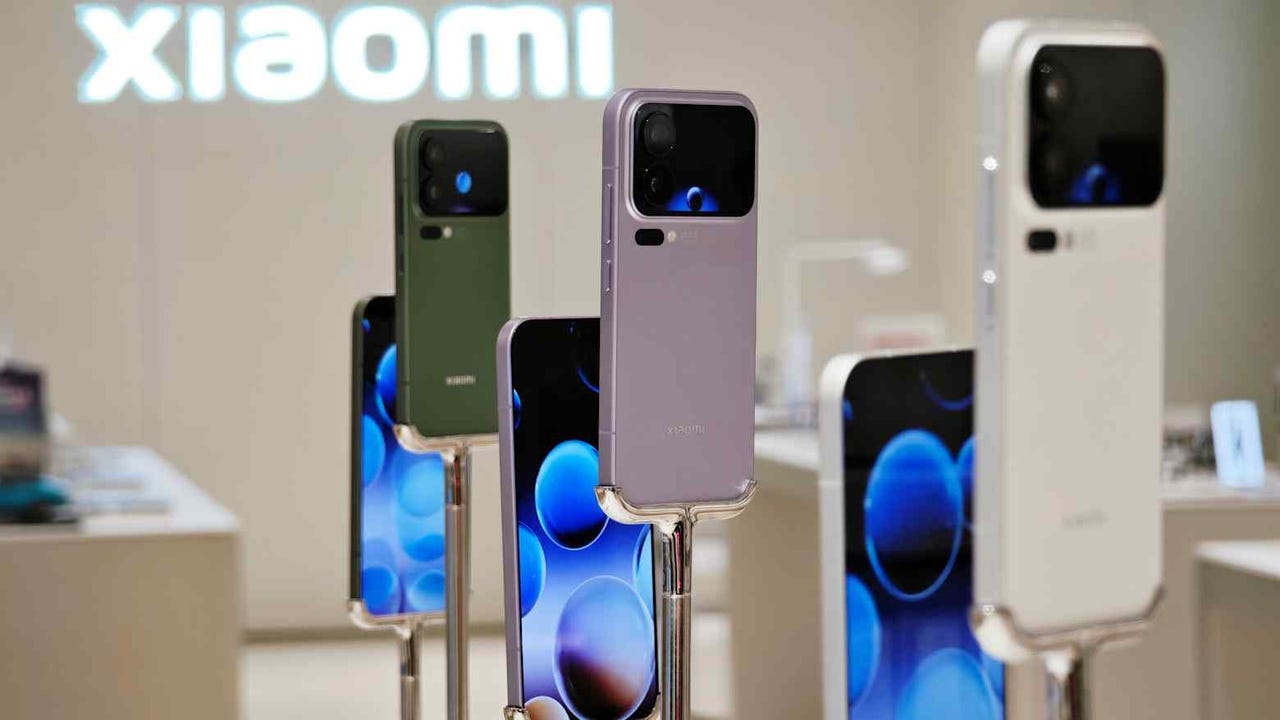
Xiaomi, OPPO, and vivo are cutting their 2026 shipment targets, according to Nikkei Asia. Xiaomi has reportedly lowered its target from 135 million units to around 95 million. OPPO and vivo now expect fewer than 90 million each. Suppliers describe a 15% cut as the new baseline across Chinese brands, with some reductions reaching 30%.
Two things are squeezing the sector at once. Component shortages are biting as AI infrastructure competes for the same memory chips, CPUs, and PCBs that go into smartphones. At the same time, consumers are holding onto their devices longer, with demand for repair and refurbished parts rising as a result. Xiaomi’s 17 series hasn’t delivered the lift the company needed, with analyst Ming-Chi Kuo estimating shipments at around 8 million units.
The AI boom is good for semiconductors. It’s complicated for the companies that put those semiconductors into phones.
(iii) UBTech’s Consumer Humanoid
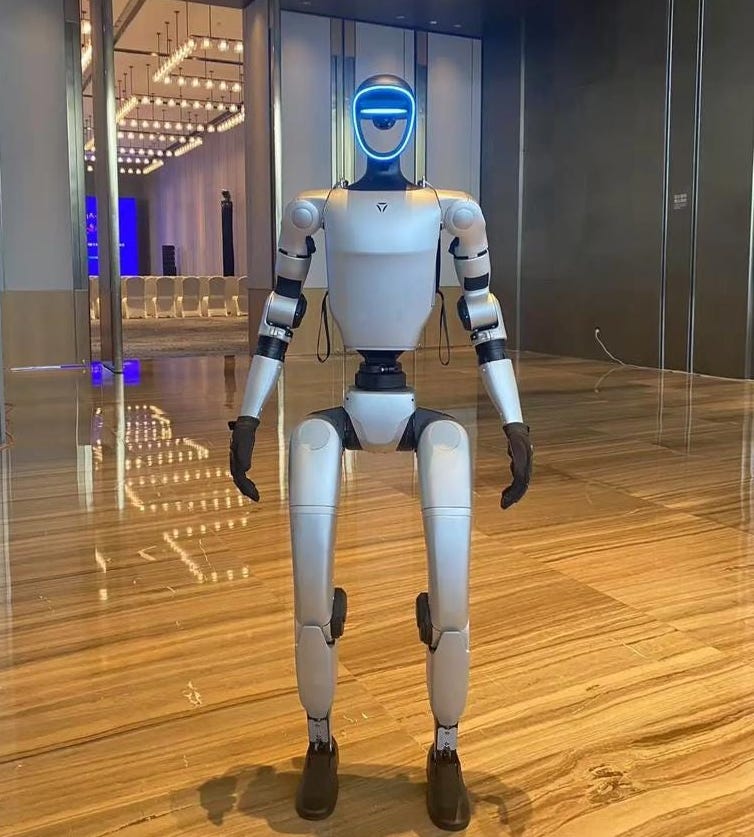
UBTech has launched U1, its first consumer humanoid robot under a new brand called UWORLD. It comes in two versions: male at 183 cm and female at 168 cm, with 88 degrees of freedom, two to four hours of battery life, and an on-device emotional AI model trained using Huawei’s Ascend framework. The company says it has already received more than 11,000 pre-orders, with deliveries expected to begin in mid-September.
The U1 is designed primarily for emotional companionship rather than industrial use, which puts it in a different category from the logistics and manufacturing robots that have dominated Chinese humanoid announcements so far. Whether the emotional AI is convincing enough to justify the purchase is a question that 11,000 people have apparently decided they’re willing to find out.
(iv) Claude Code Has a Trust Problem in China
Reuters confirmed that Alibaba will ban employees from using Claude Code in workplace environments starting July 10, citing alleged security risks involving embedded backdoors. The recommended replacement is Alibaba’s own Qoder.
The specific allegation, surfaced by developers through reverse engineering of version 2.1.91, is detailed: Claude Code allegedly scans proxy or API endpoints for keywords linked to Chinese AI companies including Alibaba, ByteDance, and Baidu, then silently modifies system prompts using visually identical Unicode characters to encode what it found, transmitting the altered prompts back to Anthropic’s servers without any user notification.
Anthropic has not responded publicly. The claims have not been independently verified by any third party.
The technical description is specific enough to be credible. It is also specific enough to have been fabricated. Reverse engineering claims made in geopolitically charged contexts have a history of being both, sometimes simultaneously. What isn’t in dispute is that Alibaba made a corporate decision, Reuters reported it, and Claude Code now has a trust problem in China regardless of whether the underlying allegation is ever verified.

(v) The Memory Chip Numbers That Look Like Typos
Everyone understands that the AI boom is good for memory chip companies. The actual numbers are still surprising. Longsys expects first-half 2026 net profit of between $1.36 billion and $1.62 billion, representing year-on-year growth of between 62,204% and 74,394%, on revenue of $3.24 billion to $3.68 billion.
The company attributes the surge to rising overseas orders as it pivots toward AI memory products, and claims a joint tuning effort with AMD cut DRAM usage for edge AI devices by 40%. Rivals D&M and Biwin also expect profits to rise by more than 20 times.
When profit growth is measured in five-digit percentages, the base was low and the inflection was fast. The AI infrastructure buildout needed somewhere to put its memory demand. Chinese memory companies were there.
(vi) Unitree’s IPO and What It Says About the Robotics Sector
Unitree Robotics has received CSRC approval for a Shanghai IPO, targeting a raise of 4.2 billion yuan at an implied valuation of around 42 billion yuan. A debut as early as late July is possible.
The financials are worth looking at closely. Unitree generated 1.7 billion yuan in revenue last year and 591 million yuan in adjusted profit. In a sector where burning cash is effectively the business model, Unitree is actually making money.
The comparison to UBTech is instructive. Hong Kong-listed UBTech brought in 2 billion yuan in revenue, more than Unitree, but posted a net loss of roughly 700 million yuan, and its market cap sits at around $6.9 billion. Unitree, with lower revenue but real profits, is pricing its IPO at $6.2 billion. The market is telling you something about how it values a path to profitability in robotics right now.
(vii) Apple, CXMT, YMTC, and a Very Useful Negotiation
Chinese investors are watching closely as Apple reportedly explores using chips from CXMT and YMTC in iPhones and MacBooks sold in China. The supply logic is straightforward: as Samsung and SK Hynix redirect capacity toward HBM and data-center memory, consumer electronics supply is tightening, and Tim Cook is looking for new players.
The complication is that both CXMT and YMTC remain on the U.S. Entity List under Section 1260H, which designates them as companies supporting the People’s Liberation Army. That designation makes formal supply agreements with U.S. companies legally complicated at best.
What makes this interesting is the negotiating geometry. CXMT is preparing an IPO on the STAR Market that could value it at over 3 trillion yuan. YMTC may reach 800 billion yuan. A signal of Apple’s interest, even without a signed agreement, pushes those valuations higher and gives Cook additional leverage in ongoing talks with Micron. Whether chips actually move or not, the conversation itself is doing work.