

Hi friends,
One of the most interesting things happening in China tech right now is what happens after a company hits a wall.
Huawei hit a very big one. US restrictions cut off key smartphone and chip supply, and its overseas business fell sharply. But five years later, the company is selling watches and earbuds, supplying solar projects, winning telecom contracts, and finding new opportunities in AI infrastructure abroad.
The same pattern is appearing elsewhere.
DeepSeek is running into compute shortages and looking at Huawei chips. Alibaba is building its own cloud and accelerator stack. CXMT is pushing domestic memory into flagship phones. CATL is moving production into Europe. Even in robotics, companies are building the infrastructure around the machines before the technology is fully mature.
China’s tech industry is not simply trying to build substitutes for everything it has lost access to.
It is increasingly trying to redesign the system around the constraint.
Anyway, let’s take a look.
Weekly News...
(I) DeepSeek May Need Huawei Chips for Its Next Giant Model
DeepSeek appears to be preparing for a much larger compute bill. According to The Information, the company is considering using up to 950 Huawei 950DT chips for training, while reportedly working on a 2-trillion-parameter model and planning an even larger 8-trillion-parameter system.
But Huawei is unlikely to replace Nvidia overnight. Limited domestic chip and HBM supply means DeepSeek may still need Nvidia capacity alongside Huawei hardware.
The bigger story is that China’s AI race is moving toward a multi-chip strategy. The question is no longer just whether Huawei can replace Nvidia, but whether Chinese AI companies can assemble enough compute from several sources to keep scaling.

(II) Kimi K3 Just Got a New Route to Enterprise Customers
Moonshot AI has brought Kimi K3 onto Amazon Bedrock, putting a Chinese open-weight model directly inside AWS’s enterprise cloud ecosystem.
The arrangement is a useful test of whether open models can generate revenue through distribution rather than direct model hosting. AWS says customer data stays within its cloud and is not shared with Moonshot or used for training.
For Moonshot, the appeal is simple: enterprises may want the flexibility of an open model without having to operate one themselves. Open source lowers the barrier to access; cloud platforms may provide the monetization layer.
(III) Alibaba Wants 20GW of Cloud Capacity
Alibaba says it wants more than 20GW of global cloud data-center capacity by 2032, as strong AI demand drives another wave of infrastructure spending.
At the same time, T-Head has unveiled the Zhenwu V900, which Alibaba says delivers three times the compute performance of the M890 and can support clusters of up to 500,000 accelerators.
Alibaba is increasingly building the whole stack around AI: chips, cloud, and models. The 20GW target shows the company is betting that the infrastructure underneath AI may be a larger and more durable business than the models themselves.
(IV) Unitree Just Put a Price on the Robot Hand
Unitree’s new Dex5-S starts at RMB 39,900 and packs 22 motors and 22 degrees of freedom into a 620-gram robotic hand.
The product addresses one of humanoid robotics’ least glamorous but most difficult problems: dexterity. Walking robots are easy to demonstrate. Getting a machine to reliably grasp, manipulate, and handle unfamiliar objects is much harder.
A cheaper, more capable robotic hand could ultimately matter more to the industry than another flashy humanoid demo.
Still not quite ready to be Wednesday Addams’ best friend, Thing.
(V) Alibaba Is Taking Its Cloud Business Further Into Europe
Alibaba plans to open new cloud regions in Turkey, Finland, and the Netherlands within the next year, while expanding data centers across Europe, the Middle East, and Asia.
The move extends Alibaba’s AI infrastructure ambitions well beyond China. Its goal is not just to sell Qwen, but to offer customers local access to computing, models, and AI services through the same cloud stack.
That puts Alibaba into a more direct fight with AWS and Google Cloud and turns its 20GW target into something much more global.
(VI) Beijing Is Investigating DeepSeek and Moonshot Over Data Transfers
China’s cyberspace regulator is investigating DeepSeek and Moonshot after Anthropic alleged that sensitive user requests were secretly routed to Claude, according to The Information.
The reported concern goes beyond commercial data, including the possibility that information from military, police, and state-owned-enterprise users could have reached US models. No penalty has been announced, and the investigation is still ongoing.
The episode shows how AI sovereignty is expanding beyond chips. Even if the hardware is domestic, sending requests to a foreign model can create a different kind of dependency — over data rather than compute.
(VII) YMTC Just Won a Significant Legal Fight Against Micron
A Munich court has ruled that Micron infringed two German utility models covering YMTC’s 3D NAND technology and ordered it to stop selling the affected products in Germany.
Micron has appealed and is challenging the validity of the rights, so the dispute is far from settled. But the ruling gives YMTC its first substantive injunction victory in the broader battle.
China’s semiconductor competition with established players is usually framed around manufacturing.
This case is a reminder that intellectual property can become another competitive weapon.
(VIII) BOE Wants Glass to Become Part of the AI Hardware Stack
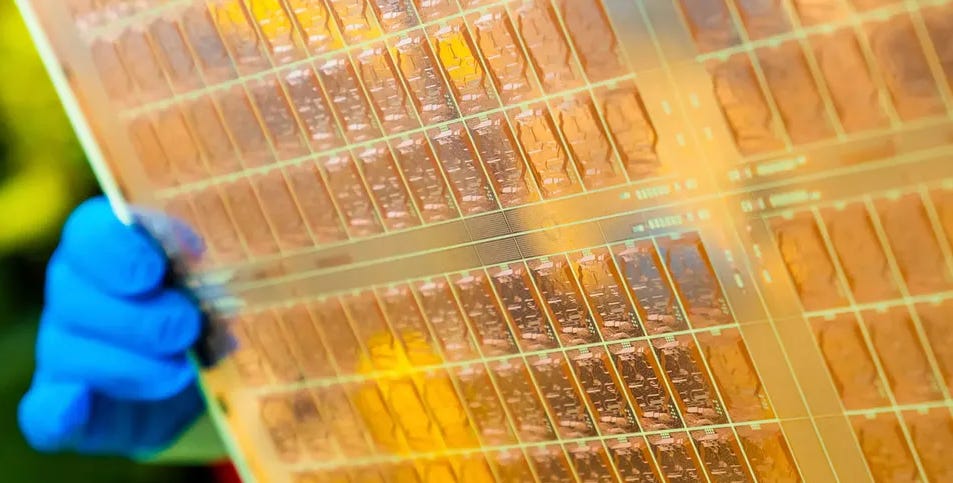
BOE says its pilot line has produced 24-layer glass substrates larger than 100×100mm, with customers already testing CPUs and GPUs packaged onto them inside servers.
The company has invested nearly RMB 1 billion in the project and is targeting a decision on mass production in the first half of 2027, depending on customer demand and yields.
Glass substrates are still an emerging technology, but the opportunity is significant. As AI chips grow larger and packaging becomes more complex, even the material underneath the processor is becoming a potential bottleneck.
(IX) Tencent Wants WeChat Pay to Be Easier for Foreign Visitors
Tencent has launched TenPayGo, allowing overseas visitors to connect foreign cards, Apple Pay, and dozens of international wallets to China’s WeChat Pay merchant network.
It is a small but practical expansion of an enormous existing system. The challenge for foreign visitors has never really been that China lacks digital payments; it is getting outsiders into the system without requiring them to change how they normally pay.
Tencent is essentially trying to solve that onboarding problem rather than build another payment network from scratch.

(X) DeepSeek’s Revenue Has Doubled. So Has the Infrastructure Problem.
DeepSeek’s annualized revenue has reportedly passed $1 billion, more than double its recent level, while Liang Wenfeng says the company has raised prices without shrinking its customer base.
But more than 70% of DeepSeek’s compute reportedly still goes toward training, and the company is seeking billions more in capital while exploring Huawei chips to ease hardware shortages.
That creates an interesting shift for a company famous for efficiency.
DeepSeek may be proving that frontier AI can be cheaper to build than expected.
It is not proving that frontier AI is cheap to operate at massive scale.
(XI) CATL Starts Trial Production in Europe
CATL has begun trial battery production at its Debrecen plant in Hungary after months of regulatory delays and local environmental concerns.
The factory is designed for 100GWh of annual capacity and is intended to bring CATL closer to European automakers as the company expands beyond China. Overseas sales rose 54.8% in the first half, even as its share of the Chinese market slipped.
The strategic shift is familiar.
China’s biggest industrial companies are increasingly moving from exporting products to building production networks overseas, turning global expansion into a manufacturing story rather than simply a sales story.
Weekly Articles...
Huawei’s Lazarus Moment
Mention Huawei and the conversation usually goes straight to sanctions and technological self-sufficiency. But the harder question is whether Huawei can still make money outside China after Washington cut off so much of what it once relied on.
Its overseas revenue fell sharply after 2019, but by 2025 it had recovered to around $35.6 billion. The recovery did not come from restoring the old smartphone business. Huawei instead leaned into watches and earbuds, solar equipment, telecom infrastructure, and, increasingly, AI chips.
That makes the story more interesting than a simple sanctions comeback. Huawei is not returning to its old position; it is building a different mix of products and markets around the constraints.
This week’s feature looks at whether Huawei has reached a “Lazarus moment” ,not a return to its old business, but a second life built around a very different global market.