



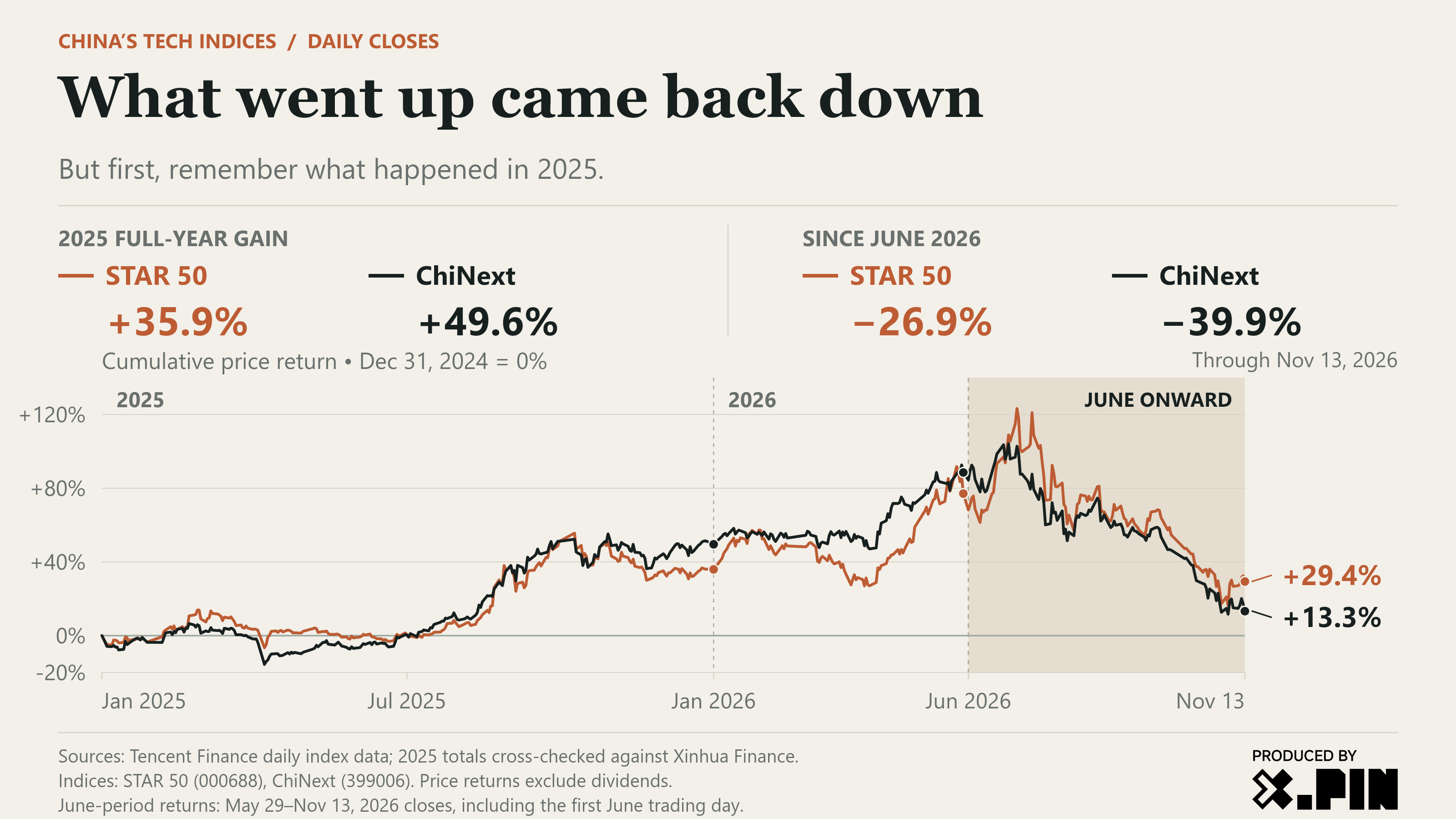
October was a dark month for Chinese stocks. Mainland markets fell for ten straight weeks, marking a rare losing streak that wiped out $480 billion in value, according to Reuters. Shanghai’s Nasdaq-style STAR 50 Index, which is packed with artificial intelligence and chip companies, has dropped 40% from its June peak. Meanwhile, the blue-chip CSI 300 Index, China’s rough version of the S&P 500, is down 20% for the year. To outside observers, China’s AI stock bubble has finally burst.
A bursting bubble makes for dramatic news, yet Western reports have focused too much on the final fallout and missed how we got here. Clear topping signals started flashing across China’s major stock indexes four to five months ago, hidden in market details that foreign media rarely cover.
As an everyday retail investor in mainland China, I lived through Beijing’s push to rein in the AI craze firsthand. Simply declaring that China’s AI bubble has burst does not tell the whole story. We still need to look closely at how that cooldown unfolded, and what happens next.
Warnings Came Much Earlier
To see why those warnings appeared so early, we need to go back to how the bubble started on September 24, 2024. That day, China’s central bank, financial regulator, and securities watchdog rolled out a surprise stimulus package to rescue a weak market. Officials cut the share of deposits banks must keep in reserve by 0.5%, lowered key interest rates by 20 basis points, allowed listed companies to buy emerging-tech businesses, and let insurance funds invest in stocks for longer periods.
Most importantly, the central bank launched its first “swap facility” for brokerages, mutual funds, and insurers. This new tool let financial institutions pledge hard-to-sell assets in exchange for safe central-bank backing so they could borrow fresh cash to buy stocks.
That wave of easy money kicked off a big tech rally led by semiconductors and AI. By December 19, 2024, shares of Cambricon Technologies, a money-losing Chinese AI chip designer, jumped 218%, while chipmaker SMIC rose more than 107% in October alone. Tech exchange-traded funds (ETFs) and mutual funds drew in crowds of everyday investors chasing fast gains. Caught up in the excitement, I bought a telecom ETF myself.
Amid the frenzy, however, investors ignored what China’s state-backed funds, known locally as the “National Team,” actually wanted. Regulators have long tried to break the Chinese market’s two-year curse, as bull runs here rarely last past two years before falling into painfully long downturns. Instead of watching gains burn out in a few crazy months, officials pushed for a “slow bull.” Yet building a slow bull is like herding sheep inside a crowded pen. Beijing wanted to bring more emerging tech companies, which it calls “new quality productive forces,” onto the market through initial public offerings (IPOs).
At the same time, it wanted to keep indexes from getting too concentrated in tech and stop traders from buying expensive stocks with borrowed money. Because of this tug-of-war, popular AI hardware stocks across co-packaged optics (CPO), circuit boards, and optical modules dropped sharply in March 2025 and again that July and August. Money briefly moved into alternatives like trendy toy maker Pop Mart and biotech drugs, though the overall bull market stayed alive through 2025.
Still, my own trading showed me a clear reality: government support for the AI industry did not mean people buying AI stocks would make money. Everyday traders who chased hot stocks like Cambricon at high prices often got stuck waiting nearly a year for the next wave of hype. Even so, index investing created an automatic upward loop. Easy money pushed up tech ETF prices, bringing in more buyers. Those index funds then blindly bought more of their biggest holdings regardless of company profits, pushing stock prices to new highs.
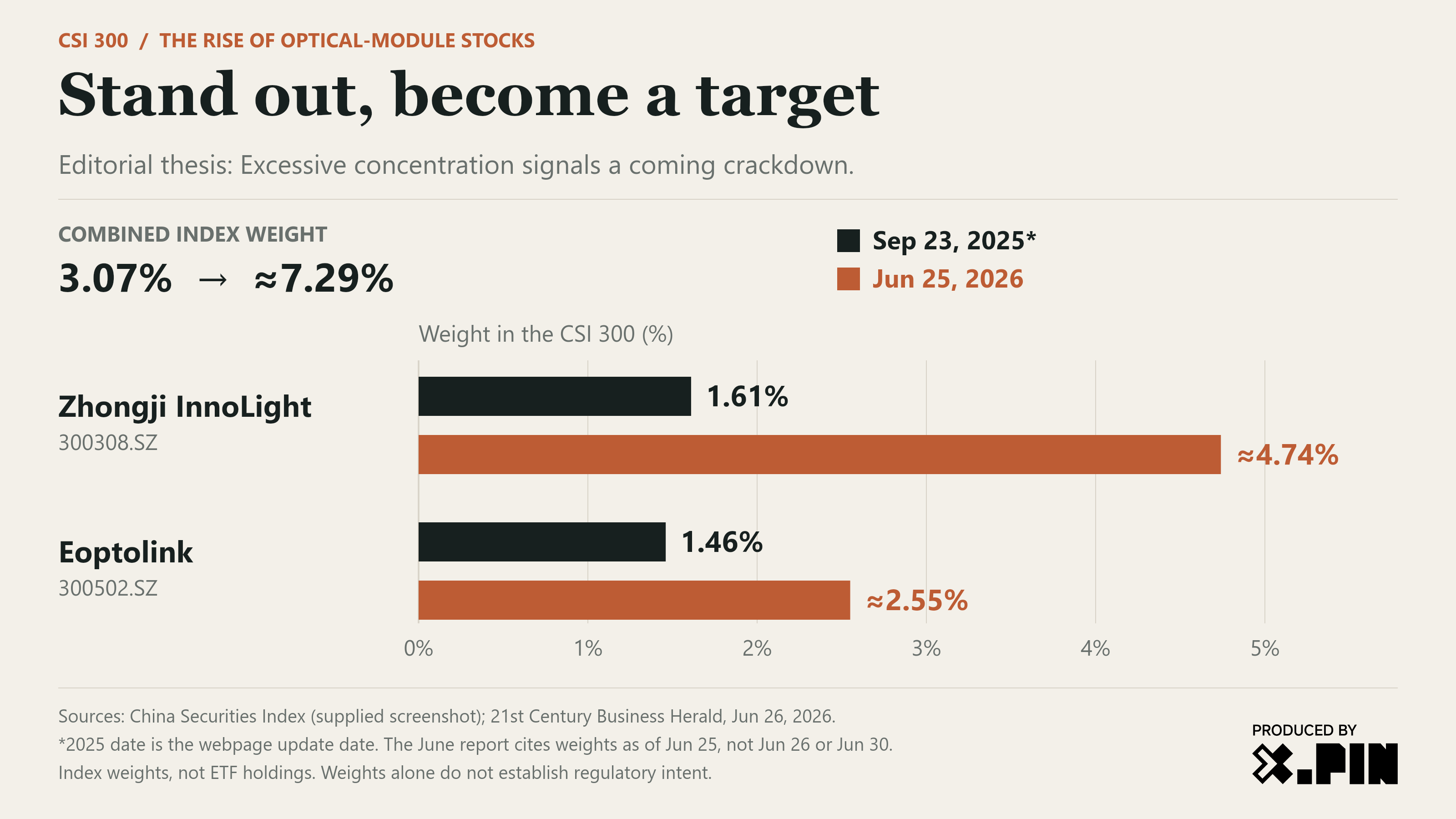
Before long, that blind buying twisted China’s main blue-chip index out of shape. By late June 2026, two Chinese makers of optical modules, the high-speed networking parts used to connect AI servers, had climbed to the very top of the mainstream CSI 300 Index. Zhongji Innolight became its single largest stock at about 4.74% of the index, while rival Eoptolink ranked third at roughly 2.55%.
When one narrow tech theme takes up that much space in a major benchmark, a long drop usually follows once investors start pulling cash out. In the third quarter alone, active mutual funds sold nearly 69.3 billion yuan ($9.6 billion) of Innolight, previously their top holding, and both stocks have plunged 63% over the past six months. The gloomy news reports in late October and November were simply recapping the aftermath of that stampede.
Popped on Purpose?
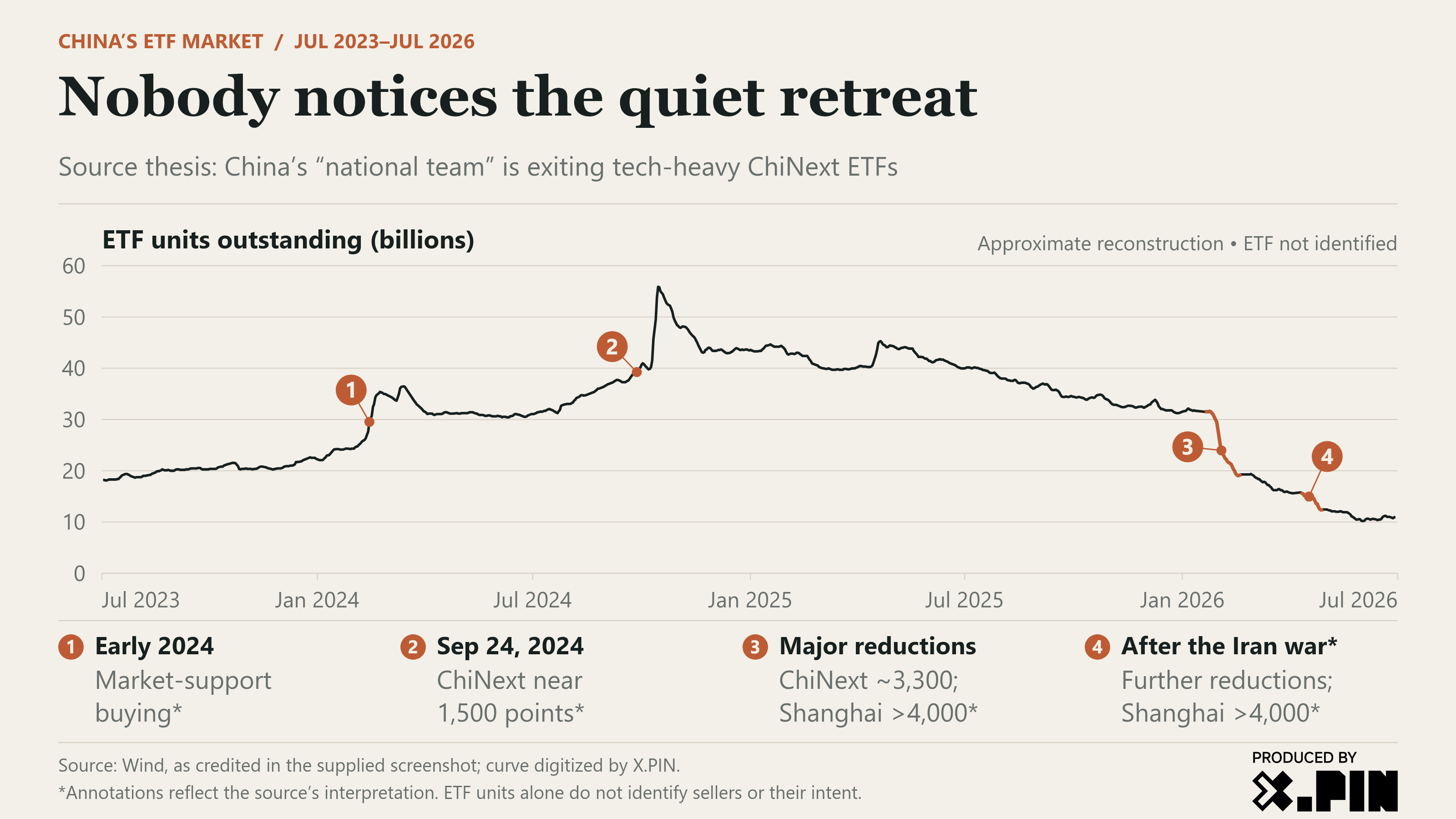
Because of my own investments this year, I closely watched the E Fund ChiNext ETF, the biggest fund tracking Shenzhen’s tech-heavy ChiNext board. Large buyers poured money into this ETF in late 2023 and early 2024. Starting in 2025, however, the total number of shares in the fund kept shrinking, even as the ChiNext Index itself jumped more than 100% that year.
By May and June of 2026, the fund’s share count had fallen below its 2023 levels. Everyday investors buy more when stocks rise rather than cashing out. Only the National Team is big enough to sell steadily throughout a 100% rally, meaning state funds were quietly pulling money out to cool the market a full year before headlines called a crash.
Along with that quiet selling, regulators began cracking down on borrowed money and high-speed trading in June. Officials ordered high-frequency trading firms to move their servers out of stock-exchange data centers, cutting their split-second speed advantage over regular investors. More directly, regulators raised the minimum deposit required for margin trading, or buying stocks with borrowed money, from 80% to 100%.
That forced traders to put up full cash collateral for new purchases, freezing fresh leverage overnight. By August 3, total margin debt in China’s stock market had dropped from a peak of about 3 trillion yuan ($415 billion) to 2.58 trillion yuan, back to mid-April levels. Between July 1 and September 15, total margin loans shrank by roughly 403 billion yuan ($56 billion), down 13%.
Semiconductors and telecom equipment, the two sectors where borrowed money was piled highest, became the main target of forced repayments. Across dozens of tech stocks on Shanghai’s STAR Market, Shenzhen’s ChiNext, and the Beijing Stock Exchange, margin debt fell between 43.65% and 65.93%.
Former market favorites including Cambricon, Innolight, memory packager Biwin Storage, and SMIC all saw heavy margin selling. Simply put, leveraged traders who suffered heavy losses in Chinese chip stocks were caught directly in a targeted regulatory squeeze on market debt.
While margin rules squeezed buyers in the stock market, regulators also used the IPO pipeline to manage tech hype. At first glance, the numbers on Shanghai’s strict STAR Market look contradictory. Even on this high-bar board, the first 11 companies to go public in 2026 jumped an average of 437% on day one, a clear warning sign of overheating. Over the year, regulators accepted 49 new STAR Market IPO applications, up 133% from 2025.
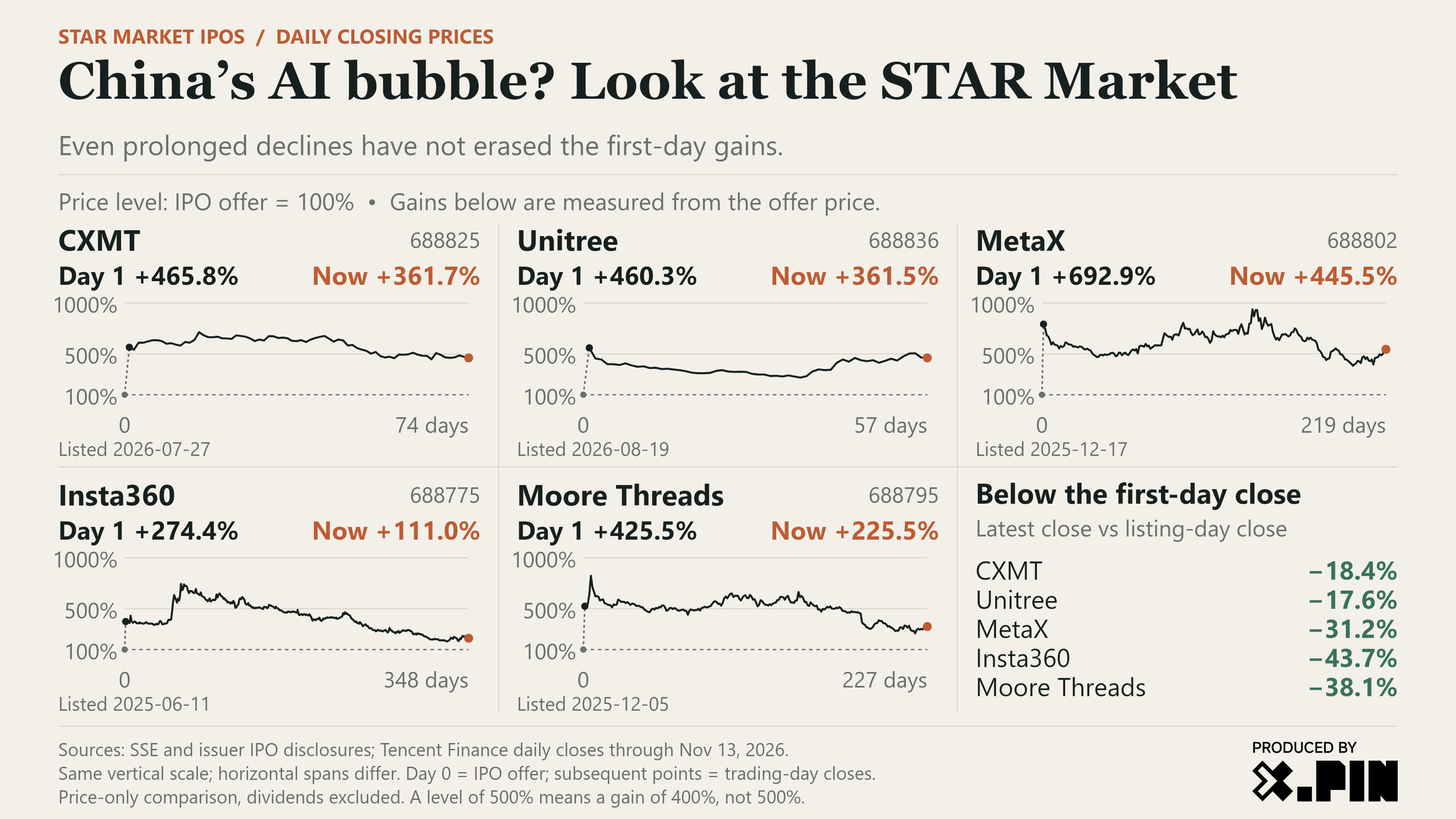
Yet they also canceled 13 applications during review, accounting for 17.1% of all canceled IPOs nationwide, up from just three on the STAR Market in all of 2025. Taking in more applicants while rejecting more of them pointed to a clear filter: officials wanted to save the market’s cash for true industry leaders, while stretching out review times to cool broader tech speculation.
Even for national champions, though, buyers could only absorb so many giant listings at once. Just as the STAR 50 Index reached an expensive valuation of 80 times earnings, regulators opened the gates for major IPOs. These included leading Chinese memory-chip maker ChangXin Memory Technologies (CXMT), top commercial robotics maker Unitree Robotics, and money-losing AI chip startups Moore Threads and MetaX. Early private investors cashing out into the public market overwhelmed everyday buyers.
CXMT lost more than a quarter of its market value in a single month. Meanwhile, Unitree has fallen by half since its buzzy August debut, and Moore Threads and MetaX also saw their share prices cut in half, dragging the STAR 50 down nearly 40% over six months. Only after Unitree’s listing did regulators tighten IPO reviews again.
Okay, It Burst—Then What?
In China, every debate over an AI bubble eventually comes back to a basic question: is the stock market built to help companies raise cash, or to help investors make money? From day one, China’s market existed mainly as a fundraising tool for businesses.
That history explains why Beijing still treats stock listings as the default funding lifeline for domestic AI and hardware firms, even when giant IPOs drain public buyers. Not until 2013 did China’s securities regulator promise to “fully balance investment and financing,” admitting it was unfair to use millions of everyday savers as mere fundraising tools without offering steady returns.
That old fundraising setup is also why Chinese bull markets, which are always sparked by easy money, remain much shorter than downturns. Over the long run, mainland bull runs last an average of just 12.1 months, compared with 27.8 months for bear markets, making downturns 2.3 times longer.
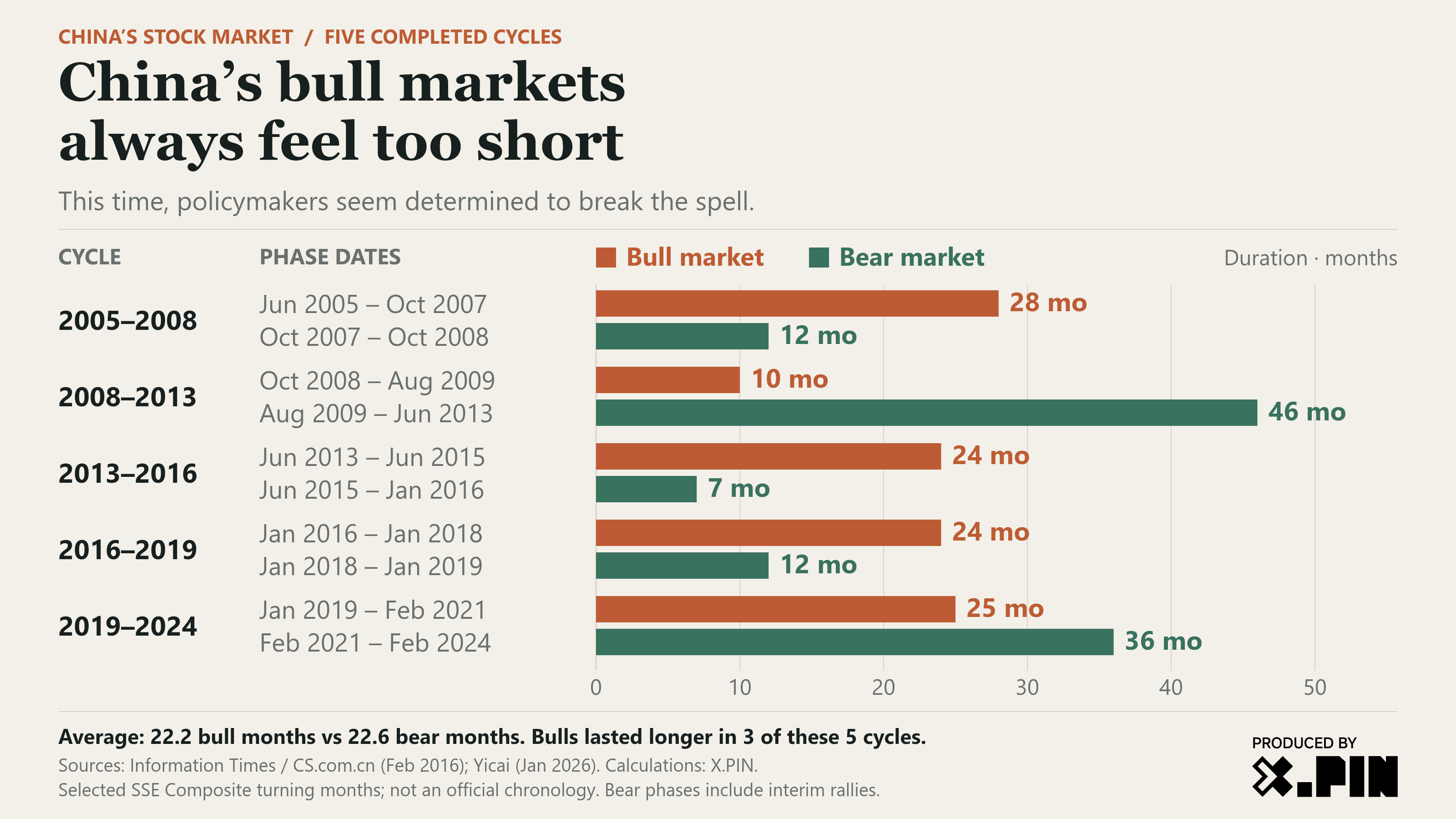
To escape short, reckless rallies driven by borrowed cash or heavy stimulus, China’s current regulators are trying something new. Their version of a “slow bull” is not necessarily a steady climb upward, but a wide, managed trading range where both gains and losses stay within controllable limits.
By the calendar, China has already passed its usual two-year bull window. Yet after September’s steep drop, top securities regulators held special meetings to help state-backed institutions buy more stocks, letting more funds swap stock ETFs for government bonds or central-bank bills to pump fresh cash back into the market. Even after the AI sell-off, Beijing is still actively steering the market according to its 2024 plan.
Looking back at the whole process, what unfolded was less a random collapse out of nowhere than an attempt by regulators to release market risk within controllable bounds before an even bigger crisis could hit, even though a 40% drop still inflicted heavy pain on everyday investors.
English-language stories declaring China’s AI bubble dead make for a peculiar spectacle to read, yet they look right past a basic reality: even when bubbles burst and stocks fall, most people in China still have to make a living and carry on with their lives. I have no intention of defending China’s stock market as it stands, especially while living through this painful adjustment period myself.
Still, what is far more worth watching now is how the National Team steers the market after the drop, and whether these adjustments can finally pull Chinese stocks out of their old cycle of short-lived bull runs.