



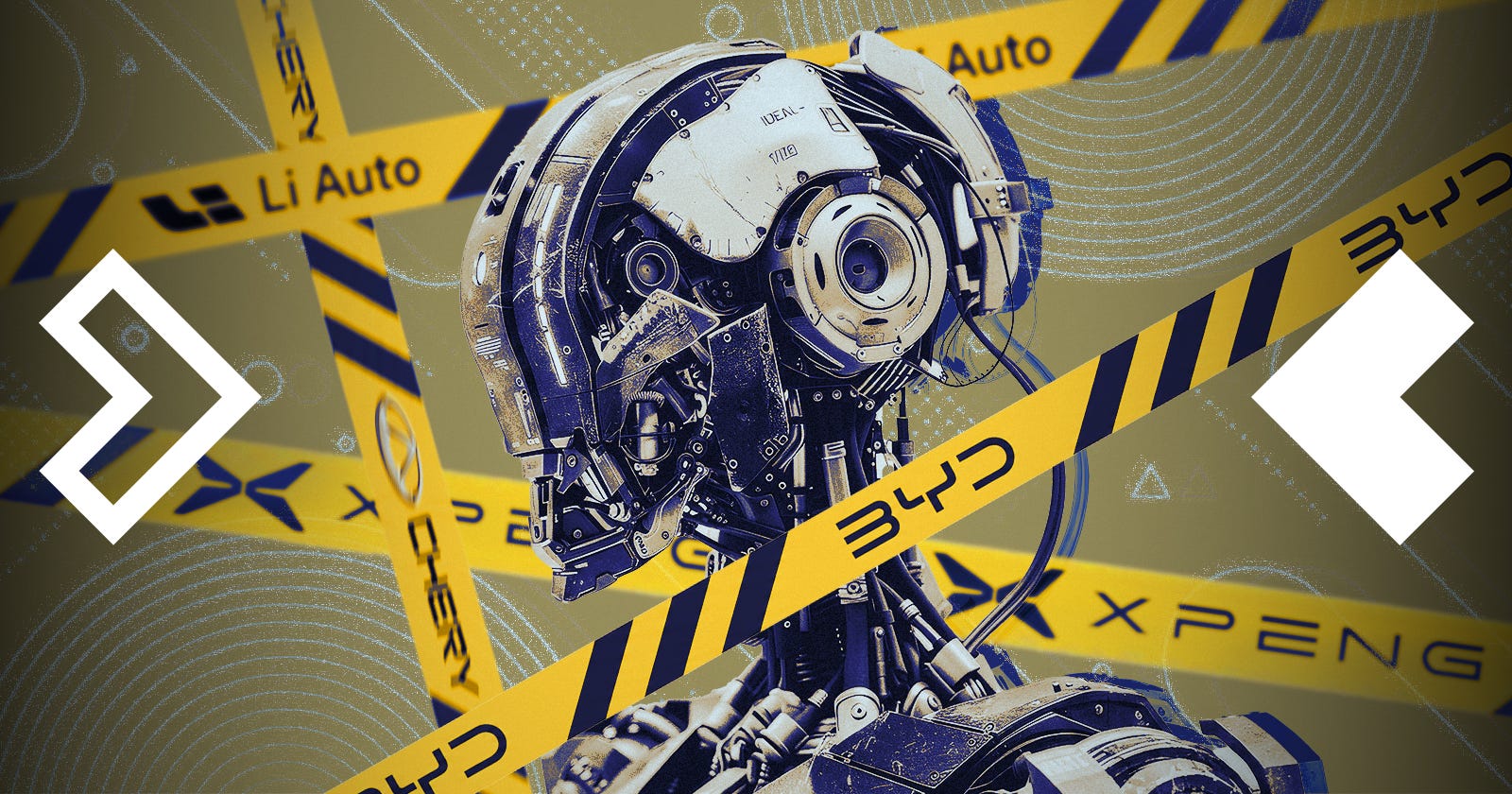
By April 2026, nearly twenty major automakers had publicly committed to robot programs: Tesla, Mercedes, BMW, Volkswagen, and on the Chinese side BYD, Xpeng, Li Auto, GAC, Chery, and Changan, among others. The wave is real, and it accelerated fast.
The obvious explanation is survival pressure. China’s auto industry posted a 3.4% profit margin in the first five months of this year, the lowest in five years, according to the China Passenger Car Association. Sales are down 19%. Profits are down 20%. Car-grade memory chip prices rose 180% between March and June, per China’s CCTV Finance,adding -by NIO CEO William Li’s estimate - roughly 10,000 to 20,000 RMB in per-vehicle costs that nobody can pass on. The price war that was supposed to solve the demand problem has made it worse: a McKinsey report from May found that relentless discounting has conditioned consumers to wait rather than buy, because the next discount is always coming.
So margins are collapsing, costs are rising, and the growth lever is broken. Of course companies are looking for something else.
But survival pressure explains why they need a second act. It does not explain why robots, specifically. And it does not explain why carmakers, specifically, might be positioned to win.
Those questions have two answers. The second one is more interesting than the first.
Answer One: Tesla Changed the Game
The first answer is financial, and it starts with Tesla.
Tesla makes cars at a 5% operating margin and a net margin under 4%. By conventional automotive metrics, it is a modestly profitable manufacturer. Yet it trades at roughly 380 times earnings and a $1.5 trillion market cap, multiples that Ford and GM can only observe from afar. That gap is not manufacturing quality. That gap is narrative.
Tesla convinced the market it is not a car company. It is an AI company that happens to run vehicle factories while it builds its real product: a robotics and autonomous driving platform that Musk estimated, in September 2025, could eventually account for 80% of Tesla’s total value. Investors bought the story. The stock price reflects it. Ford trades at six times earnings. Tesla trades at 380.
Chinese automakers noticed. Being categorized as an AI company rather than a car company is worth, in Tesla’s case, roughly a factor of sixty in valuation multiple. The survival pressure is a push. The Tesla premium is a pull. Together they explain why every major automaker is suddenly announcing a robot program.
But this is also where the Tesla-as-model story gets misread. Chinese automakers are not trying to become Tesla. They are not trying to out-Optimus Optimus. The valuation lesson is the catalyst. The real bet is something structurally different.
Tesla showed the world that a car company could become an AI company. Chinese automakers are betting that the opposite is also true: that an AI-powered manufacturing ecosystem, one that already exists and already operates at scale, can expand from cars into robots.
Answer Two: The Industrial Ecosystem
This is the part that most coverage of China’s robot pivot misses.
The easy version of the technology transfer argument is that cars and robots share components. Both use electric motors. Both need sensors. Both run on battery systems. All of that is true. It is also not the interesting part.
The more important point is systemic. Building millions of intelligent machines at consistent quality and falling cost requires a specific industrial infrastructure: the AI stack to develop the intelligence, the supply chain to source and assemble the hardware, the manufacturing systems to build it reliably at volume, and the distribution to put it in front of buyers. Building that infrastructure from scratch takes years and costs billions. Chinese EV companies already have it.
Start with the AI stack. Autonomous driving and humanoid robotics have been solving versions of the same problem on parallel tracks, and their algorithmic architectures have converged. Both now run on VLA (Vision-Language-Action) models: neural networks that integrate perception, language understanding, and physical action into a single system. The convergence is not theoretical. Tesla has publicly confirmed it uses the same generative model to train both its cars and its robots, swapping in different training data rather than rebuilding the architecture from scratch. Xpeng’s second-generation VLA model powers its cars, its IRON humanoid robot, and is designed to eventually pilot its flying cars, all from one underlying system. Li Auto’s MindVLA model, current being rolled out across its vehicle fleet, is designed explicitly for both vehicles and robots.
The data infrastructure transfers with it. Simulation environments, world models, automated data labeling pipelines, data flywheels: the tools built over years to develop autonomous driving systems can be redirected toward robot training without rebuilding from scratch. You do not need to construct a new factory. You need to change what the factory produces.
The supply chain story is where the advantage becomes most concrete. A company that sources electric motors for ten million vehicles per year has fundamentally different leverage with motor suppliers than a robotics startup buying ten thousand. The volume economics, quality standards, supplier relationships, and production line tooling that took years to build give established manufacturers a structural cost advantage that AI breakthroughs alone cannot close. Industry analysis projects humanoid robot bill-of-materials costs falling 30 to 50 percent between now and 2030, and automakers are positioned to drive that decline faster than anyone without their supply chain infrastructure.
The distribution angle is easy to underestimate. BYD operates one of the largest retail networks of any product company in the world. If it eventually sells consumer robots through dealerships, it reaches households through a channel that no robotics startup can replicate for less than a decade of effort.
Put it together and the argument is not that cars and robots are similar products. The argument is that the industrial system built to mass-produce intelligent electric vehicles is, almost by definition, the industrial system needed to mass-produce intelligent robots. Not the products. The system. Chinese automakers are not starting from zero. They are redirecting.
This is the structural difference between the Tesla story and the Chinese story. Tesla’s contribution was changing how investors think about car companies. China’s potential contribution is changing how robots get manufactured.
What Chinese EV Companies Are Actually Building
Three companies show the thesis playing out in different ways.
BYD is running the manufacturing moat version. Four years ago, without announcement, it launched an internal robot program codenamed “Yao-Shun-Yu” after three legendary Chinese emperors. The secrecy was deliberate: build industrial-grade hardware before making any claims. Today roughly 150 prototypes are being tested inside BYD’s own factories, with plans to deploy 20,000 units across its operations this year and eventually build an Xi’an facility running at 50,000 units of annual capacity. BYD has also signaled it may sell consumer robots through its dealership network and supply hardware to other robot companies through an open platform model. This is not a company announcing a robot pivot. This is a company that has been quietly building a robot factory for four years while everyone else was watching demos.
Li Auto is running the AI-native transformation version. The company CEO Li Xiang said in 2015, when founding the company, that the ultimate form of a car is a robot. In February 2026 he described the new L9 SUV as “not just a car, but the pioneer work of embodied intelligence robots.” In May, at a public forum, he articulated what he called the two halves of embodied intelligence: autonomous driving is the first half, humanoid robots are the second half. In January he reorganized Li Auto’s entire R&D structure by biological analogy rather than by software and hardware functions: a foundation model team for cognition, a software body team for agency, a hardware body team for robot construction, an evaluation team grading performance. Li Xiang is not describing a new business line. He is describing a company that has always been building toward a unified AI system that runs across physical platforms, and spent a decade constructing the prerequisite layers.
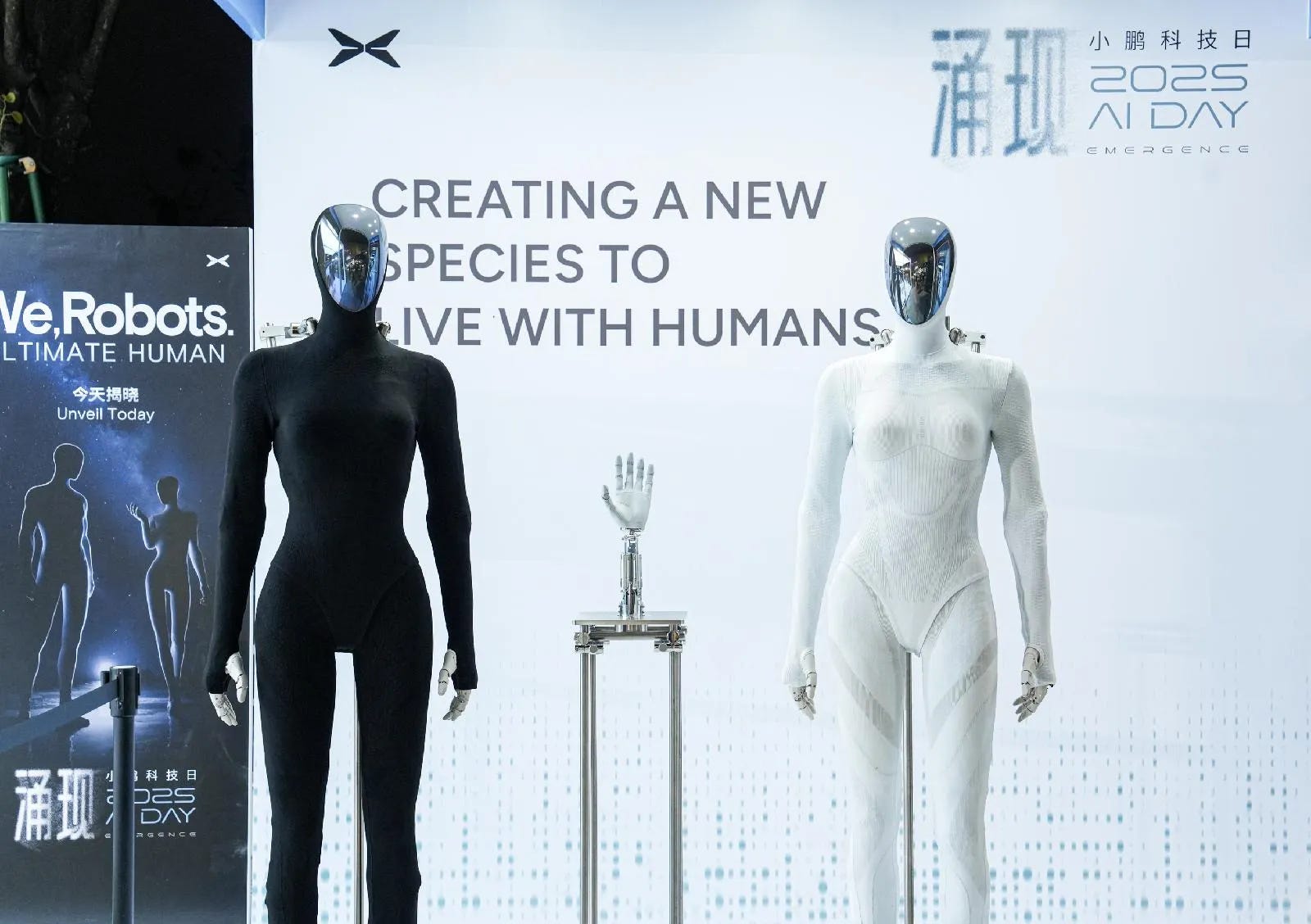
Xpeng is making the unified platform argument most explicitly. Its second-generation VLA model was designed from the start to control cars, robots, and flying cars from the same underlying architecture. The company CEO and co-founder He Xiaopeng renamed the company “Xpeng Group” in the first quarter of this year, repositioning from an intelligent EV company to a “physical AI company,” and announced plans to mass-produce its IRON humanoid robot by year-end. The logic is simple enough to state plainly: if the same model can drive your car and control your robot, and you already know how to manufacture complex intelligent machines at scale, then expanding into robots is not a leap. It is an extension.
China’s robotics race is often framed as a competition between Tesla and a field of Chinese challengers, or between American AI capability and Chinese manufacturing scale. Those frames are not wrong. They are incomplete.
The competition actually forming is three-way: AI giants like Nvidia that own the AI brain layer, native robotics companies like Unitree and Zhiyuan that have built real products with real deployments, and automakers that bring industrial manufacturing scale. None of these three is dominant. They are occupying different parts of the same ecosystem and, in some cases, collaborating: Nvidia recently announced a humanoid robot project where it provides the AI platform and foundation model, Unitree builds the body, and Sharpa builds the dexterous hands.
What automakers bring that neither tech platforms nor native robotics startups have is the proven ability to turn AI-enabled products into manufactured goods at prices that ordinary buyers can afford. Unitree shipped more than 5,500 humanoid robots in 2025. BYD manufactures more than three million vehicles per year. The scale comparison matters because the critical question in the robot market over the next decade is not who has the best AI model. It is who can manufacture the best AI hardware at falling cost and rising reliability. That is an industrial problem as much as a technology problem. It is the problem Chinese automakers have spent the last decade learning how to solve.
The Risk, and the Real Question
The narrative is ahead of the hardware. By quite a bit.
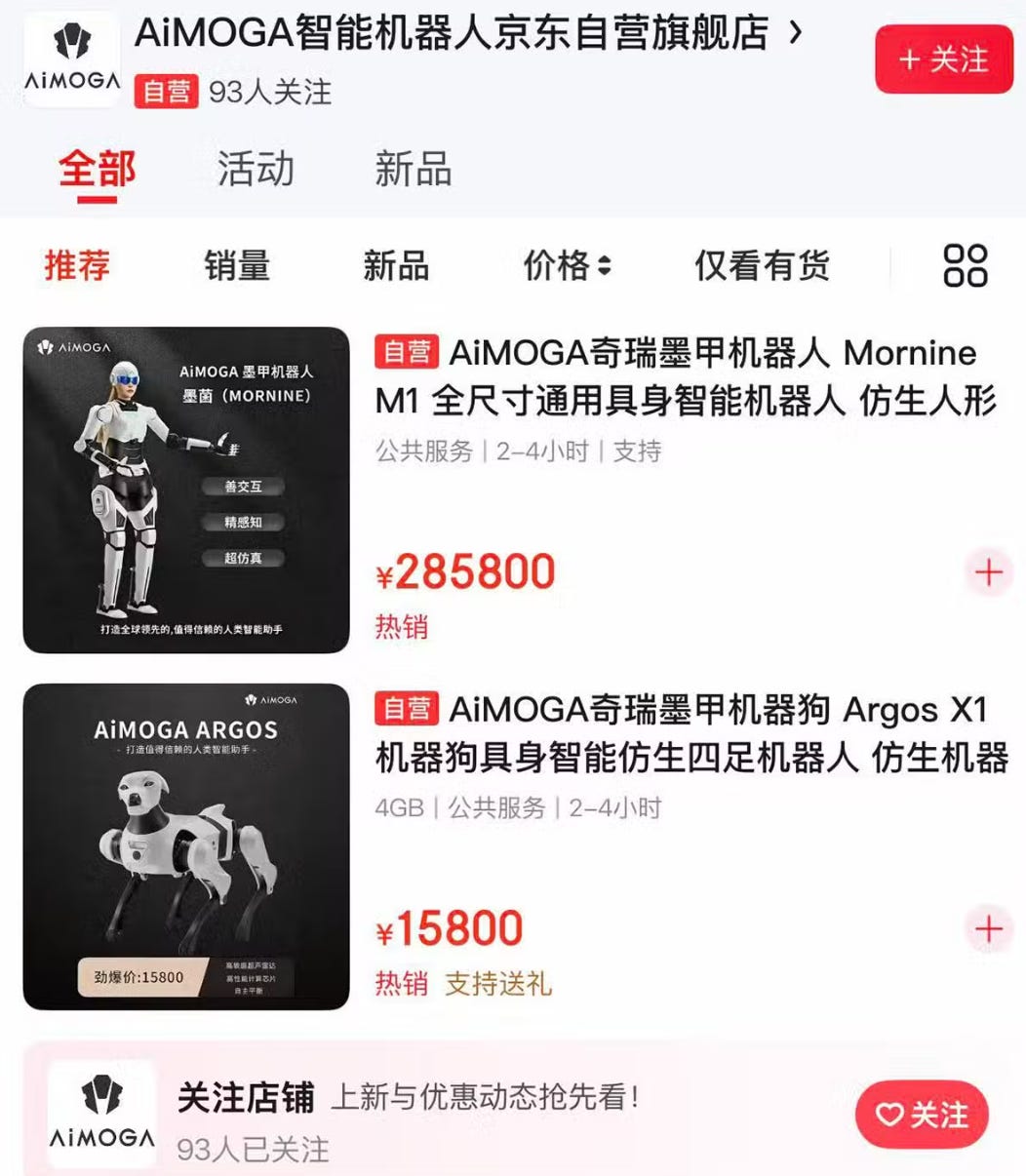
No humanoid robot from any manufacturer has reached commercial scale or the operational reliability that would independently justify the most ambitious projections being made. Li Auto’s internal robot team reportedly has fewer than 30 people. BYD’s consumer products remain a stated goal. Chery, which has moved fastest, now sells robots called Aimoga on JD.com at roughly $41,800 each, with 300 dealer agreements signed, but at volumes that are still far from industrial scale.
At some point, capital markets stop pricing in optionality and start asking for revenue. The companies that survive the transition will be the ones that can close the gap between the company they are claiming to be and the one they can demonstrably deliver.
The question worth asking is not whether Chinese automakers will succeed. It is whether the industrial bet makes structural sense. And it does, with caveats. The AI stack transfer is real. The supply chain advantage is real. The manufacturing infrastructure is real. The gap is in the robot-specific capabilities that neither driving data nor automotive assembly experience fully prepares you for: dexterous manipulation, fine motor control, the ability to operate reliably in environments that are not a production line or a highway.
Building those capabilities will take time and will not transfer automatically from cars. The companies that figure it out will be the ones that treat robotics as its own engineering discipline, not just an extension of what they already know.
Tesla converted one factory in Fremont from car production to robot production. That is one version of the transformation story.
The Chinese version is different in scale and ambition. It is not a single company converting a single factory. It is an entire industrial ecosystem, built around the most competitive electric vehicle market in the world, asking whether it can redirect its manufacturing capability toward a new category of intelligent machine.
That question has not been answered yet. But unlike the question of whether a car company can become an AI company, which Tesla answered in Fremont, this one gets decided in Xi’an, in Guangzhou, in Hefei, across an industry that has spent a decade building something that might turn out to be useful for something else entirely.
One thing strikes me as weird about this. The big advantage that China as a nation can claim is cheap flexible intelligent labor (people). And if the AI-robot gamble fails, or gets overregulated, then they still have that advantage. Gambling on an idea that undercuts one of their big advantages, is weird to me. Why don't they just double down on global regulation (based on safety concerns) instead?