



Hi friends,
Welcome back.
I have been thinking about a strange contradiction this week.
China is producing more AI engineers than any country in the world. It is also producing more unemployed graduates than at any point in recent memory. Those two facts are not in conflict. They are the same story.
That is the kind of week it was. Every headline looked like progress. Every headline also had a shadow underneath it. Moonshot dropped Kimi K3, a 2.8 trillion-parameter model that is probably the largest open-source model anyone has ever released. Apple handed Alibaba the keys to AI on every iPhone in China. Humanoid robots are shipping at prices that would have seemed impossible two years ago.
And yet. Universities are canceling majors faster than they can open new ones. The jobs everyone trained for are disappearing before the graduates arrive. A city in Guangxi is selling robot training data because that turned out to be more valuable than anything else it had to offer.
I am not sure whether this week felt like the future arriving or the present catching up. Maybe both.
Let’s get into it.

This Week’s Features…
Is AI Breaking China’s University?
Here is a bet millions of Chinese families have made for decades: sacrifice everything for the Gaokao, pick the right major, and the future takes care of itself.
AI just made that bet a lot riskier.
China’s universities added 10,200 new majors in five years and canceled 12,200 others. The “intelligent construction” program at one university turned out to be civil engineering with an AI label slapped on top. Students learned to label bounding boxes and called it machine learning. One graduate described it as “being treated like a temporary worker.”
The cruelest part is not that the system is broken. It is that it is breaking in exactly the direction families cannot see coming. You study AI, you graduate into a market where AI is eliminating the entry-level jobs that used to absorb fresh graduates. You pick the safe major, and find out three years later that safe no longer exists.
This week’s piece is about why China’s university system, built around the idea that the right degree unlocks the future, is running out of road. And what, if anything, comes after it.
Don’t Watch the Robot. Watch What It Can’t Move Without.
The robot videos from China all look the same. A humanoid walks down a factory corridor. Folds a shirt. Waves at a crowd. Everyone applauds. Nobody talks about the screw.
Specifically: a planetary roller screw, the component inside every humanoid linear joint that determines whether the robot walks reliably for a year or strips under load in weeks. China’s domestic yield on that screw sits at 60%. Swiss and European manufacturers hit 85% or higher. That gap, in a component most people have never heard of, is a more honest description of where China’s robotics industry actually stands than any demo video will tell you.
The humanoid robot market is about to become one of the most important industrial competitions of the decade. The companies that win it will not necessarily be the ones with the most impressive AI. They will be the ones that control the parts the robot cannot move without: the reducers, the screws, the force sensors, the hands. Especially the hands, which no one, anywhere, has solved yet.
This week’s piece takes the robot apart, component by component, and shows you where China leads, where it is still dependent on Japan and Switzerland, and what a third-tier city in Guangxi figured out that most people building robots have not.
The News…
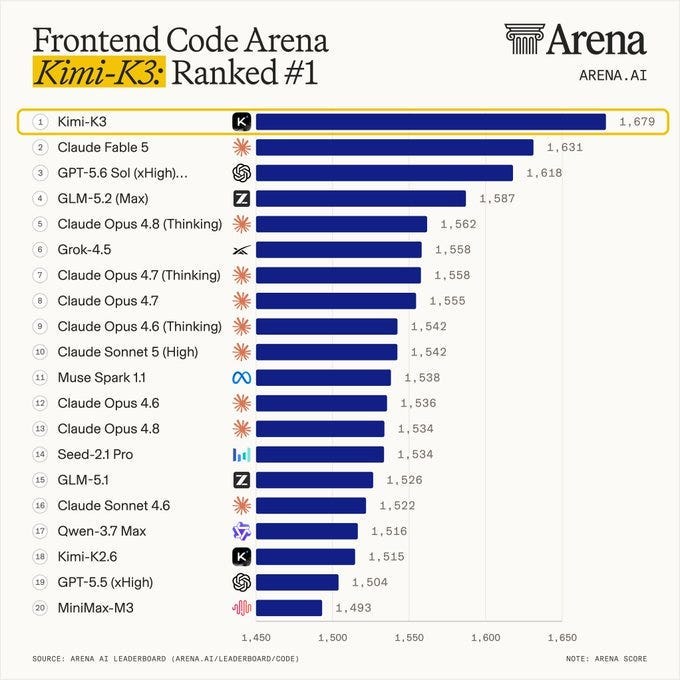
(i) Kimi K3 Is Probably the World’s Largest Open-Source Model
Moonshot AI released Kimi K3 ahead of WAIC, a 2.8 trillion-parameter open-source model that is likely the largest by parameter count globally. K3 natively supports vision understanding and a 1 million-token context window. Moonshot says it beats Claude Opus 4.8 and GPT-5.5 on most coding and general AI-agent benchmarks, though it still trails Fable on many tests.
In practice, K3 feels built around agent workflows rather than conversation. The interface looks less like a chatbot and more like office software, with desktop widgets and kanban boards. It can edit video and shows unusually strong 3D modeling ability. Moonshot used Kimi itself to cut the launch video.
It also predicted Spain has a 60% or higher chance to win the World Cup. Whether that says more about the model’s confidence or its calibration is a question worth keeping open.
(ii) Brain Signals as Robot Training Data
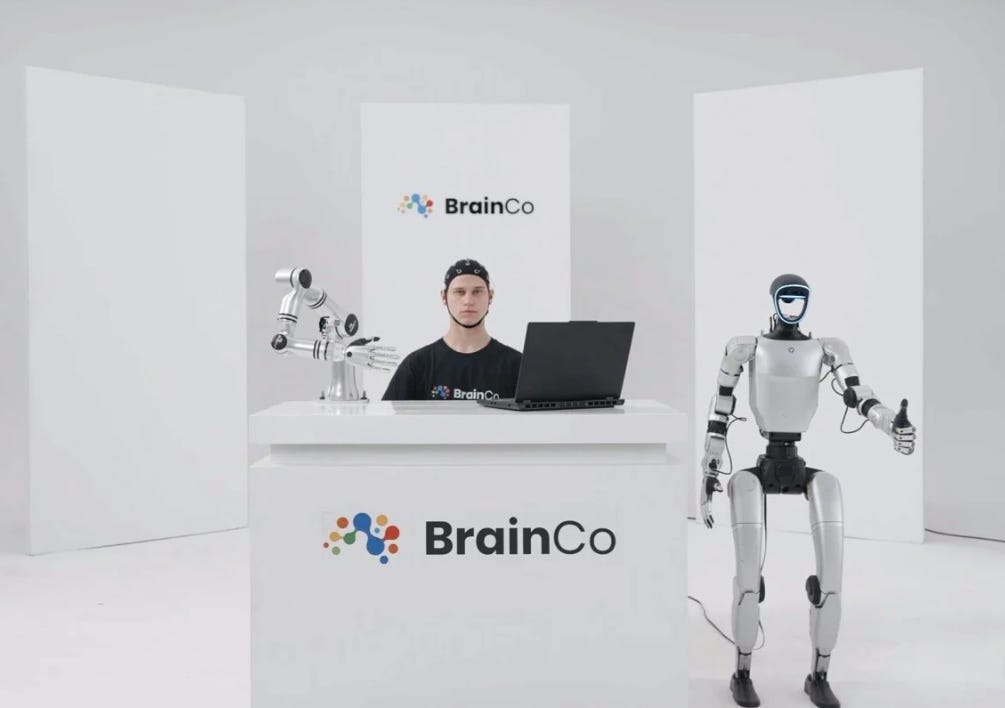
Chinese brain-computer interface startup BrainCo unveiled what it calls the world’s first integrated brain-to-robot platform, allowing users to control robots through brain signals captured by a non-invasive EEG headset. The system uses AI models to decode neural activity and translate human intentions into robotic actions, and can work across humanoid robots, robotic arms, and robotic dogs.
The headline is the control demo. The more interesting story is what this implies for training data. A chatbot can learn from billions of pages of text. A robot needs billions of examples of physical interaction, and those examples are hard to generate at scale. BrainCo’s approach points toward a different path: using humans as a direct source of intelligence, capturing intentions and demonstrations through neural signals rather than programming movements manually. Whether it scales is an open question, but the direction is worth watching.
(iii) DeepSeek’s Valuation, Accidentally Revealed
A Chinese luggage and apparel company called Korrun disclosed that its wholly owned subsidiary invested around $6 million in a fund managed by Tianjin Lisi Xingling. The fund has approximately $430 million in paid-in capital and has indirectly invested all of it in DeepSeek’s parent entity, holding 0.8265% of the company.
The math implies a post-money valuation of roughly $52 billion, which would make DeepSeek one of the five largest unicorns in China alongside ByteDance, Ant Group, SHEIN, and Xiaohongshu. The disclosure was not intentional. Corporate filings in China occasionally surface information that no press release would have volunteered.
(iv) The Doubao Phone Is Real, and It Already Has a Resale Market
ByteDance and Nubia are preparing several models of the Doubao AI agent phone this year, with one expected at WAIC 2026. Total planned production is around 200,000 units, with fewer than 100,000 in the first batch. The first engineering prototype, released last December in a run of about 30,000 units, sold out and was never restocked. On China’s resale market, prices reached roughly $1,180, about twice the official price.
Supply chain sources say rising component costs cut planned production from 300,000 to 200,000 units. The demand signal from the prototype run is clear enough. Whether a consumer AI agent phone at scale finds a mainstream audience beyond early adopters is the question that 200,000 units will start to answer.

(v) Apple Chose Alibaba
Alibaba’s Qwen will be integrated into Apple Intelligence as the AI backend for Chinese users across iOS, iPadOS, macOS, and visionOS. The integration allows users to access text and image understanding, content generation, and other AI functions without switching apps. China’s cyberspace regulator published filing information for seven mobile on-device generative AI services on the same day, including Apple Intelligence, Huawei’s Xiaoyi, and OPPO’s AndesGPT.
Alibaba chairman Joe Tsai confirmed that Apple spoke with multiple Chinese companies before choosing Alibaba. The list of companies Apple did not choose is not public, but the decision makes Qwen the default AI layer for iPhone users in the world’s largest smartphone market. That is a distribution channel no benchmark score can replicate.
(vi) LimX Dynamics Raises $200M Pre-IPO
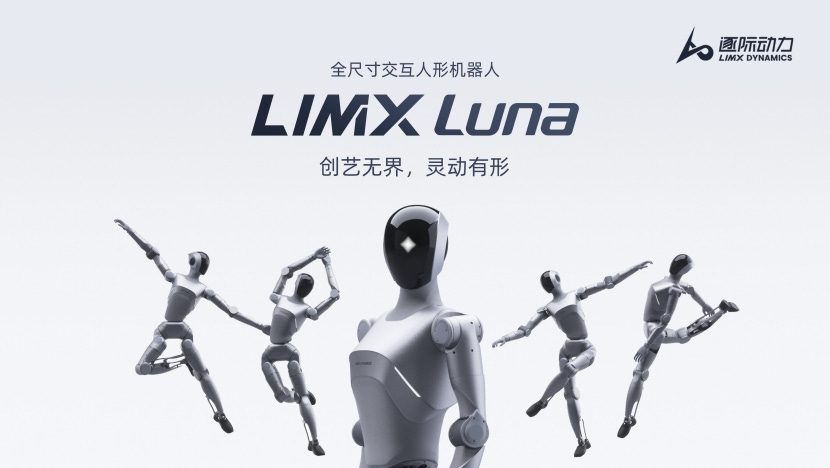
Chinese robotics startup LimX Dynamics raised nearly $200 million in a Pre-IPO round at a valuation of around 15 billion yuan, or $2.21 billion. The company has raised $400 million in the past six months and reportedly began its IPO process earlier this year.
LimX’s path to this point is worth noting. It initially focused on its System 0 whole-body motion foundation model and a robot agent operating system, staying out of the humanoid hardware race longer than most peers. In 2025 it pivoted into humanoid hardware and launched its commercial robot Luna. The sequence, software and models first, hardware second, is a different bet from companies that led with the physical machine. Whether the model-first approach produces a structural advantage in the next phase is the question its IPO timing will help answer.
(vii) China Southern Power Grid’s Narrow AI
China Southern Power Grid introduced an AI planning agent designed specifically for electricity distribution network engineers. The system can analyze grid conditions, generate planning proposals, run simulations, evaluate investment options, and produce engineering reports alongside human planners.
For most of the past two years, AI products competed by becoming more general. This points in the opposite direction: a highly specialized agent built around a single industry workflow, with no ambitions beyond that workflow. The economic logic is straightforward. Industries with established, high-stakes processes, power grids, logistics networks, hospital systems, have more to gain from AI that deeply understands their specific domain than from a general assistant that understands everything at a shallower level. That may be where much of AI’s durable economic value ends up: not replacing general software, but becoming indispensable inside the workflows that already exist.